
A complete new septic system costs more than a tank delivered to the property. The project may include site and soil evaluation, design, authorization, a tank, distribution components, a drainfield, excavation, inspection, backfill, and restoration. U.S. market estimates from specialist cost research separate several of those layers, but they are directional rather than a national fee schedule. Canadian pricing should be obtained locally in CAD; it should not be created by converting a U.S. figure.
Directional U.S. cost anchors
The current U.S. specialist guides display ranges of $3,593–$12,463 for septic-system installation, $100–$1,300 for inspection, $627–$3,041 for septic-tank repair, and $5,000–$12,000 for tank-and-drainfield replacement. These are broad market observations, not quotes or universal rates; they are not Canadian prices and must not be converted into CAD.
Not every article in this category has the same scope as those anchors. Use the closest comparison only to set an order of magnitude, then ask the contractor, designer, pumper, or authority to separate the work specific to this decision from access, excavation, design, permits, restoration, pumping, disposal, equipment, service, or future operating costs.
What the complete project includes
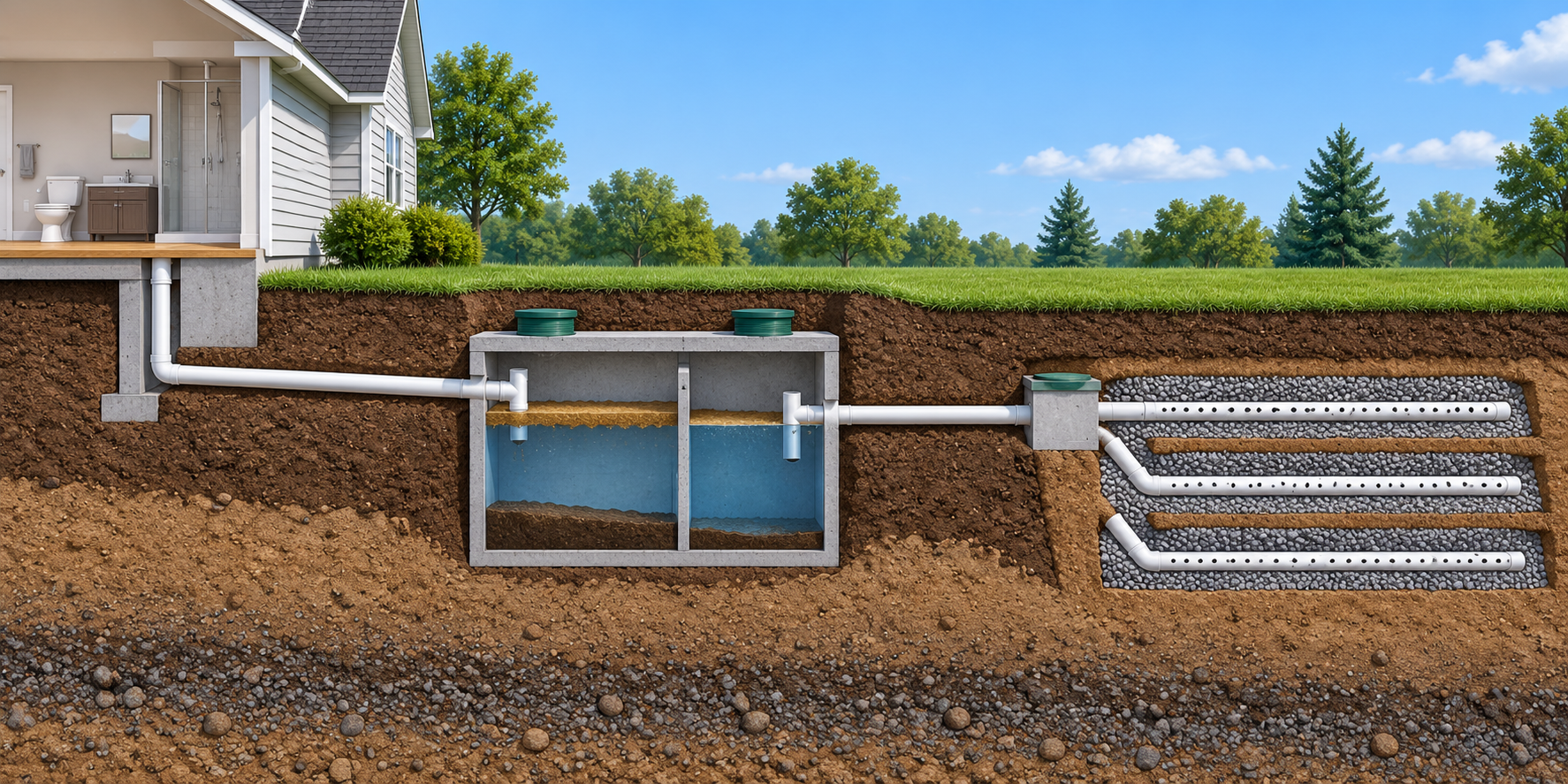
A conventional system usually moves wastewater from the house to a buried, watertight septic tank. Solids settle in the tank, while liquid effluent flows onward to a drainfield or soil-absorption field. The soil provides part of the treatment and dispersal function. A quote that names only the tank is therefore a materials quote, not a functioning-system quote.
The complete scope commonly has these layers:
- site evaluation, soil testing, and a system design;
- permit or application work and required inspections;
- tank, baffles, filters, risers, lids, and connecting pipes;
- gravity distribution or a pump chamber, pump, controls, and electrical work;
- drainfield trenches, bed, chambers, or another approved dispersal arrangement;
- clearing, excavation, dewatering, rock handling, and material delivery;
- backfill, grading, seeding, driveway or landscape restoration, and closeout records.
Not every project needs every layer. The point is to ask where each layer appears in the quote.
The largest price drivers
The design begins with the property, not the tank catalog. Household wastewater load, soil, slope, lot size, groundwater, sensitive-water proximity, weather, and local regulation can change both the system type and the amount of work. A large easy-access lot with suitable soil may support a relatively straightforward gravity design. A small or steep lot with shallow soil or high groundwater may require fill, pressure dosing, more engineering, pumps, or an alternative treatment approach.
Excavation is often the most uncertain physical layer. An open, level field with known soil is easier to price than a wooded or rocky lot, a narrow side yard, a steep slope, or a site reached only through a finished driveway. Hauling equipment, protecting the house and well, dewatering, exporting unsuitable soil, and restoring disturbed surfaces can materially change the total.
Tank size matters, but it does not determine field cost or site feasibility by itself. Ask the designer to explain the design load and field basis rather than choosing a tank by capacity alone.
Gravity versus pumped distribution
A gravity system can be simpler when elevation and soil conditions allow wastewater to move from the tank to the field without a dosing pump. A pumped or pressure-dosed system may be needed where the field is higher, the site is constrained, or more controlled distribution is part of the approved design. That adds a pump chamber, pump, floats or controls, alarm equipment, an electrical connection, and future service items.
The installation price is only part of that choice. A pumped system also creates a recurring power and maintenance exposure. If a quote includes a pump, ask who supplies the electrical circuit, what alarm is included, what happens during a power outage, and which maintenance visits or replacement parts are excluded.
Simple, typical, and difficult project cases
Simpler case: The property has an approved building location, suitable soil, clear equipment access, a conventional gravity design, and no unusual rock or groundwater. The quote can be divided into a predictable design/permit layer, tank and pipe work, field excavation, and restoration.
Typical case: The system needs soil evaluation, a designer, a tank with access risers, a defined field, ordinary excavation, inspection, and moderate lawn restoration. The price can still move if the field is larger than assumed or if access requires protection and extra handling.
Difficult case: The lot is small, steep, wet, rocky, or close to a well or sensitive water. An engineered alternative, pump system, imported sand or fill, additional testing, more complex authorization, or a limited restoration plan may be required. This is not a “more expensive tank” problem; it is a different project architecture.
Permits, design, and restoration
Permit and inspection requirements are jurisdiction-specific. The United States and Canada do not have one universal septic approval process, and terms such as “perc test,” “septic permit,” and “qualified designer” do not mean the same thing everywhere. Treat the local authority’s requirements and the approved design as part of the price, not as optional paperwork.
Restoration deserves its own line. A field may be left as rough grade, seeded lawn, gravel, or another agreed surface. Fences, irrigation, trees, paved areas, retaining features, and ornamental landscaping may require separate site work. Confirm whether the installer will restore those features or whether the homeowner must budget them separately.
How to compare installation quotes
Ask each bidder to identify the approved design basis, tank and component specifications, field type and area, excavation assumptions, rock or groundwater allowances, pumping or electrical work, permit responsibilities, inspection, restoration, taxes, and warranty or service obligations. Ask whether the price changes if the existing well location, property boundary, or access route limits the design.
Do not compare a tank-only number with a complete installation. Compare the same deliverables, and keep a contingency for conditions that cannot be confirmed until soil is opened. If the proposed design is mound, aerobic, drip, sand-filter, or another engineered system, use the dedicated alternative-system economics rather than treating it as a conventional installation with a surcharge.
How the design changes the budget
The system’s hydraulic path is more useful for comparing quotes than the label on the tank. Trace wastewater from the house to the tank, through any filter or pump chamber, into distribution, and through the soil field. At each stage ask what is being installed, how it is accessed, and what happens if that stage needs service. This exposes omissions such as a pump shown in the equipment list but no electrical circuit, or a field shown on a plan but no allowance for rock or imported fill.
The approved design load also matters. A larger household, a future suite, or a property with unusually high water use may need a different field or tank arrangement. Do not buy extra capacity as a substitute for design; it may increase cost without solving soil, slope, or dispersal constraints. Conversely, do not accept a low price based on an undersized assumption that will be revisited during approval.
What is and is not a contingency
Ask the installer to identify fixed scope, unit-priced allowances, and genuine unknowns. “Rock allowance” should say whether it covers a defined quantity or only a provisional amount. “Restoration included” should say whether that means rough grade, seed, sod, paving, irrigation, or landscape replacement. A contingency is useful for uncertainty that cannot yet be observed; it should not conceal omitted work.
The same logic applies to the existing property. A narrow access route can raise equipment and labor cost. A nearby private well can constrain the field location. A high groundwater condition can change the design rather than merely increase pumping time. Make those assumptions visible before comparing bids.