
Septic tank repair is a condition-and-access decision. A quote can range from a localized inlet, outlet, or seal repair to excavation, pumping, structural work, and ultimately tank replacement. U.S. specialist market signals list separate ranges for several tank repairs, but they are planning observations rather than a universal price list. Canadian pricing should be quoted locally in CAD.
Directional U.S. cost anchors
The current U.S. specialist guides display ranges of $3,593–$12,463 for septic-system installation, $100–$1,300 for inspection, $627–$3,041 for septic-tank repair, and $5,000–$12,000 for tank-and-drainfield replacement. These are broad market observations, not quotes or universal rates; they are not Canadian prices and must not be converted into CAD.
Not every article in this category has the same scope as those anchors. Use the closest comparison only to set an order of magnitude, then ask the contractor, designer, pumper, or authority to separate the work specific to this decision from access, excavation, design, permits, restoration, pumping, disposal, equipment, service, or future operating costs.
What counts as a tank repair
The tank is the buried, watertight settling component. Solids should remain in it while liquid leaves through the outlet toward distribution and the drainfield. Repair can involve a leak, crack, deteriorated inlet or outlet connection, damaged baffle, cover or seal, or a structural defect that a qualified professional considers repairable.
Small tank-side parts are consolidated in the component repair guide. This article is about the tank body and its structural connections. The drainfield is a different treatment and dispersal system; repairing the tank does not cure a failed field.
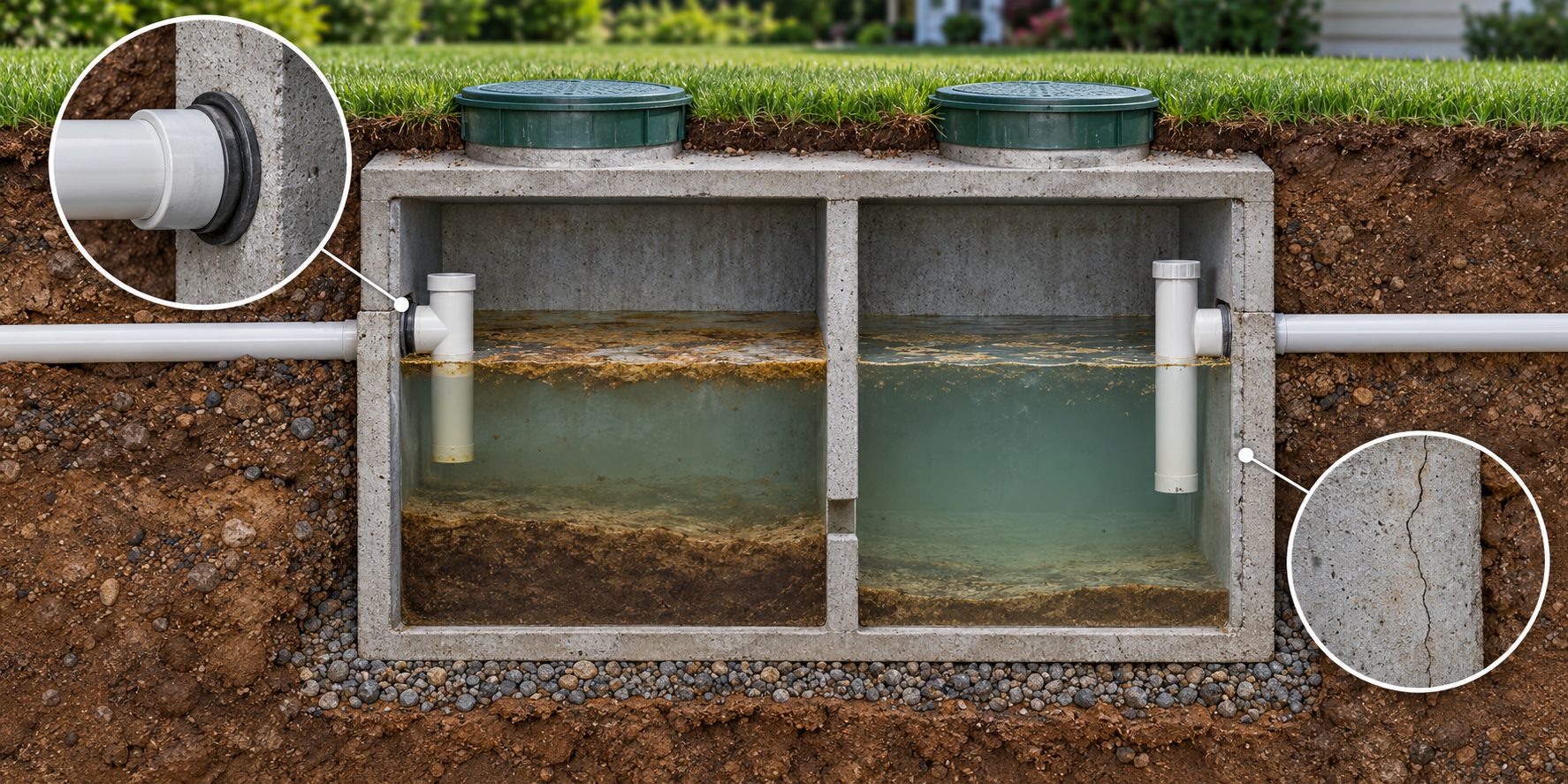
Cost layers to identify
- locating and exposing the tank;
- pumping and safe access before inspection;
- diagnostic inspection and leak or connection assessment;
- repair materials and professional labor;
- inlet, outlet, baffle, pipe, or seal reconnection;
- excavation, dewatering, shoring or difficult soil handling where applicable;
- backfill, grading, landscape restoration, permits, and inspection.
The buried location makes access a major part of the economics. A tank under an open lawn is different from one beneath a driveway, deck, retaining feature, or mature landscaping. Ask whether the quote assumes the tank location is known and whether restoration stops at rough grade.
Repairable damage versus replacement risk
A localized connection or seal problem can be economically repairable when the tank body remains sound and the work is accessible. A crack, corrosion, settlement, leaking structure, or multiple failed connections can change the decision. Material, age, structural condition, groundwater, soil movement, and the ability to meet current requirements all matter.
Do not accept age alone as proof that a tank must be replaced. Also do not treat a patch as a permanent solution without asking what caused the damage and whether the remaining structure can be inspected. A professional should describe the observed condition, the repair boundary, expected service objective, and what remains unknown.
Simple, typical, and difficult cases
Localized repair: Access is exposed, the defect is at an inlet, outlet, baffle, or seal, and the tank body is sound. Pumping and a focused repair may be the full tank scope, with the field assessed separately.
Excavated structural repair: The tank must be exposed, pumped, and examined; the repair requires structural or connection work and restoration. The bill is driven as much by access and restoration as by the repair material.
Replacement threshold: The tank is structurally compromised, leaks cannot be responsibly corrected, multiple areas are deteriorated, or the approved design requires a different configuration. Compare tank replacement and the whole-system implications before authorizing a cosmetic patch.
Safety and approvals
Only trained professionals should clean or repair septic tanks. Tanks can contain dangerous gases, and wastewater may contain pathogens. Do not enter a tank, lean into an opening, or attempt an unqualified confined-space or excavation repair.
Repairs and replacements may require authority notification, a permit, inspection, or a change to the approved system. Rules differ by state, province, and municipality. Ask who obtains approval and whether the proposed repair preserves the existing design.
Quote questions
- What exact defect was observed, and how was it established?
- Is pumping included, and are all compartments accessible?
- Does the repair address the tank body, a connection, or a component?
- Is excavation, groundwater, rock, disposal, backfill, and restoration included?
- Was the existing drainfield and distribution system evaluated separately?
- What permit, inspection, warranty, or follow-up is required?
- What condition would change the work from repair to replacement?
The right comparison is not “patch versus new tank” in isolation. It is the cost of a defined repair, the probability that unresolved tank or field conditions remain, the access that will be opened anyway, and the consequences of repeating the work.
How to interpret a tank finding
Ask whether the finding is a visible defect, a measured leak, a structural concern, or an inference from a symptom. A low liquid level may suggest leakage in some professional inspection contexts, while a high level can have several downstream explanations; neither observation is a homeowner diagnosis. The provider should explain what was inspected and whether the tank was evaluated separately from the field.
Material affects the repair approach, but the material name alone does not determine the answer. Concrete, fiberglass, and plastic tanks have different construction and connection details, and age or settlement may affect more than one area. A repair proposal should state whether it restores watertightness or only addresses a pipe or accessory.
Repair economics in context
If excavation is already required, compare the marginal cost of a durable tank repair with replacement while the area is open. Include pumping, removal, delivery, reconnection, restoration, permit, and inspection in both options. Replacement can also expose a field or distribution issue; repair can be preferable when the rest of the system is sound, but postponing a known systemic problem can create repeat mobilization.
Never enter a tank or perform a confined-space repair. Ask the contractor how the work will protect workers, occupants, and the property, and which local approval or inspection closes the job.