
The repair-versus-replacement decision turns on which layer failed, how much of the system remains sound, what the property can support now, and how likely repeat work is. A low repair quote is not automatically economical if it leaves a failing field. A full replacement is not automatically justified by age or one alarm.
Directional U.S. cost anchors
The current U.S. specialist guides display ranges of $3,593–$12,463 for septic-system installation, $100–$1,300 for inspection, $627–$3,041 for septic-tank repair, and $5,000–$12,000 for tank-and-drainfield replacement. These are broad market observations, not quotes or universal rates; they are not Canadian prices and must not be converted into CAD.
Not every article in this category has the same scope as those anchors. Use the closest comparison only to set an order of magnitude, then ask the contractor, designer, pumper, or authority to separate the work specific to this decision from access, excavation, design, permits, restoration, pumping, disposal, equipment, service, or future operating costs.
Separate the system into decisions
Treat the tank, inlet and outlet, filter and baffles, distribution box, pump and controls, drainfield, soil, and site drainage as related but distinct. Ask which component was inspected and what evidence supports the recommendation. A pump-out or new tank does not prove that the field can absorb wastewater; a wet field does not prove that the tank is structurally failed.
When repair tends to make sense
Repair is more defensible when the defect is localized, the tank and field have evidence of continued function, access is reasonable, the approved design remains suitable, and the repair comes with a defined objective. Examples include a riser, lid, baffle, filter, distribution box, pump, float, or localized line issue.
The economic case improves when the repair can be bundled with already-planned access work and when records show the system has not been accumulating unresolved symptoms. It weakens when the same component has failed repeatedly or the repair is only a temporary way to postpone a known field decision.
When replacement becomes stronger
Replacement deserves serious comparison when there is systemic drainfield failure, structural tank deterioration, repeated major repairs, an unsuitable or exhausted site, changed wastewater load, or a design that no longer meets current approval conditions. Municipal sewer availability can create a third option.
Age is evidence to investigate, not a universal lifespan cutoff. The package did not establish a reliable general tank or field life. Condition, maintenance history, site risk, and records are more useful than a single age number.
Compare total economics, not two headline prices
For repair, include diagnosis, pumping, excavation, component labor, access, restoration, any required permit, and the probability of another call. For replacement, include site evaluation, design, authorization, demolition or abandonment, tank and field, pumps and controls, electrical, excavation, disposal, restoration, and future service.
For each option, ask:
- What cost is certain, and what is an allowance?
- What condition could expand the scope?
- How much of the existing system remains unverified?
- Does the option create recurring power, service, or contract costs?
- Will it conflict with an addition, well, driveway, or future property plan?
- What does the local authority require?
Check assistance before treating the quote as unaffordable
In the United States, EPA points homeowners to possible federal, state, and local septic assistance and recommends checking with the current state septic program or local environmental or public-health office. Canadian owners can ask the responsible provincial or municipal office whether a current local program applies. For example, the Municipality of Chertsey, Québec describes a repayable financing program for some existing-system replacement or compliance work. Confirm eligibility, available funds, covered scope, application timing, repayment terms, and approval before including any assistance in the budget; it is not a guaranteed award or permission to delay needed work.
Three decision scenarios
Localized, first-time failure: A component repair may preserve a functioning tank and field. Request evidence that the repair boundary is real.
Repeat component failures: Compare the cost of another repair, the cost of opening the same area again, and the risk that a second failed layer will soon dominate. A larger plan may be economical even if the immediate component is repairable.
Field or site failure: A new field, engineered alternative, sewer connection, or property-use change may be required. Do not spend repeatedly on emergency pumping without a permanent path.
Site and regulation can decide the outcome
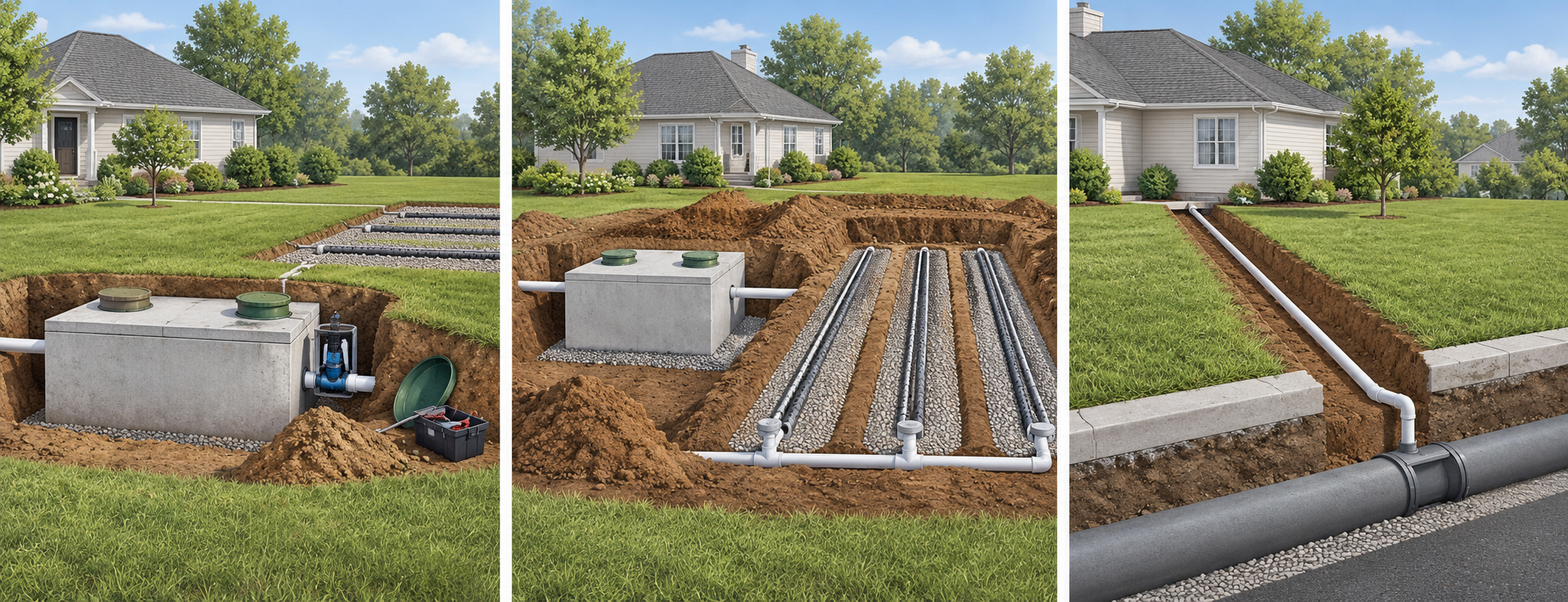
A replacement may not be a like-for-like project. Soil, groundwater, slope, lot area, well separation, reserve areas, and local authorization can make a conventional system unavailable. An engineered system can cost more to install and maintain but may be the only approved path. Requirements differ sharply across jurisdictions; ask the authority before treating a contractor’s assumption as a rule.
A quote-comparison worksheet
Request two written scopes if both are plausible: one for the defined repair and one for replacement or redesign. Require the same information about pumping, access, permits, excavation, restoration, warranties, and unresolved conditions. Ask the professional to state what result would change the recommendation.
Choose repair when it solves a defined localized problem with acceptable repeat-work risk. Choose replacement when the system or site has become the problem, or when repeated repairs consume money without reducing the underlying uncertainty. If neither scope is clear, the next economical purchase is better diagnosis, not a guess.
A practical scoring conversation
Ask the professional to rate, in plain language, the condition of each layer: tank, outlet and baffles, distribution, pump and controls, field, soil, and site constraints. Then mark each option as known cost, allowance, or unresolved. This does not create a scientific score; it prevents a single visible failure from standing in for the whole system.
Repair is stronger when most layers are sound and the proposed work has a defined endpoint. Replacement is stronger when multiple layers are uncertain or failing, the site no longer supports the old design, or the next repair would reopen the same ground without reducing risk. If sewer is available, add it as a separate lifecycle option rather than forcing it into the repair/replacement binary.