
Replacing a drainfield is a design-and-site project, not simply trenching a new set of lines. The cost may include confirming failure, site and soil evaluation, design, authorization, a conventional or engineered field, distribution and pumps, excavation, unsuitable-soil handling, and restoration. U.S. specialist market estimates provide a broad replacement signal, not a universal price. No comparable national Canadian range was established.
Directional U.S. replacement observations
Angi’s July 2026 U.S. field-cost guide puts drainfield-only replacement at around $7,000. A separate broad estimate for replacing both a tank and drainfield is $5,000–$12,000. These scopes overlap but are not interchangeable, and the field-only figure should not be added to the combined range. Soil, design, permits, excavation, access, and restoration affect the local quote. These are specialist estimates, not Canadian prices.
Confirm what is being replaced
The field is the soil-absorption and dispersal part of the system. A tank, pump, distribution box, or outlet problem can mimic field failure. Before authorizing a new field, request the evidence for replacement and ask whether the existing tank, distribution components, and other treatment stages can remain.
Site and design determine the price
The available field must suit wastewater load, soil, slope, groundwater, bedrock, lot size, sensitive-water proximity, climate, and local rules. A replacement area may be required or reserved where the jurisdiction uses that concept. A field can be technically possible but costly if it conflicts with a driveway, addition, well, pool, easement, or future building area.
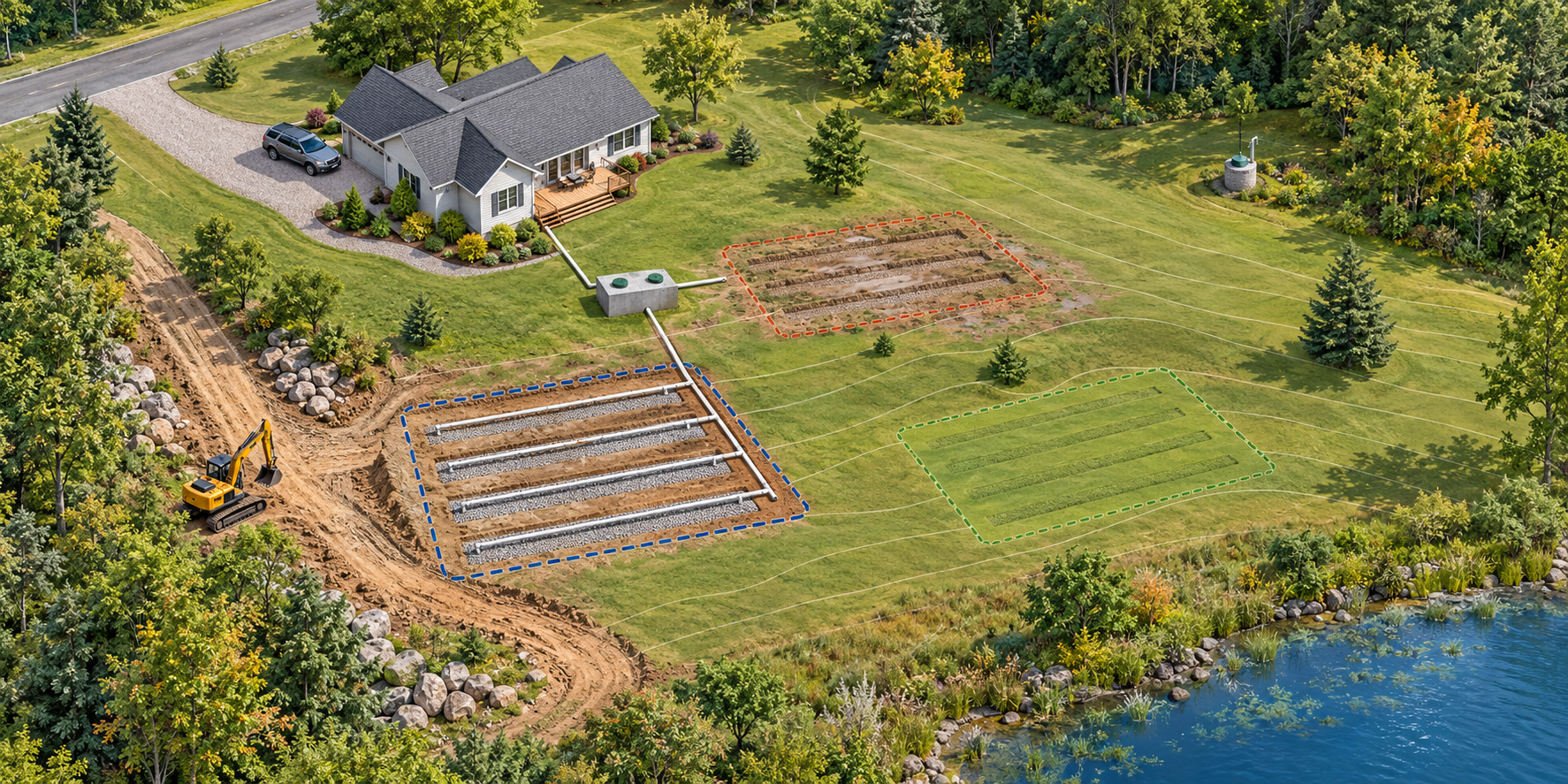
If the original conventional layout no longer works, the replacement may need pressure dosing, imported fill, a mound, drip, sand filter, aerobic treatment, or another engineered arrangement. Those choices add equipment, design, power, service, and lifecycle costs.
Cost structure
- diagnostic inspection and system records;
- site evaluation, soil testing, design, engineering, and permit/application;
- clearing, excavation, rock, groundwater, dewatering, and soil disposal;
- trenches, beds, chambers, piping, distribution, pumps, controls, and electrical work;
- tank repair or reuse, or replacement if the tank is not suitable;
- inspection, testing, backfill, grading, seeding, and restoration.
Do not compare a field-construction quote with a complete replacement proposal unless they include the same design, equipment, and restoration boundary.
Conventional, pumped, and engineered cases
Conventional replacement: Suitable soil and space remain available, the tank and distribution can be reused, and gravity or a relatively simple design is approved.
Pumped replacement: Elevation or controlled distribution requires a pump chamber, controls, alarm, and electrical work. Future power and component service become ownership costs.
Engineered replacement: The lot has shallow soil, high groundwater, bedrock, limited area, slope, or another constraint. More design and treatment equipment can make the installation and recurring budget materially different.
Restoration and future risk
Ask whether the contractor restores only rough grade or returns the lawn, driveway, irrigation, fence, trees, or planting beds. Saturated soil and heavy equipment can create additional restoration risk. Keep the approved design and field location accessible for future service.
Questions for a replacement quote
- What establishes that replacement, rather than localized repair, is needed?
- Can the existing tank and distribution system remain?
- What soil, groundwater, reserve-area, setback, and load assumptions were used?
- Is the proposed field conventional, pressure-dosed, mound, drip, sand-filter, or aerobic?
- Are design, permit, inspection, pumps, electrical, excavation, disposal, and restoration included?
- What recurring service and power costs follow the proposed design?
The lowest installation bid is not necessarily the lowest ownership cost. Compare approved design, site risk, future service, and restoration along with the field price.
How to normalize field-replacement quotes
Ask each bidder for the field type, area, design load, soil assumptions, tank-reuse assumption, distribution method, pump and controls, excavation allowance, rock or groundwater treatment, permit responsibility, inspection, and restoration standard. If one bid excludes design or treats the tank as sound without inspection, it is not a lower price for the same project.
The phrase “new leach field” can conceal major differences. A gravity trench, pressure-dosed bed, mound, drip field, and sand-filter sequence may each solve a different constraint. Compare the approved layout and the recurring service plan, not only the amount of pipe or square footage.
When the tank can remain
Tank reuse is more plausible when the tank is structurally sound, appropriately configured, accessible, and accepted by the new design and authority. If the tank, outlet, filter, or distribution system also has unresolved problems, a field-only price understates risk. Have the professional list retained components and the evidence for each.
Restoration is part of the decision
Field work can disturb lawn, trees, fences, irrigation, paths, driveways, and future building areas. Saturated soil may need protection from heavy equipment. Ask whether the final condition is rough grade, seed, sod, gravel, or full landscape replacement. That is not an optional detail when comparing a repair with a replacement or sewer connection.
Replacement is a design milestone
The field layout should be coordinated with well separation, property boundaries, reserve areas, additions, driveways, trees, and future access before construction. A replacement that uses the only open land may solve today’s failure but reduce future flexibility. Ask what records, as-built drawing, or markers will be provided at closeout.
If an alternative system is proposed, price the recurring obligations at the same time: pumps, alarms, power, service, monitoring, filters, media, and response. A conventional field may be less expensive only when the site still supports it. A more complex field may be the only approved way to avoid repeated failure on a constrained lot.