
An inspection finding involving a baffle, effluent filter, riser, lid, cover, or seal can be a relatively localized professional repair, but the bill depends on access and whether the component problem exposed a wider tank condition. U.S. specialist market observations list separate component signals; Canadian pricing is local and should be quoted in CAD.
Directional U.S. component observations
Angi’s September 2026 U.S. repair guide lists these component-cost observations: lids $150–$500, baffles $300–$900, filters $200–$300, and pumps $250–$1,000. The figures are specialist market estimates, not a combined repair package or local quote. Tank access, diagnosis, excavation, and restoration may be separate; ask which items the quote includes. These are not Canadian prices.
Why these parts matter
Baffles or inlet and outlet tees help keep settled solids and floating scum from moving into the drainfield. An effluent filter provides another barrier against solids leaving the tank. Risers make future access easier, while lids and seals protect the opening and property users. A failed component can increase the risk of blockage or unsafe access even when the tank body is sound.
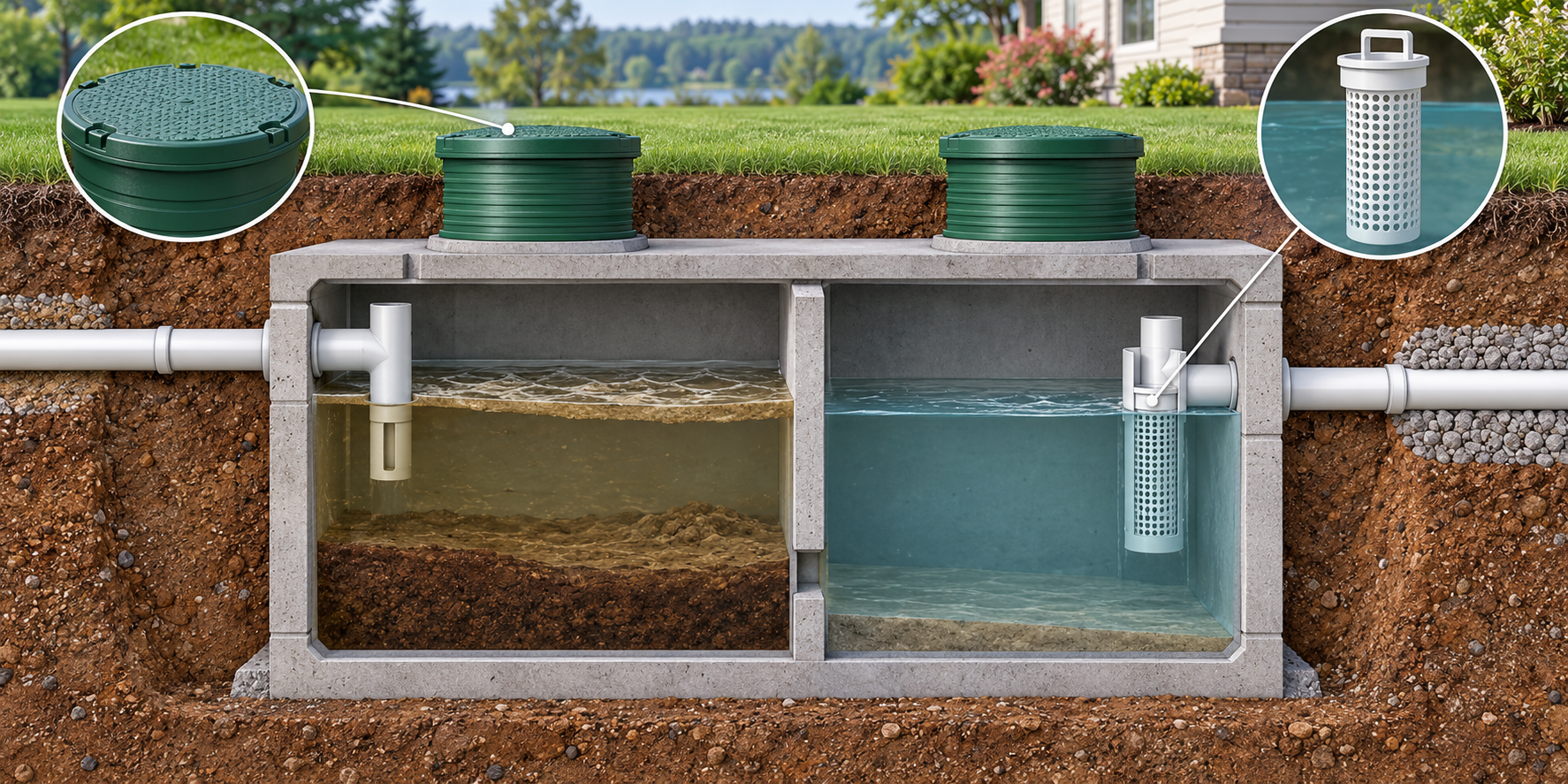
What the quote may include
- pumping or partial access needed to inspect and service the tank;
- filter cleaning or replacement;
- baffle or tee repair/replacement;
- riser, lid, cover, gasket, or seal replacement;
- locating and excavating buried access;
- backfill, grading, and lawn or surface restoration;
- a broader tank inspection if the defect suggests structural deterioration.
The lowest component price may exclude excavation, pumping, restoration, or a second access point. Ask for those lines explicitly.
Component-by-component decisions
Baffle or tee: Confirm whether the damaged part is inlet-side or outlet-side and whether solids have reached the outlet. A local repair may be sufficient, but the provider should explain whether the field was affected.
Effluent filter: Cleaning and replacement are different services. Ask whether the filter is the correct type for this system, whether access is safe, and whether repeated loading points to a tank, use, or field problem.
Riser: Adding a riser can increase today’s access-work cost while reducing future locating and excavation. Confirm lid load, sealing, height, and surface finish with the professional; do not treat a generic cover as interchangeable.
Lid or seal: A damaged cover can create a safety and water-infiltration concern. Ask whether the support and tank opening are sound before replacing only the lid.
When a small repair is not the whole answer
Repeated filter blockage, unusually high liquid level, surfacing wastewater, odor, or a damaged outlet may indicate a downstream distribution or drainfield problem. A component repair can restore a missing safeguard without restoring the entire system. The inspection report should separate the repair from unresolved field or tank observations.
Bundling and access economics
If the tank is already being pumped or opened, bundling a riser, lid, filter, or baffle repair may avoid a second mobilization. That does not justify adding unneeded work. Compare the component evidence, the future access benefit, the restoration cost, and whether the same excavation reveals a more serious tank defect.
Only trained professionals should work around septic tanks. Do not enter a tank, reach into an opening, or attempt a buried-lid excavation without proper equipment and local professional direction.
Questions before approving
- Which component failed, and what evidence supports that finding?
- Is pumping, locating, excavation, and restoration included?
- Is the replacement compatible with the tank and approved system?
- Was the tank body, outlet, distribution, and field condition assessed?
- Does the quote include a safer permanent access improvement?
- What signs would trigger a separate tank or drainfield repair?
For a narrow component problem, a focused repair can be sensible. The economic safeguard is making sure a small part is not being used to hide a larger unresolved system condition.
When bundling helps
Bundling makes sense when the same access, pumping, and restoration work would otherwise be repeated. For example, adding a riser while a buried lid is being replaced can lower future locating effort, while cleaning a filter during scheduled pumping may avoid another visit. Ask for the incremental price of each item rather than accepting an unexplained package.
Bundling is less useful when the added item is unrelated to the observed defect or when it prevents comparison with a focused repair. A new lid does not establish a sound tank; a new filter does not establish a sound field. Keep the component repair, the underlying condition, and optional access improvements separate in the proposal.
What should be documented
Keep the component type, location, reason for replacement, tank access condition, and any recommendations. If an inspector says the filter is repeatedly loaded or the outlet is damaged, record that observation and ask whether a diagnostic follow-up is warranted. Good records reduce the chance that the next provider sells a duplicate discovery visit or misses a recurring pattern.
A useful component quote
The quote should name the component, its location, the reason for replacement, the access method, and the service outcome. For a filter, that may be cleaning or replacement and a statement about the tank outlet. For a riser or lid, it may be safe, sealed future access. For a baffle, it may be preventing solids from entering the field. If the outcome is not stated, the parts list is difficult to evaluate.
Ask whether the component is a symptom of a larger issue. Repeated filter loading, a damaged outlet, water infiltration, or a high tank level may change the economical next step from a minor repair to diagnosis of the tank or field. That follow-up should be priced separately rather than smuggled into the component line.