
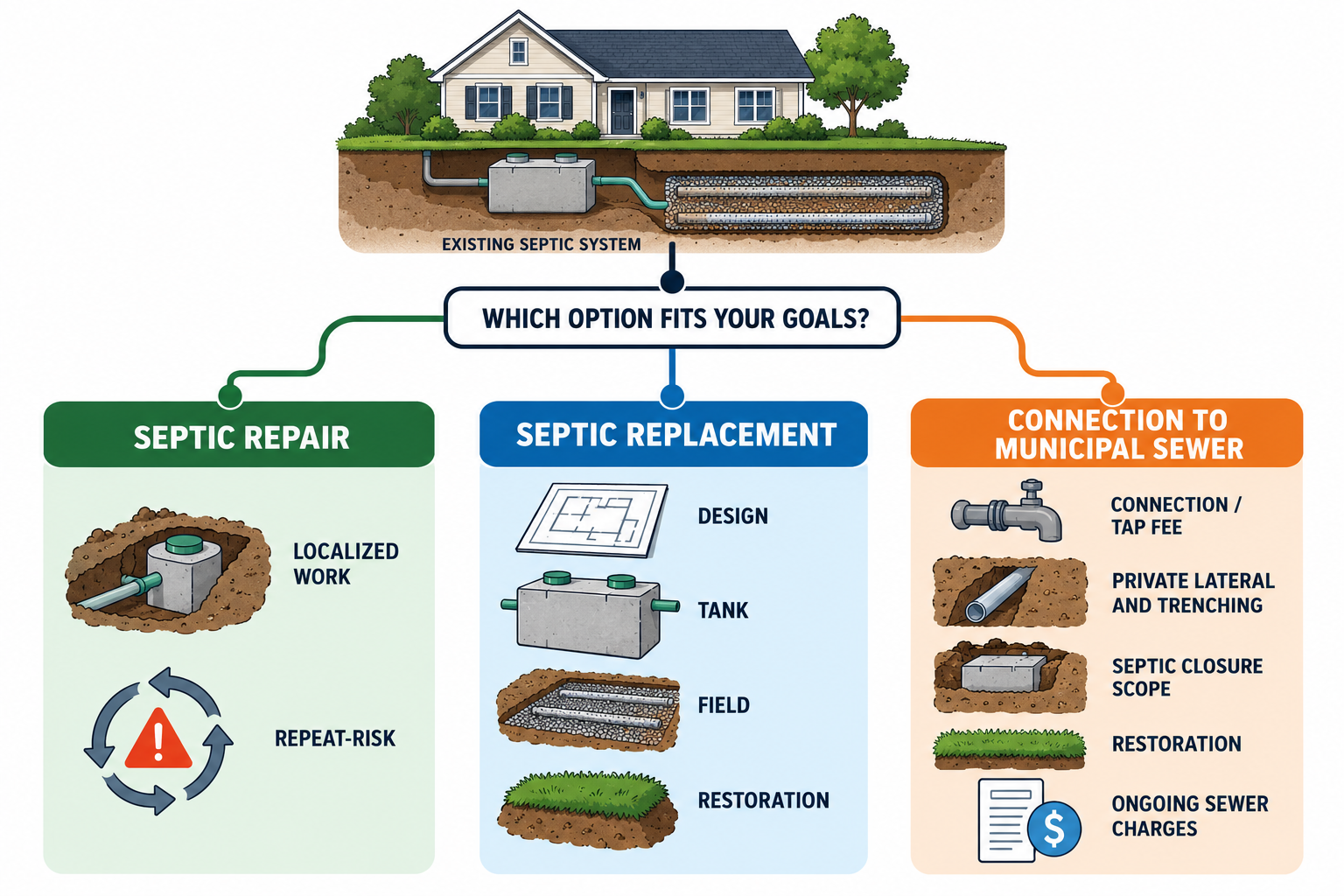
Connecting to municipal sewer can be a third option when a septic system is failing, a property is required to connect, or service has become available. The comparison includes municipal connection or tap fees, private lateral and trenching, permits, road or driveway restoration, septic abandonment, and future sewer charges. Fees and mandatory-connection rules vary dramatically by municipality.
Directional U.S. cost anchors
The current U.S. specialist guides display ranges of $3,593–$12,463 for septic-system installation, $100–$1,300 for inspection, $627–$3,041 for septic-tank repair, and $5,000–$12,000 for tank-and-drainfield replacement. These are broad market observations, not quotes or universal rates; they are not Canadian prices and must not be converted into CAD.
Not every article in this category has the same scope as those anchors. Use the closest comparison only to set an order of magnitude, then ask the contractor, designer, pumper, or authority to separate the work specific to this decision from access, excavation, design, permits, restoration, pumping, disposal, equipment, service, or future operating costs.
Separate the two sides of the connection
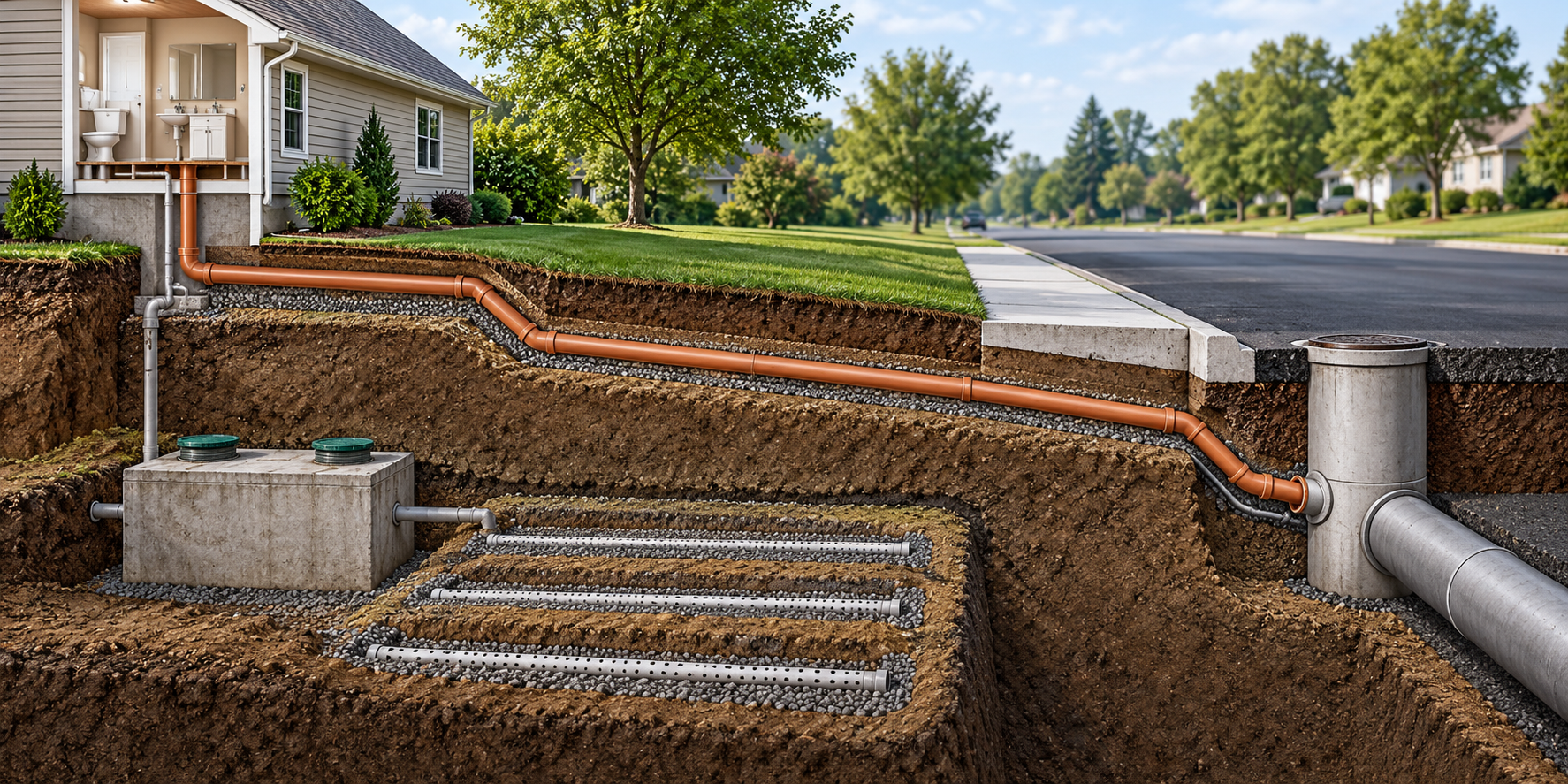
The municipality or utility may own the public main and define the connection point. The homeowner may still pay for the private lateral, excavation, building connection, permits, traffic or right-of-way controls, and surface restoration. This guide focuses on deciding whether to leave septic service and the cost of abandoning the onsite system. Public connection charges vary by provider and locality, while private-lateral costs depend on the property’s route, site conditions, and project scope.
Cost layers to request
- utility application, tap, capacity, or connection fee;
- private lateral route, trenching, excavation, and building connection;
- pumping and decommissioning of the septic tank and field;
- electrical disconnection for pump or treatment equipment;
- permits, inspections, easements, and engineering;
- road, sidewalk, driveway, lawn, and landscape restoration;
- recurring sewer charges, assessments, or maintenance responsibilities.
Do not compare an advertised tap fee with a complete septic replacement quote. Ask who pays for each line and whether the municipality requires a particular contractor or inspection.
Compare replacement, repair, and sewer
Repair: Lower immediate cost if the failure is localized, but repeat-work risk remains. It may be reasonable when the system and site are otherwise sound.
Septic replacement: A major capital project with site evaluation, design, field construction, restoration, and future maintenance. It may be the only option where sewer is unavailable.
Sewer conversion: Can remove septic maintenance and field risk, but adds connection cost and recurring utility charges. Private trenching and restoration can dominate on a long or difficult route.
Use the ownership horizon. A sewer connection may be attractive for a long-term owner who values predictable service, while a high fee or assessment may change the decision for a short hold. Neither outcome is universal.
Property and jurisdiction scenarios
Sewer at the property line: The private connection may be relatively contained, subject to local fees and restoration.
Main across a road or easement: Trenching, traffic control, utility conflicts, and authority coordination can materially expand the project.
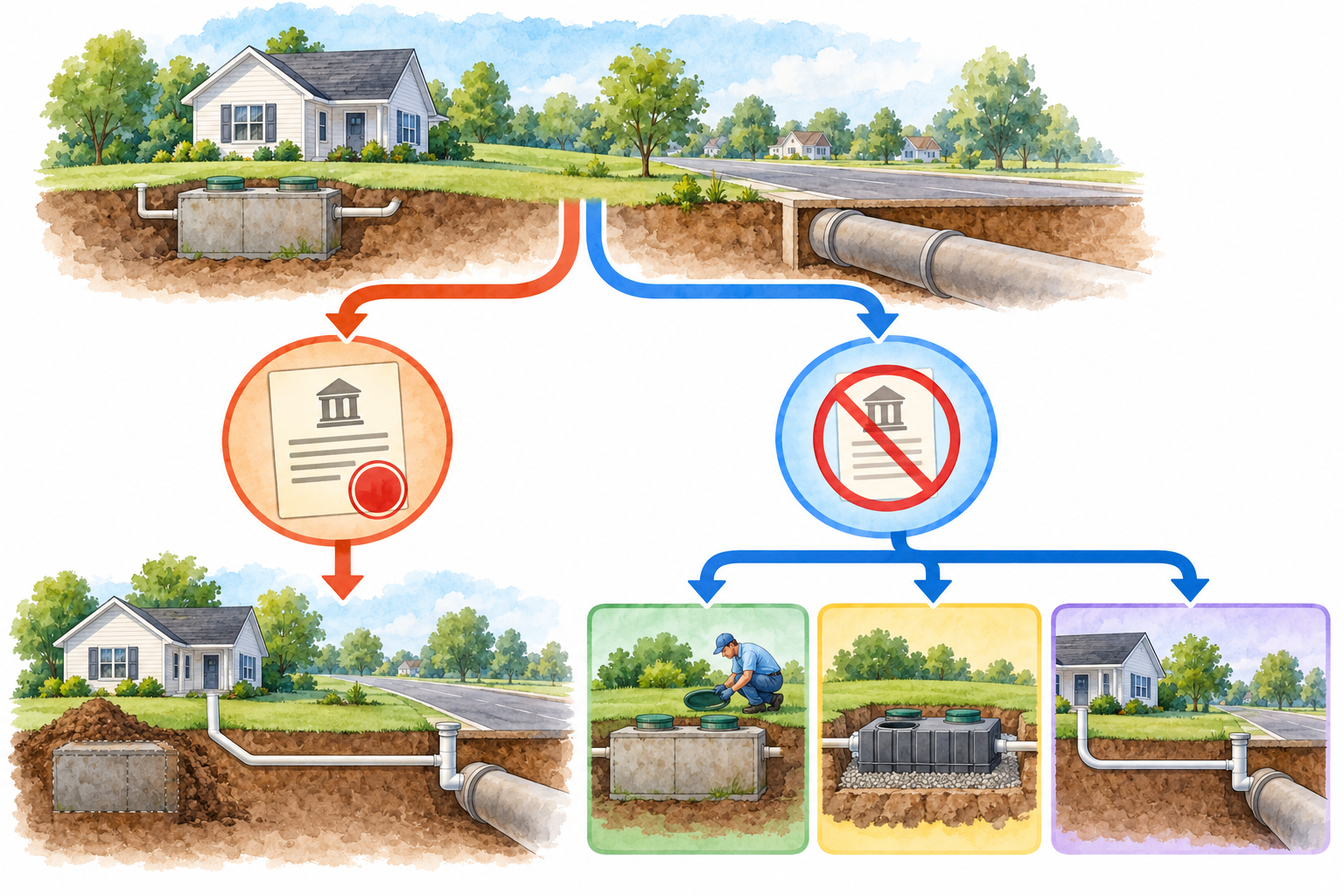
Mandatory connection or sale: Local rules may create a deadline or transfer requirement. Massachusetts demonstrates that septic status and property transactions can be regulated locally; it does not establish another municipality’s rule.
For a VA-guaranteed loan, the handbook states that connection is required when public sewer is available and the local authority mandates it. Availability alone is not enough under that program-specific condition. Confirm the actual local mandate, deadline, and lender documentation; it is not a national requirement for every property with nearby sewer service.
Questions before deciding
- Is sewer available, and is connection optional or mandatory?
- What fees, assessments, permits, easements, and inspection requirements apply now?
- What is the private-side lateral route and restoration boundary?
- How must the tank, pump chamber, field, and electrical equipment be closed?
- What recurring sewer charges follow?
- What would a compliant septic repair or replacement cost at the same property?
Obtain a written utility estimate and a separate septic-abandonment scope. Compare the complete one-time cost, recurring charges, property disruption, and certainty of the long-term arrangement.
Normalize the private-side quote
Ask whether the proposal includes locating the building connection, trench depth, rock, groundwater, utility conflicts, road or sidewalk permits, traffic control, temporary access, backfill, and surface restoration. Confirm whether the homeowner, utility, or municipality owns and maintains each segment after connection. A public connection fee does not answer those private-side questions.
If the route crosses an easement or shared property, obtain the required written permissions before pricing the work as certain. A short route on paper can become a major project when the connection point, grade, or restoration standard is controlled by another party.
Use the ownership horizon
Estimate one-time conversion cost, annual sewer charges, likely septic-maintenance savings, and the value of removing field and emergency-pumping risk. Do not assign a universal payback period: fees, rates, local responsibility, and the condition of the existing septic system vary. A homeowner who must connect by a deadline has a different decision from one choosing voluntarily between a repair and a long-term conversion.
If the conversion is mandatory, ask for the actual deadline, inspection, and closeout requirements. If it is optional, request a septic repair or replacement comparison using the same restoration, access, and future-use assumptions.