
“Engineered septic” is not one standardized product. It describes a design that uses additional treatment, pumping, dosing, fill, distribution control, or site-specific engineering because a simple gravity tank-and-field arrangement is not suitable or approved. It can cost more upfront and add recurring service, power, and component costs, but a conventional design may not be feasible on the property.
Directional U.S. installation comparison
Angi’s 2026 U.S. installation guide lists conventional anaerobic systems at $3,000–$8,000 and aerobic systems at $10,000–$20,000. This is one specialist comparison, not a universal engineered-system premium: aerobic is only one engineered design, and soil, field layout, system components, permits, and quote inclusions vary. Do not treat either range as Canadian pricing.
A bounded Southern B.C. comparison
One British Columbia provider lists Type 1 gravity systems at $20,000–$30,000, Type 1 in-ground pressure-distribution systems at $35,000–$45,000, and Type 1 sand mounds at $55,000–$65,000 for the Fraser Valley, Lower Mainland, and most of Southern B.C. The provider uses $ without identifying a currency code, so the denomination is unspecified. Its page labels the figures as reflecting current (2026) construction costs and dates the post to October 14, 2025. These are one provider’s regional observations, not bids for the same property or a representative market comparison. The page does not disclose a project sample or full installation inclusions. Compare the approved design and full scope in a current local quote.
What conventional means
A conventional system commonly consists of a house pipe, septic tank, and gravity-fed trench or bed drainfield. The tank settles solids and the soil treats and disperses effluent. It is simplest when the site has enough suitable soil, usable area, acceptable slope and groundwater conditions, and an approved layout.
Why a site may need more
High groundwater, shallow soil, bedrock, steep slope, limited lot area, proximity to sensitive water, seasonal conditions, or a changed wastewater load can affect the design. The answer may be a mound, drip distribution, sand filter, aerobic treatment unit, pressure dosing, or another approved alternative. EPA lists common system types but states that the list is not exhaustive.
The word “engineered” should prompt a question: what constraint is being solved, and which added layer solves it? It should not be used as a blanket premium without a design explanation.
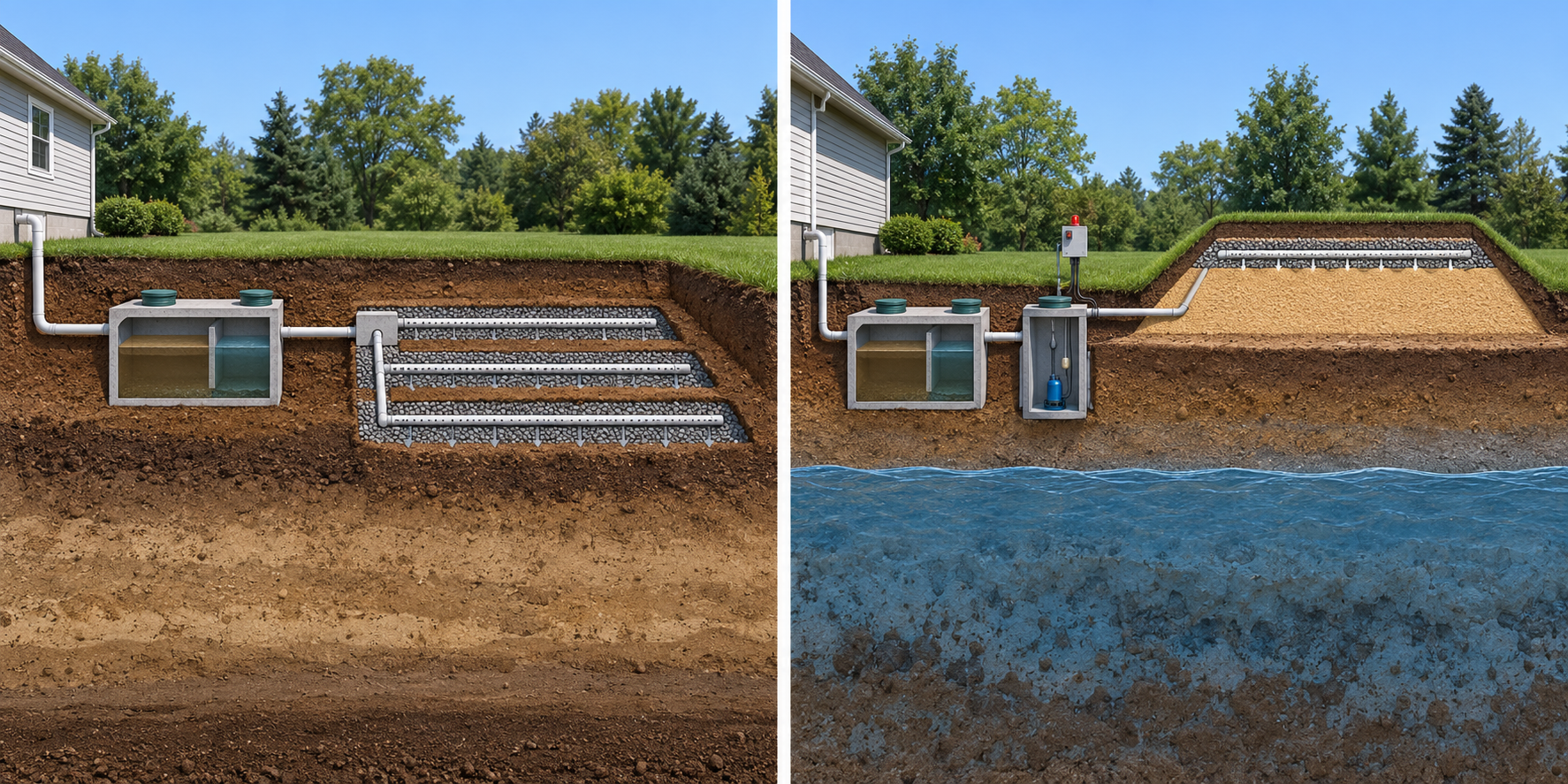
Where the extra cost appears
- soil/site evaluation, survey, engineering, and design;
- additional tanks, treatment media, aeration, or disinfection;
- pump chamber, pump, floats, controls, alarms, and electrical supply;
- imported sand or fill and specialized field construction;
- more complex inspection, authorization, commissioning, and records;
- service contracts, monitoring, electricity, filters, media, and replacement parts.
Comparative national totals are not established. Use broad local quotes and compare the complete project boundary.
Installation and ownership tradeoffs
| Question | Conventional system | Engineered or alternative system |
|---|---|---|
| Site fit | Needs suitable soil, space, and layout | Can address some constraints through treatment, dosing, fill, or controlled dispersal |
| Equipment | Often fewer mechanical components | May add pumps, controls, blowers, media, or disinfection |
| Upfront work | Simpler when the lot is straightforward | More design, construction, electrical, and commissioning layers |
| Recurring cost | Mainly inspection, pumping, and repairs | May include contracts, power, monitoring, and specialized parts |
| Uncertainty | Driven by site and field construction | Driven by design approval, compatibility, service obligations, and equipment |
This is a decision comparison, not a claim that every alternative has every listed feature.
Three property cases
Straightforward lot: A conventional design may minimize upfront and recurring cost because the field can be installed by gravity with ordinary access.
Constrained lot: Fill, pressure dosing, mound, drip, or treatment equipment may be required. The higher quote reflects a different architecture and may be the only approvable option.
Existing-system conversion: A failing field or addition may force a redesign. Compare the proposed alternative with repair, field replacement, and municipal sewer where available, including future service and power.
How jurisdiction changes the answer
British Columbia, Alberta, Nova Scotia, and Ontario demonstrate different authorization, qualification, system-class, and maintenance frameworks. A province or state example cannot establish another jurisdiction’s requirements. Ask the authority and designer whether the system requires a written service agreement, annual inspection, specific filing, or qualified installer.
Questions for the designer and installer
- What site constraint rules out or weakens a conventional design?
- Which treatment and dispersal components are included?
- What power, alarms, service contracts, inspections, and parts are required?
- Who is responsible for design, permit, commissioning, and records?
- What happens during a power outage or service interruption?
- What local rule or approved document supports the proposed system?
- What is the long-term cost compared with a feasible conventional, repair, or sewer option?
Choose the design that solves the actual site constraint and remains supportable locally. A lower conventional quote is not a saving if it cannot be approved or maintained; an engineered quote should still explain every added lifecycle layer.
Compare the decision in stages
First compare feasibility: can each option meet the site and authority requirements? Then compare installation: design, equipment, excavation, fill, electrical work, and restoration. Finally compare ownership: service, power, pumping, monitoring, parts, access, and the consequence of a failure. A system that is cheaper only at stage one may be more expensive over the ownership horizon.
Ask the designer to identify the rejected alternatives and why they were rejected. “Engineered required” is not enough. The constraint may be shallow soil, a high water table, slope, field area, well separation, or a changed load. Understanding the constraint helps you judge whether a different layout, property plan, or sewer connection changes the economics.
Avoid comparing labels
One contractor may call a pressure-dosed field engineered while another reserves that word for advanced treatment. Compare the drawings, treatment steps, dispersal, controls, and service obligations. Also confirm whether a proposed “conventional” chamber or pump arrangement carries the same recurring obligations as the other bid. Labels are less informative than the approved system boundary.
What belongs in a lifecycle comparison
Use the same ownership horizon for each feasible option. Include installation and restoration first, then ordinary inspection, pumping, electricity, service contracts, filters, media, alarms, parts, and access. Add a difficult-year scenario for a pump, control, or field intervention. These scenarios do not forecast failure; they reveal which option exposes the homeowner to more recurring service or specialist dependence.
If an alternative is required by the site, its premium should be explained by the constraint it addresses. If it is merely preferred, ask what decision value it adds and what obligations it creates. A design that meets the authority’s requirements but has no local service capacity may carry a practical cost absent from the installation bid.