
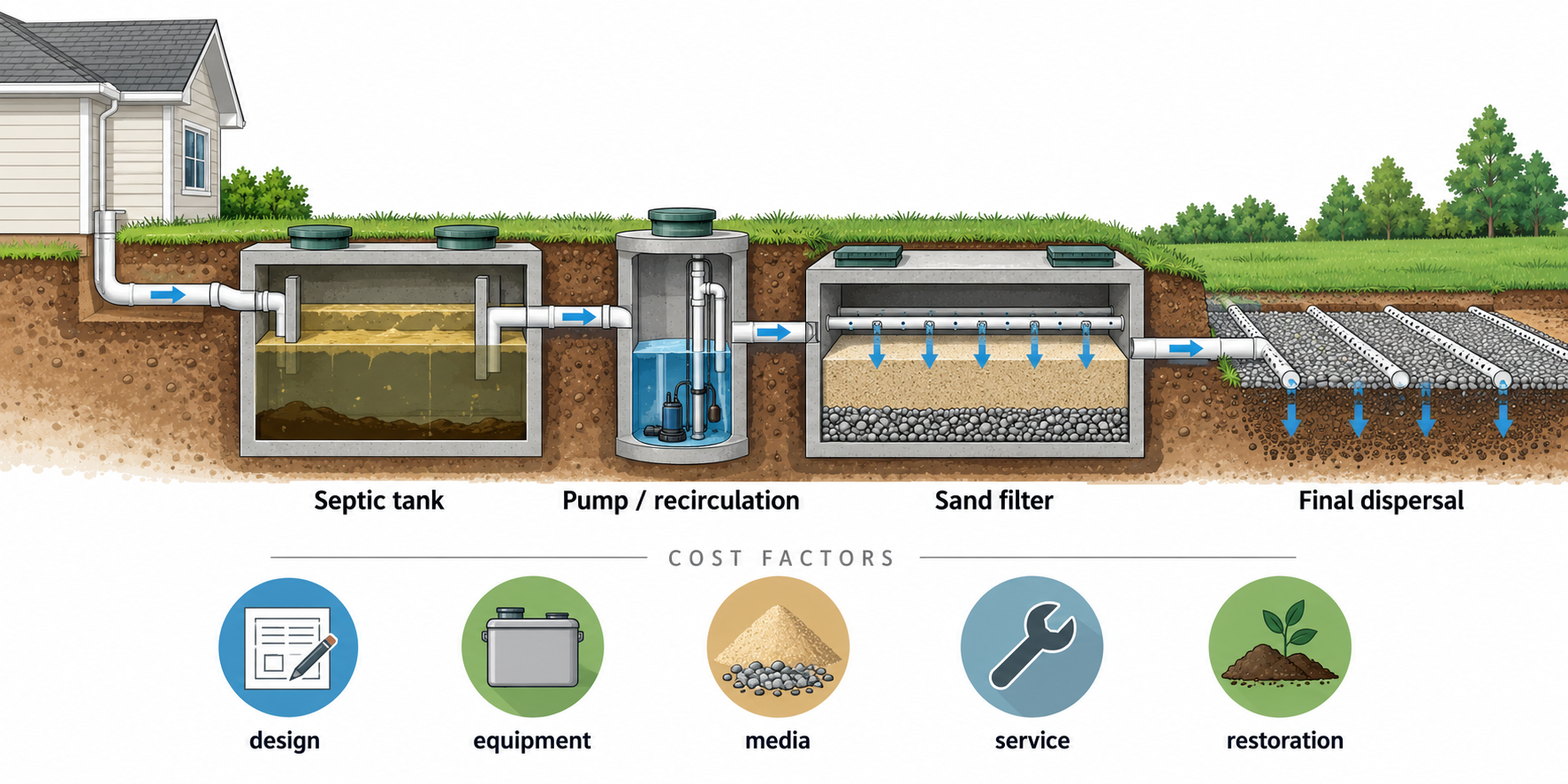
A sand-filter system adds a sand treatment stage before final dispersal. Depending on the design, it may include a septic tank, pump chamber, recirculation, pressure distribution, a liner or container, controls, and a drainfield. “Sand filter” therefore describes a treatment stage, not one identical package or price.
Directional U.S. installation estimate
Angi’s 2026 U.S. installation guide lists sand-filter septic systems at $7,000–$18,000. Configuration, whether the filter is above or below ground, the dosing equipment, field, site conditions, and quote inclusions vary. Treat this as a specialist market estimate, not a local quote or Canadian price, and compare the complete approved system scope.
Why a design may include a sand filter
An engineer or authority may use additional treatment where site conditions, treatment objectives, or an approved alternative-system design call for it. EPA lists recirculating sand filters among common alternative types. The actual configuration, media, dosing, and dispersal must be confirmed from the approved design.
Cost layers
- site and soil evaluation, design, engineering, and permit;
- tanks, pump chamber, pump, floats, controls, and alarm;
- sand-filter bed, liner or container, recirculation piping, and media;
- final dispersal field or pressure distribution;
- electrical work, commissioning, inspection, access, excavation, and restoration;
- scheduled inspection, pumping, filter or media service, power, and component reserve.
No current universal U.S. or Canadian installed price, media-replacement price, or service contract is established. Ask for a local complete-system quote.
Recirculating versus other configurations
Recirculating systems can add a pump and control relationship that changes service and power exposure. A non-recirculating or differently packaged system may have another maintenance pattern. Do not compare bids using the phrase “sand filter” alone; compare the treatment sequence, equipment, dispersal, and obligations.
Ownership scenarios
Straightforward design: Suitable access and a complete approved package make installation layers easy to identify, even if the system is more complex than gravity septic.
Difficult lot: Rock, groundwater, slope, fill, or limited space raises both design and excavation uncertainty. Restoration may be a significant separate cost.
Maintenance-heavy system: Pumps, controls, media, filters, and service visits can dominate ownership cost. Ask whether a local provider can obtain compatible parts and document the required maintenance.
Compare with alternatives
A sand filter may be compared with aerobic treatment, a mound, drip distribution, or another approved engineered design. The relevant economics include why the option is required, upfront construction, power, service, media, field area, restoration, and the risk of unavailable expertise. A cheaper alternative is not useful if the site or authority will not accept it.
Questions for the quote
- What exact sand-filter configuration is proposed and why?
- Are the pump chamber, recirculation, controls, media, liner, field, and electrical work included?
- What inspection, pumping, media, filter, and service obligations follow?
- Who designs, approves, commissions, and maintains it?
- What conditions expand excavation or restoration?
Treat the system as an engineered treatment chain. The visible sand bed is only one cost layer, and the long-term service plan should be priced before installation is approved.
What to ask about media and access
“Media maintenance” can mean inspection, cleaning, replacement, or a future reconstruction, depending on the design. Ask the designer to identify the expected service activity, access points, and whether the media is part of a sealed or open configuration. Do not assume a quoted service interval or replacement cost without the actual design and provider.
If the filter is recirculating, ask how the pump and controls are tested and what happens when the dosing cycle is interrupted. If the final field is pressure-dosed, include its pump, alarm, electrical, and service layers. A sand filter may solve a treatment constraint while moving more cost into equipment and maintenance.
A useful comparison horizon
Compare a normal operating year, a pump or control failure, and a media or field intervention. Then compare the same scenarios for a feasible mound, aerobic, drip, or conventional system. The purpose is not to predict a failure date; it is to prevent a lower installation price from hiding a system that cannot be supported by local service or future access.