
An aerobic treatment unit (ATU) adds an aerated treatment stage to an onsite wastewater system. The complete cost can include tanks, aeration, pumps or blowers, controls, alarms, electrical work, disinfection or final treatment where approved, dispersal, design, authorization, commissioning, and recurring service. The equipment and obligations vary by model and jurisdiction, so there is no single responsible national installation price to use.
Directional U.S. ATU installation estimate
Angi’s 2026 U.S. installation guide lists aerobic septic systems at $10,000–$20,000. This is a specialist market estimate, not a price for every treatment-unit model or an itemized property quote. The approved dispersal design, pumps or blowers, controls, electrical work, permits, commissioning, and restoration affect the actual scope. It is not a Canadian price.
How an ATU changes the project
A conventional system relies on settling in a tank and treatment and dispersal through soil. An ATU uses additional mechanical or treatment components before the effluent reaches its dispersal stage. The design may be selected for site constraints, treatment objectives, or a local approval pathway. It is not automatically a better choice for every lot.
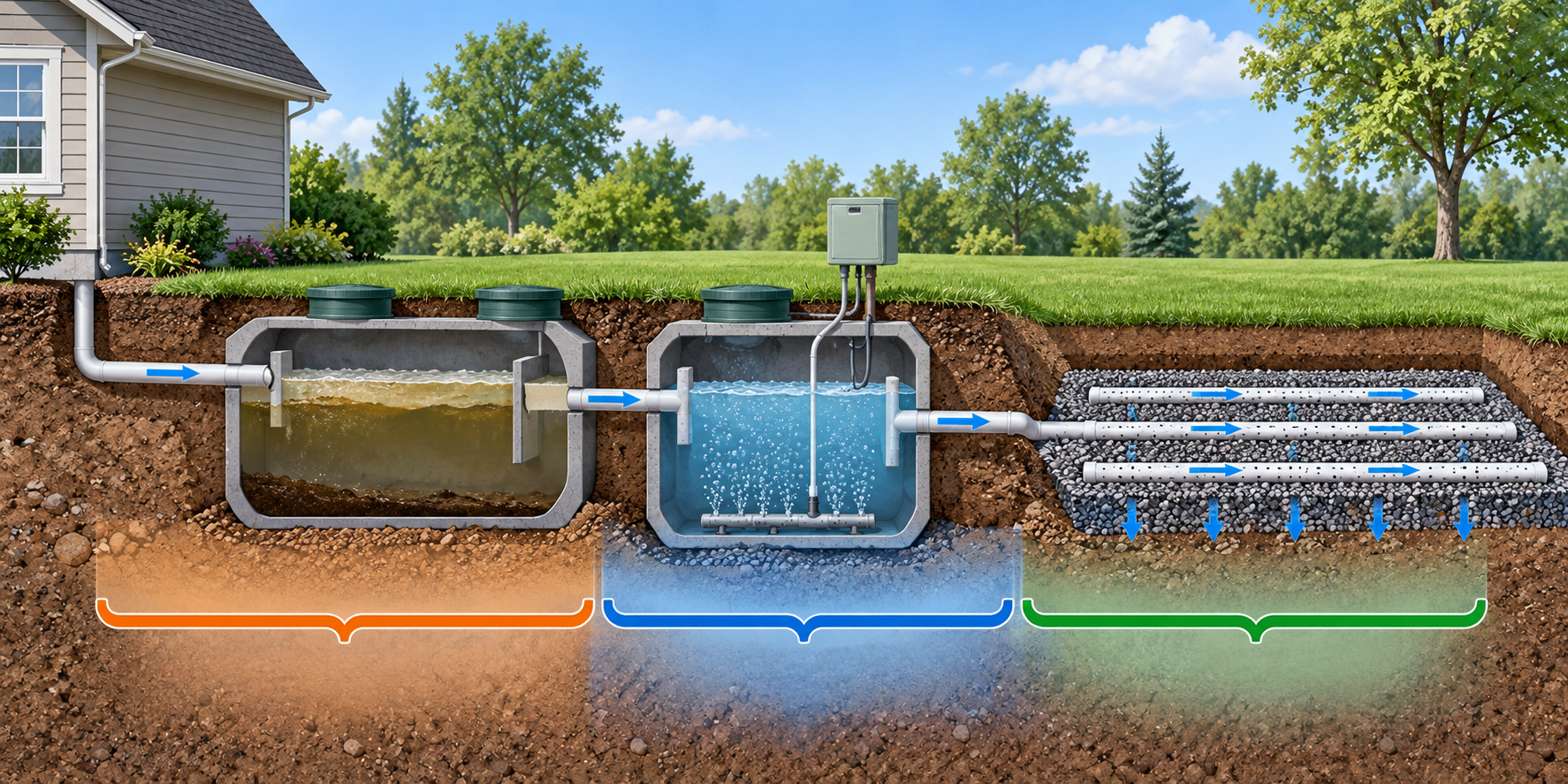
Upfront cost layers
- site evaluation and approved design;
- tanks, treatment chamber, aerator or blower, pump, controls, and alarm;
- electrical circuit, service disconnects, and commissioning;
- final dispersal field, distribution, and any mound, drip, or sand-filter stage;
- permit, inspection, startup documentation, and operator handover;
- excavation, rock, groundwater management, access, backfill, and restoration.
Ask whether the proposal prices the treatment unit only or the complete installed system. A product price is not a working wastewater solution.
Recurring ownership cost
An ATU can add electricity, service visits, alarms, blower or pump replacement, treatment-media or disinfection components, inspections, pumping, and a maintenance agreement. EPA guidance recommends more frequent attention for systems with mechanical, electrical, pump, float, or advanced-treatment components. A former Ontario class-specific aerobic servicing rule in R.R.O. 1990, Regulation 358 was revoked on June 23, 2009; its agreement and annual-inspection clauses are historical, not current requirements. Confirm the current Building Code and responsible authority’s requirements for the property and approved model.
The operating budget should identify what is required by the approval and what is recommended by the manufacturer. Do not assume a generic service contract covers every component or that a contract transfers responsibility for a failed field.
Simple, typical, and complex ATU cases
Simple conversion: The approved design has clear access, an existing tank or field can be reused, and the new treatment equipment has a defined electrical and service scope.
Complete new system: The ATU is one stage in a new tank, pump, dispersal, and restoration project. Design and site work may cost more than the treatment unit.
High-service system: The unit includes pumps, blower, alarms, disinfection, monitoring, and mandated service. The recurring budget and parts availability may matter more than a modest difference in upfront bids.
Questions to ask
- Why is an ATU required or preferred for this site?
- Which model, approval, treatment stage, and dispersal method are proposed?
- What are the electrical, alarm, inspection, service-contract, pumping, and replacement-part obligations?
- Who commissions the unit and keeps the operating records?
- What happens if power, blower, pump, or service is unavailable?
- Are excavation, restoration, design, permit, and field work included?
Compare the ATU with a feasible conventional or other engineered system on a full ownership horizon. The right question is not “what does the unit cost?” but “what does this approved treatment-and-dispersal system cost to install and keep operating?”
Make the service plan part of the quote
Ask the installer to name the treatment unit, dispersal method, pump and blower arrangement, alarm, electrical scope, inspection requirement, service provider, and replacement-part assumptions. If a maintenance agreement is required, obtain its price and coverage before approving installation. A contract that excludes pumps, blowers, electrical faults, media, disinfection, or excavation may leave the largest failure costs outside the apparent annual fee.
The lifecycle comparison should include a normal operating year and a component-failure year. A normal year includes service, power, pumping, and any required reporting. A failure year may include an alarm response, pump or blower, controls, and a temporary-use restriction. These scenarios are not forecasts; they show why a small upfront difference can be outweighed by serviceability and local provider availability.
When conventional is not the cheaper choice
If a conventional design cannot be approved or requires repeated repairs on a constrained field, its lower equipment price has little economic value. Conversely, an ATU should not be chosen merely because it sounds more advanced. Confirm the site constraint, approval basis, performance obligation, and long-term service capacity before comparing totals.
Commissioning and handover matter
Ask what the installer demonstrates at startup: alarm operation, controls, pumps or blower, treatment sequence, access, records, and service contacts. A homeowner should receive the approved documents and a clear maintenance schedule. Commissioning is not a promise of future field performance, but it prevents the system from being handed over with an unknown control or service boundary.
When comparing a conventional system with an ATU, ask whether the ATU changes the field design or only adds treatment. If it also uses a mound, drip, sand filter, or pressure dosing, the cost belongs to the complete combined system. Avoid counting the treatment unit as the only “advanced” cost layer.