
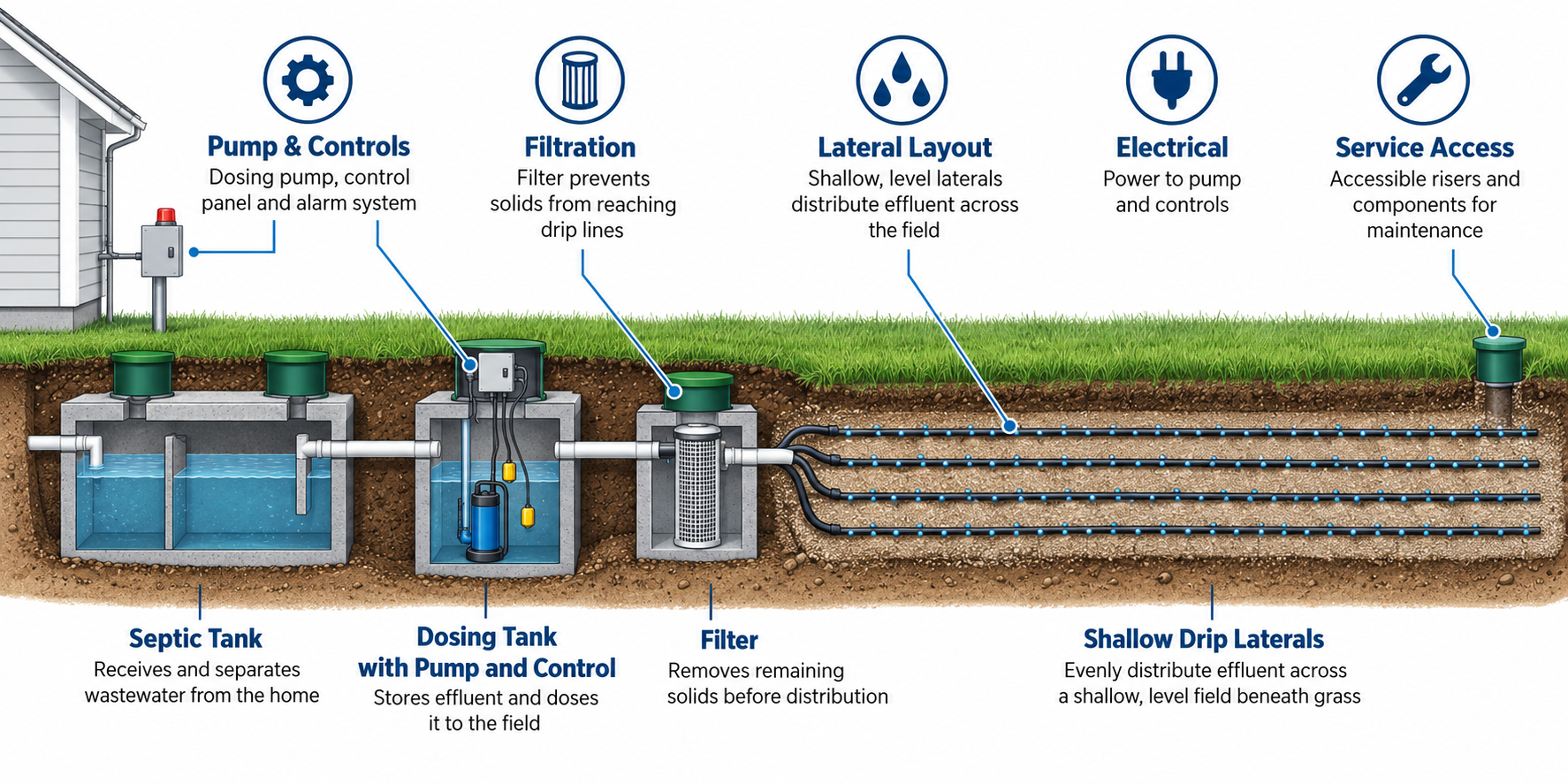
Drip distribution applies treated effluent through shallow laterals rather than a basic gravity trench or bed. EPA identifies a dosing tank and electrical power as part of this system type, which adds installation, controls, maintenance, and failure-response costs. The installed price depends on the approved design, field area, soil, climate, access, and local requirements; no universal national total is established.
Directional U.S. installation estimate
Angi’s 2026 U.S. installation guide lists drip septic systems at $8,000–$18,000. Its description includes additional components such as a dosing tank and pump, but the range is not an itemized quote and local designs differ. Confirm treatment, dispersal, electrical, permits, site work, and restoration inclusions with the designer and installer. It is not a Canadian price.
Why drip may be proposed
Shallow controlled dispersal can suit some constrained sites, but the designer must establish whether it fits the soil, slope, groundwater, wastewater load, and jurisdiction. It is not a generic upgrade that should be selected from a feature list.
What the project includes
- site evaluation, design, engineering, and authorization;
- septic and dosing tanks;
- pump, floats, controls, alarm, and electrical work;
- filters and shallow drip laterals;
- final treatment stage where the approved system requires one;
- excavation, installation, access, backfill, restoration, and commissioning;
- service agreement, filter maintenance, pumping, power, and component reserve.
Compare the complete treatment-and-dispersal scope. A quote for drip tubing alone is not comparable to an installed system.
Recurring cost and cold-climate uncertainty
The pump and controls create an operating layer. Filters and dosing equipment may need scheduled professional attention. Cold-climate performance, freeze protection, flushing, and component compatibility depend on design and manufacturer; no universal procedure or price is established. Do not improvise dosing or flushing instructions.
B.C. practice guidance gives an example of professional pump-dosed maintenance that checks controls, alarms, valves, and dosing components. It is useful context, not a universal service schedule.
Three cost scenarios
Straightforward new installation: Open access, approved design, suitable soil, and an uncomplicated electrical route. Design, equipment, and field construction are separable quote layers.
Constrained site: More field area, difficult excavation, fill, rock, slope, or restoration increases cost. The system may still be cheaper than acquiring more land or redesigning the property, but that is a property-specific comparison.
Maintenance-heavy ownership: Filters, alarms, pump wear, power, and service visits dominate the long-term difference from a conventional system. Compare provider availability and parts support before choosing on installation price alone.
Questions to ask
- What site constraint and approved design require drip distribution?
- What pump, dosing, filter, controls, alarm, and electrical work are included?
- What service, cleaning, inspection, power, and replacement obligations follow?
- What is the cold-weather operating plan, and who verifies it locally?
- What restoration and access protection are included?
Use local professional and authority confirmation for the system design. The right economic comparison includes the added control and service layers, not just the visible field installation.
Compare a drip quote by the maintenance path
Ask who will access the dose tank, filters, controls, valves, and laterals, and what records the service visit produces. A design that is inexpensive to install but difficult for local providers to service can create travel and downtime costs. Confirm whether routine filter or flushing work is included in the service plan; the evidence does not establish a universal interval or homeowner procedure.
The field’s shallow layout can affect future landscaping and construction. Ask which areas must remain protected and whether the restoration quote covers only installation disturbance or also changes to the yard that the design requires. A future driveway, tree planting, addition, or grading project can change the value of the original layout.
Decision threshold
Choose drip when the approved site problem is genuinely solved by controlled shallow distribution and the household can support the power and service plan. If another engineered option is feasible, compare total design, installation, access, maintenance, freeze uncertainty, and restoration rather than treating drip as automatically cheaper or more efficient.
What makes a drip bid comparable
Ask for the number and layout of laterals, dosing and filtration equipment, controls, alarm, electrical work, final dispersal, and access points. Ask whether the price includes startup and documentation. Two drip proposals can have different field areas or treatment stages while using the same headline term.
For an existing property, include the cost of protecting or relocating shallow laterals during future landscaping. If the home is vacant in winter, require a locally verified seasonal plan rather than assuming a generic shutdown. The evidence supports preparation questions, not a universal thawing or flushing procedure.