
A mound system builds an elevated treatment and dispersal area when native soil depth, groundwater, bedrock, or other site conditions do not support a conventional field at the required location. The cost is therefore driven by the constraint being solved: design, fill or sand, excavation, pump dosing, controls, electrical work, construction, restoration, and recurring service.
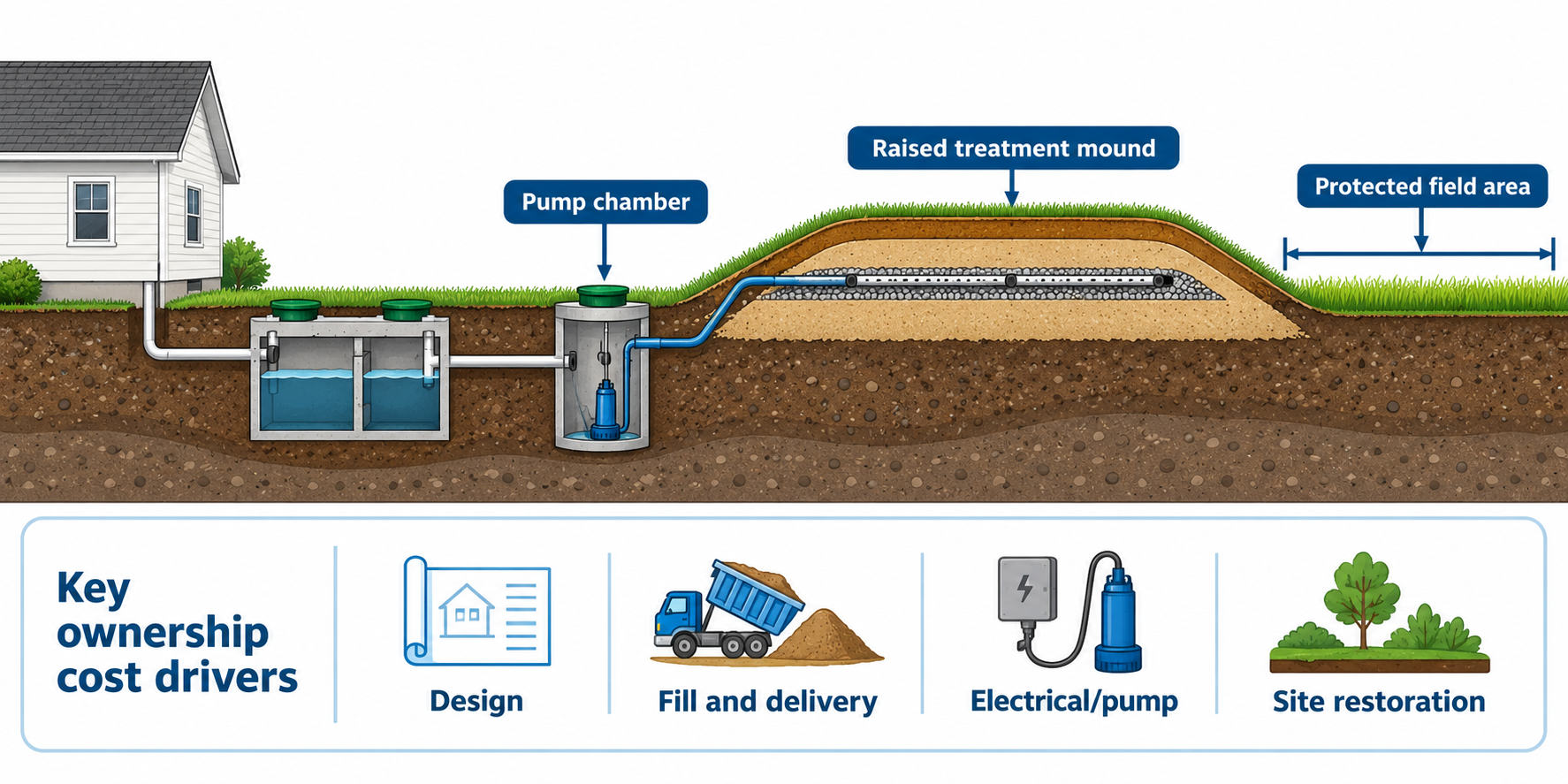
Directional installation examples
Angi’s 2026 U.S. installation guide lists mound systems at $10,000–$20,000. Separately, one septic provider reports $55,000–$65,000 for a Type 1 sand mound in the Fraser Valley, Lower Mainland, and most of Southern B.C. The source uses $ without identifying a currency code, so the denomination is unspecified. Its page labels the figures as reflecting current (2026) construction costs and dates the post to October 14, 2025. This is one provider’s regional observation, not a Canadian market average or a current property quote; the source does not disclose a representative sample or full installation inclusions. Do not compare these figures as equivalent system scopes. Obtain a local quote for the approved design and property.
Why a mound is proposed
EPA identifies mound systems as one common alternative type. The exact design and approval criteria are local. A mound is not a universal answer for every wet or shallow lot, and one jurisdiction’s dimensions or loading rules must not be copied to another property.
Complete cost structure
- site and soil evaluation, survey, design, and authorization;
- tank, pump chamber, pump, floats, controls, and alarm;
- sand or other approved fill and mound construction;
- pressure distribution and field piping;
- electrical circuit and commissioning;
- clearing, excavation, material delivery, access, backfill, grading, and seeding;
- inspection, maintenance agreement, pumping, power, and component reserve.
U.S. specialist market comparisons suggest mound fields can cost more than basic installations, but they are not a universal estimate. Canadian prices should come from local CAD bids.
How the mound changes ownership
The elevated field can make the site fit possible, but the pump and control system add power, alarms, and service. The homeowner should know where the pump chamber is, who responds to an alarm, what inspection or contract is required, and how the field is protected from traffic, erosion, and surface-water changes.
Property scenarios
Moderately constrained site: The mound fits with ordinary access and a clear electrical route. Design and fill are the main additions over a conventional system.
Difficult access or material site: Long delivery routes, narrow access, rock, slope, clearing, or restoration raise construction cost and schedule risk.
Existing-system conversion: A failing field may require comparing a mound with another engineered system, replacement, or sewer connection. Include recurring service and landscape impact, not just the new field.
Quote questions
- What site condition requires the mound, and what evidence supports it?
- How much fill, what distribution, and what pump/control equipment are included?
- Are electrical, alarm, commissioning, inspection, service contract, and power assumptions clear?
- Does restoration include the full disturbed area or only rough grade?
- What access and traffic restrictions protect the mound after installation?
- What happens if groundwater, soil, or rock differs from the design assumption?
A mound can be the most economical way to achieve an approved system on a constrained lot, even if it has a higher upfront and recurring cost. Compare it with feasible alternatives using the same site and ownership assumptions.
The mound is also a site-management decision
The finished mound occupies visible land and may change mowing, planting, traffic, drainage, and future construction options. Ask what area must remain protected, what surface finish is included, and whether fencing or erosion control is part of the restoration. These are not merely appearance issues if traffic or grading could damage the field.
If the proposal relies on a pump chamber, compare the pump and alarm service plan with the cost of a conventional gravity design that is actually feasible. Ask what happens during a power outage and how an alarm is communicated. Do not infer a universal backup-power requirement; confirm the approved design and local authority.
What would change the quote
Request unit prices or allowances for fill, rock, groundwater, clearing, long material delivery, electrical trenching, restoration, and authority revisions. A mound bid is especially sensitive to assumptions that are not visible from the final equipment list.
Compare the usable land cost
The mound’s footprint and protected area can reduce the land available for a garage, addition, pool, trees, driveway, or future replacement area. Ask the designer to show those constraints on the site plan before finalizing the project. A system that fits the lot today may create a later relocation or redesign cost if the family’s property plan is not considered.
The maintenance budget should also include pump and alarm response, not just periodic tank pumping. If the mound is on a rural or seasonal property, provider travel and winter access can be material. These are not universal surcharges, but they are reasonable questions for a local ownership estimate.