
Replacing a small cluster of wind-damaged shingles may cost hundreds of dollars; edge, flashing, multiple-slope, deck, or water-entry damage can cost thousands; broad replacement follows full reroof economics. Emergency dry-in, insurer documentation, interior damage, and hazard upgrades are separate cost layers.
What wind can affect
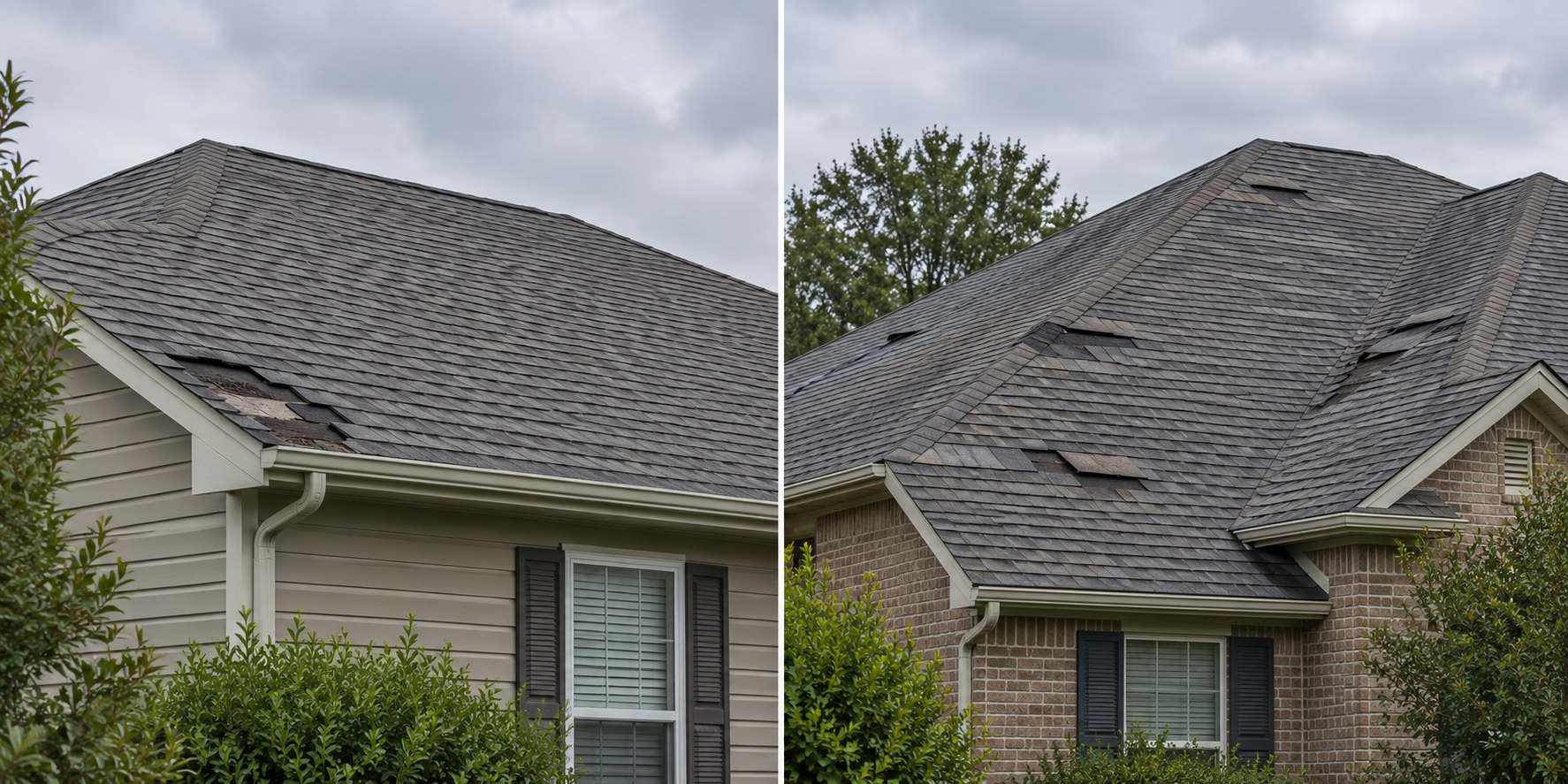
Visible outcomes include missing, lifted, creased, or displaced covering; damaged ridge or edge components; loosened flashing; displaced tile or metal; branch impact; and openings that admit wind-driven rain. Concealed attachment and deck condition cannot be inferred from a yard-level shingle count.
IBHS notes that asphalt shingle sealant is temperature-activated and can weaken with weathering. Tile and metal assemblies have different mechanical attachment behavior. The complete installed system controls.
Immediate response versus permanent work
Temporary protection may limit further water entry after a storm. Its contract should identify area, method, duration expectations, removal, and whether permanent repair is included. Do not climb onto an active-storm, wet, steep, or unstable roof.
A temporary patch is valuable when it protects the building; it becomes expensive when repeatedly renewed because diagnosis or permanent work never follows.
Repair or replace
Repair is strongest for localized damage with sound workable neighbors and compatible material. Partial replacement may fit one slope or a separated area. Replacement becomes stronger with distributed lifted or missing components, broad edge failure, unmatchable material, repeated water entry, or widespread substrate damage.
No universal wind speed or damage percentage decides the intervention. Weather reports can establish event context, not the roof’s exact physical condition.
Stronger reroof scope
FEMA P-804’s 2023 Basic package for eligible one- and two-family dwellings in hurricane-prone US regions treats a reroof as coordinated work: check or improve deck attachment, seal the deck, improve eave underlayment details, install a wind-rated covering, and improve attic-vent water resistance. Many prescriptive measures are limited to basic wind speed of 130 mph or less and Exposure Category C; check each measure’s limit, and use a registered design professional where conditions exceed it. This is not a generic reroof specification, price, or Canadian requirement.
Ask whether a proposal follows a named program, local code, engineered design, manufacturer requirement, or general contractor recommendation. One upgraded shingle does not create a complete wind-resistant assembly.
Cost drivers
- number and distribution of affected planes;
- roof edge, ridge, flashing, and deck involvement;
- temporary protection and emergency timing;
- height, access, debris, and unsafe conditions;
- matching and brittleness;
- deck/cover attachment investigation;
- local wind design, product, evaluator, and inspection requirements;
- interior drying or restoration outside roofing scope.
Scenarios
Few missing shingles, no water entry: Focused repair plus broader condition check.
Edge and one slope damaged: Partial replacement may allow coherent edge and field reconstruction; compare with complete reroof if remaining system is mature.
Broad hurricane-region loss: Physical replacement, mitigation package, insurer scope, temporary protection, and interior restoration may need coordinated but separately defined contracts.
Visible covering intact, interior leak: Diagnose wind-driven rain paths at walls, edges, and penetrations before assuming the whole roof failed.
Quote checklist
Require mapped damage, temporary versus permanent scope, covering and edges, flashings, deck allowance, matching, water-entry findings, upgrade basis, local/product compliance, and insurance exclusions. The most economical repair restores a coherent wind-and-water assembly, not merely the components visible from the street.
Event documentation and inspection limits
Record date, wind direction if known, interior water, fallen objects, and ground-visible conditions. A drone or edge inspection can document covering without unsafe traversal, but concealed deck attachment and water migration may remain unknown. Do not let photographs of intact surfaces become a guarantee that no hidden entry occurred.
Matching and repairability
Wind often affects edges, ridges, and scattered field components. If matching stock exists and surrounding material remains workable, repair can preserve strong value. If shingles or units break when lifted, a larger bounded slope may be the smallest coherent intervention.
Temporary versus capital budget
Price emergency response, permanent repair, roof replacement, mitigation upgrade, and interior restoration separately. This prevents a storm contractor’s all-in number from hiding which spending protects now and which renews the asset.
Insurance boundary
Coverage, deductible, depreciation, matching, code-upgrade allowances, emergency duty, and deadlines depend on policy and jurisdiction. Obtain written policy guidance. The physical scope should be defensible even if coverage differs.
State programs and insurance verification
Wind-resilience incentives and insurance documentation are state-specific. Alabama’s Department of Insurance describes its Strengthen Alabama Homes program as funding- and qualification-dependent; check the current program portal for open applications and eligibility rather than relying on an older grant amount. A state/University of Alabama study of insured coastal homes after Hurricane Sally reported lower losses for FORTIFIED-designated groups, but it is observational evidence from one storm and geography, not a promised premium reduction or project payback.
Florida offers a separate verification path: its Office of Insurance Regulation says the OIR-B1-1802 mitigation inspection form became effective April 1, 2026, is completed by an authorized inspector, and can remain valid for up to five years if the structure has no material changes and the form remains accurate. The regulator says related insurer discount forms are still being evaluated. Confirm current forms, eligibility, and any policy credit with the insurer or agent; neither state’s process applies automatically elsewhere.
Alternatives during replacement
Exact product selection, edge details, deck attachment, sealed-deck measures, and flashing can be evaluated as a coordinated system. In regions outside FEMA guide applicability, local code, manufacturer documents, and design professionals control. Do not buy a single “hurricane shingle” as a substitute for complete assessment.
Contractor comparison
Ask for local wind-project experience, product and attachment basis, evaluator/inspection need, temporary dry-in, debris handling, solar/gutter coordination, and change-order process. A high-wind upgrade that cannot be documented may have little program or insurance value even if the materials are physically useful.
Normalize the storm scopes
Map missing, lifted, creased, displaced, punctured, or impact-damaged areas and note edges, ridges, soffits, flashings, gutters, and rooftop equipment. Separate emergency dry-in, diagnostic access, permanent roof repair, broader replacement, interior restoration, and elective resilience upgrades. Compare totals only after those categories align.
For repair, identify visible damaged units, removal needed for integration, matching, surrounding workability, starter/ridge/edge components, underlayment and deck assumptions, and what happens if concealed uplift or water entry extends farther. For replacement, keep the same material and deck assumptions before pricing upgrades.
A policy estimate is not automatically a construction specification. Coverage and payment questions remain separate from the contractor’s explanation of what is damaged and how the proposed work restores the assembly.
Low, typical, and complex wind cases
A low-complexity case is a bounded group of displaced or missing components on a serviceable accessible roof, with matching stock and no broader edge or substrate concern. Permanent repair can follow stabilization promptly.
A typical case includes several areas or one slope, damaged ridge/edge pieces, water entry, matching uncertainty, and a need to open enough material to confirm attachment and deck condition. Repair, slope work, and replacement may all deserve priced options.
A complex case involves widespread covering displacement, damaged deck or framing, fallen debris, solar or equipment, difficult access, interior damage, and extended temporary protection. Structural, electrical, tree, and restoration trades should remain separately accountable while one plan coordinates weather protection.
Decide repair, section work, or replacement
Favor repair when wind effects and the failed mechanism are local and surrounding materials can accept a reliable integration. Consider section work where one plane or edge zone contains the damage and natural boundaries support a durable transition. Compare replacement when failures are distributed, attachment or substrate problems repeat, or retained material breaks during careful access.
Do not base the choice on age or a universal percentage. A recently installed roof can have a systemic attachment defect; an older roof can have a repairable tree or edge event. Ask what observation connects the proposed scope to the wind mechanism and what remains at risk afterward.
Upgrade without mixing budgets
If replacement is chosen, price the base suitable restoration first. Then isolate deck attachment, sealed-deck or underlayment measures, edges, covering product and attachment, flashings, openings, and other hazard-package elements supported by local design, code, manufacturer documents, or a named program. A single premium shingle does not represent the whole load path.
Evaluate the installed premium against ownership horizon, verified insurance treatment, exposure, repair availability, and risk tolerance. Do not promise that an upgrade prevents damage or pays back. It may still be a rational resilience purchase when its scope is documented.
Temporary-work economics
Emergency work buys time and limits additional water entry; it should state its area, material, attachment, inspection need, monitoring, and path to permanent removal. Repeated temporary visits can exceed a planned repair while continuing interior risk. Conversely, an emergency is a poor time to accept an undefined whole-roof decision solely to avoid one temporary invoice.
Stabilize safely, document before discarded materials disappear, obtain the evidence needed for scope, and set a date or trigger for permanent work. That sequence balances mitigation with purchasing control.
Read wind-repair quote language
“Replace missing shingles” should state what happens to lifted, creased, unsealed, or surrounding material and whether edges/ridges are inspected. “Repair to match” should identify product availability and acceptable visual outcome. “Upgrade to high-wind shingles” should identify exact product and complete installation conditions rather than relying on a label.
For change orders, define deck quantity, underlayment and attachment findings, repair-area expansion, and interior work. A contractor who cannot see concealed uplift should state the uncertainty; a blanket worst-case replacement should still be connected to observed distribution.
Ownership-horizon examples
A short-horizon owner with a serviceable roof and one bounded wind event may choose a documented repair, retain matching stock, and monitor after subsequent storms. A long-horizon owner facing repeated edge damage may compare a coordinated edge/covering/attachment scope during replacement. Neither should assume resale or insurance recovers an elective premium.
If solar, gutters, siding, or trees were involved, correct their damage under named scopes and coordinate weather protection. The roof repair should not absorb every storm consequence into an unreviewable total.
Closeout and future evidence
Keep pre-repair damage maps, temporary-work records, product identity, fastening or edge details where documented, deck repairs, final photographs, and warranty contacts. After another wind event, compare the same elevations. A pattern of new failures may change the next repair-versus-replacement decision; one successful bounded repair should not be assumed to prove or disprove the entire system.
Compare the cost of waiting
Once the building is safely stabilized, delay can buy time for diagnosis, material matching, competing scopes, policy review, and coordinated solar or tree work. It can also expose temporary materials, interiors, and loose surrounding components to another event. Ask how long the temporary scope is intended to serve, what monitoring it needs, and what permanent-decision date is realistic.
Emergency replacement can carry constrained product choice, scheduling, and purchasing leverage. Repeated temporary calls can cost more and preserve risk. The economical middle is a defined stabilization interval followed by the smallest permanent scope supported by distribution and workability evidence.
Example: edge loss versus distributed uplift
A bounded eave/rake loss may support local edge and covering repair if the deck and surrounding field are sound. Similar-looking missing units accompanied by lifted areas across slopes, repeated fastening problems, or substrate damage can justify a broader section or replacement. Price both using the same material and accessory assumptions.
If an upgrade is considered, show which edge, deck, underlayment, covering, opening, or flashing measure changes and why it applies locally. This lets the owner purchase resilience without allowing a generic storm package to obscure the base repair.
Final storm-cost worksheet
Separate temporary protection, diagnostic opening, permanent local repair, section/full replacement, non-roof trades, interior restoration, and resilience alternates. For each, identify observed distribution, matching/workability, concealed allowance, timing, warranty, and retained condition. Compare physical scopes independently of expected claim payment. The worksheet exposes whether replacement follows system evidence or simply bundles every storm cost into one total.