
For a 2,000-square-foot asphalt-shingle roof, one 2026 US specialist estimate places a broad replacement range around $6,900–$24,000, with an average near $15,400. That is useful only when the assumptions are visible: roof area, asphalt material, complexity, location, labor, and included scope. Premium materials, difficult geometry, extensive deck replacement, solar removal, or hazard upgrades can move far beyond it.
Canadian homeowners need independently quoted CAD pricing. US figures should not be exchange-rate converted into a Canadian “average.”
Two Canadian reference points, with different bases
CMHC’s 2025 materials guide gives an illustrative material-only comparison for a 140 m² roof: about CAD $10,500 for asphalt shingles and CAD $16,800 for a prefinished 38 mm standing-seam metal roof. Its 60-year illustration totals about $31,500 and $33,600 respectively. Those figures exclude installation and other roof layers, and the guide uses a 40-year metal-life narrative while its table lists 60 years; treat the lifecycle result as that source’s illustration, not a forecast.
QuoteSaver’s September 2026 modeled scenario estimates CAD $13,134–$17,410 before tax for a 2,000 sq ft, two-storey architectural-asphalt roof. Its stated baseline includes one-layer tear-off and disposal, synthetic underlayment, eaves ice/water membrane, flashing, ridge ventilation, and labor. It is a derived estimating-service scenario, not a representative accepted-bid survey. Keep this installed-work scenario separate from CMHC’s material-only comparison and obtain local quotes for the actual roof.
Start with roof area, not house area
Roof surface area includes pitch and overhangs and can exceed the home’s floor area. A one-story 2,000-square-foot home may have more roof than a compact two-story home with the same living area. Waste also rises with hips, valleys, dormers, and short cut-up planes.
Ask each bidder for measured roof area and waste assumptions. If two quotes disagree materially, resolve the measurement before comparing price per square foot.
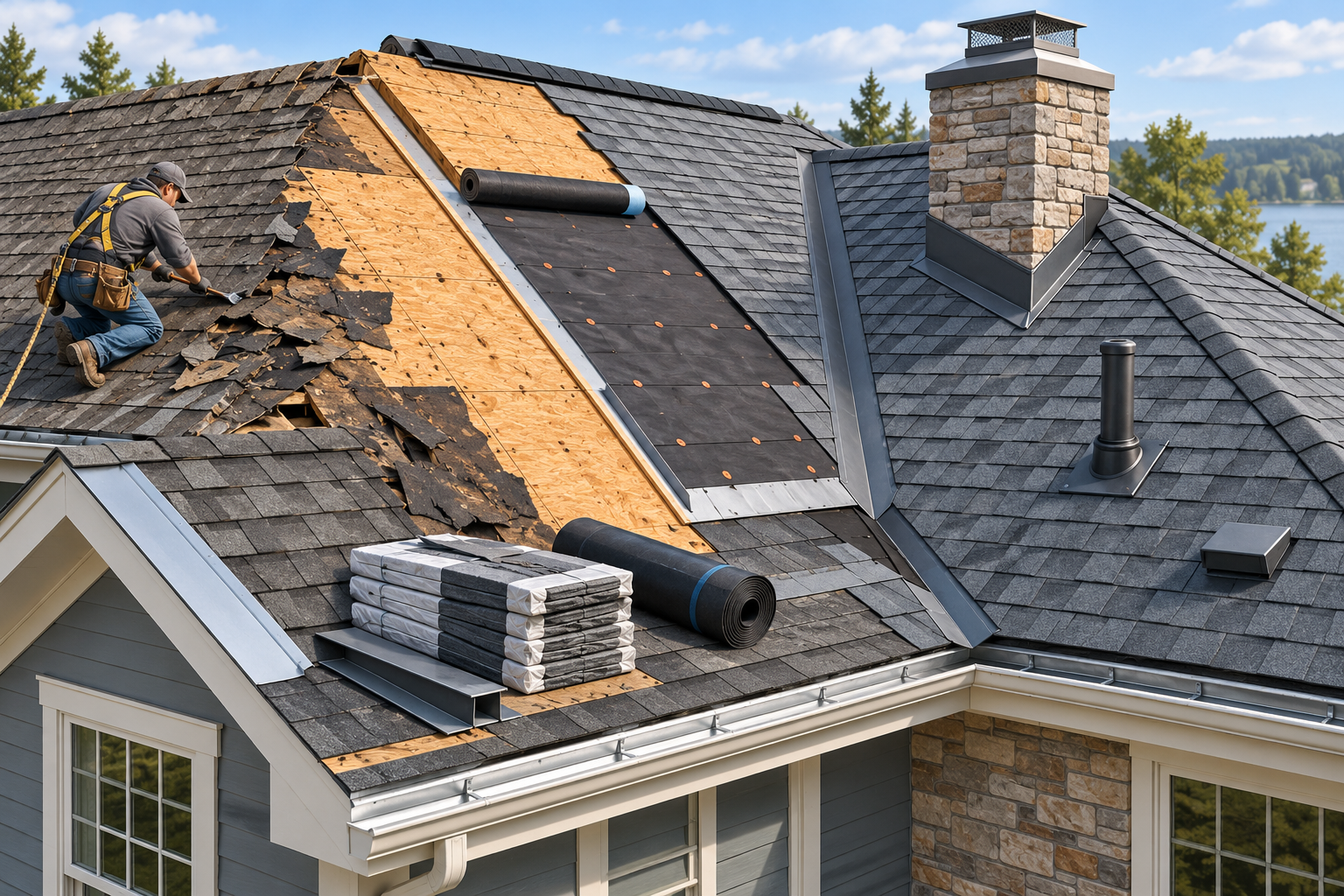
What a complete base scope should address
A reroof proposal should make these components explicit:
- protection, access, and setup;
- removal or approved retention of existing covering;
- disposal and cleanup;
- deck inspection and unit pricing for replacement;
- underlayment and any self-adhered membrane;
- starter, field, ridge, hip, edge, and termination components;
- flashings at walls, valleys, chimneys, skylights, and penetrations;
- pipe boots and roof vents;
- ventilation changes, if any;
- gutters or solar equipment affected by access;
- permits, inspections, and warranty documentation where applicable.
A lower quote may simply omit more. Compare the assembly, not just the covering brand.
Major cost drivers
| Driver | Why it changes cost |
|---|---|
| Material system | Product price, weight, substrate, detailing, labor specialization, waste |
| Pitch and height | Access, staging, production rate, fall protection, material handling |
| Geometry | Valleys, hips, dormers, walls, penetrations, and cuts increase detail labor |
| Tear-off | Labor, containers, disposal, number and type of layers |
| Deck condition | Concealed sheathing quantities become known after opening |
| Flashing and edges | Custom or adjacent-trade work can dominate small areas |
| Labor market and season | Crew availability, travel, weather windows, local overhead |
| Local requirements | Permit, inspection, wind, ice-barrier, fire, drainage, or product rules |
Material changes more than material cost
Asphalt shingles are the common US reference case. Metal, tile, slate, wood, synthetic/composite products, and low-slope membranes have different preparation, fastening, flashing, access, and specialist requirements. A published material-only square-foot comparison does not predict installed scope.
For example, switching to heavy tile may require structural assessment. Standing-seam metal involves custom trim and panel detailing. Slate may call for specialist labor and staging. A low-slope system may include insulation, cover board, drains, parapets, and moisture investigation.
Hidden-condition contingency
Decking is the classic unknown. Build an allowance or agreed unit price into the contract, with photographs and an approval threshold. Other discoveries can include inadequate flashing, wet insulation, deteriorated fascia, structural framing, or obsolete penetrations.
Use scenario budgeting:
- Simple: one accessible roof, one tear-off layer, ordinary asphalt system, minimal deck work.
- Typical: moderate geometry, new flashings and boots, some deck allowance, normal disposal.
- Complex: steep or high access, many interfaces, specialty material, broad substrate work, solar or adjacent-trade coordination.
The scenario is more useful than one falsely precise national average.
Hazard and climate upgrades
High-wind work can include roof-cover attachment, deck attachment, sealed-deck measures, and roof-edge improvements. FEMA guidance applies within stated US hurricane-region conditions and may require an evaluator or design professional; it is not a universal package or price. Local rules also change scope. For example, unincorporated Jefferson Parish lists a $50 permit fee when at least 50% of a qualifying home’s covering is replaced, requires installation-stage photos and a final inspection, and applies a contractor-license threshold to work over $7,500 from 2026. Newport Beach’s January 2026 guidance adds listed Class A covering, ember-resistant vents, and screened noncombustible gutters for homes in mapped high or very-high fire hazard zones. These are jurisdiction-specific examples, not national rules or roofing prices; confirm current requirements with the authority for the actual property. Ice-barrier coverage and drainage requirements also depend on location and system.
Ask which measures are required, elective, or part of a named program. Verify incentive and insurance claims separately.
Read the quote economically
Separate fixed base price, allowances, unit prices, options, and exclusions. A useful comparison normalizes:
- measured area and material system;
- tear-off layers and disposal;
- underlayment and flashing scope;
- included deck quantity and additional unit price;
- ventilation, gutters, solar, and adjacent work;
- permit and warranty responsibility;
- payment schedule and change-order control.
Do not assume a long material warranty equals roof service life. Installation, assembly, weather, maintenance, exclusions, and workmanship terms all matter.
When the normal range breaks
Complex tile or slate, custom metal, inaccessible urban roofs, remote logistics, large low-slope assemblies, broad structural work, hazardous-material controls, or emergency conditions can exceed ordinary published ranges. Conversely, a small simple roof in a competitive market may fall below them.
The best budget is a defined base scope plus a realistic contingency—not a national average multiplied by house square footage.
Low, typical, and high example budgets
For a US asphalt project, the cited $6,900–$24,000 band can be read as scenario space rather than a promise. A low case is a small/simple accessible roof with ordinary material and sound decking. A middle case includes moderate geometry, tear-off, flashings, and some deck work. A high case includes larger area, difficult access, premium product, multiple interfaces, and meaningful concealed work. Specialty materials can exceed the band entirely.
Do not compare your quote with the average until you identify which scenario assumptions match. A $20,000 scope can be competitive on one roof and excessive on another.
Common optional and adjacent costs
Solar removal/reinstall, chimney masonry, skylight-unit replacement, fascia/soffit, attic insulation/air sealing, structural framing, hazardous-material controls, interior water restoration, and site drainage are not automatically part of reroofing. Coordinate them where the roof must be opened, but preserve separate ownership and prices.
New gutters may be convenient during reroofing without being necessary. Ventilation changes may be useful without solving a whole-attic moisture problem. Ask which work is required for the roof system and which is elective.
Payment and change-order risk
Milestones should correspond to materials, mobilization, progress, and completion under local contracting norms. Avoid paying a large undefined concealed-condition budget upfront. Decking and other discoveries should use agreed unit prices, photographs, quantities, and authorization thresholds.
Weather delay, temporary dry-in, material substitution, container overage, and permit correction should have a process. Contract clarity cannot remove uncertainty, but it assigns control.
Cost-saving choices that preserve value
Simplify product tier rather than omit flashing or substrate work. Schedule outside emergency conditions when climate permits. Retain serviceable accessories only after explicit inspection. Coordinate solar or skylight work once. Use natural roof boundaries for phasing. Obtain comparable local bids and resolve measurement differences.
Savings that reduce the water-control assembly or conceal deck condition may create a lower bid but not lower ownership cost.
Normalize bids into one replacement scope
Build a comparison sheet for measured roof area, waste, removal layers, disposal, deck allowance and unit price, underlayment and vulnerable-area membrane, field covering, starter/edge/ridge components, valleys, wall/chimney/skylight/pipe flashings, ventilation, drainage interfaces, access, protection, permits where applicable, cleanup, warranty, and tax. Record exact products and quantities.
Resolve measurement differences before comparing totals. A bidder may include a garage, porch, low-slope section, or more waste for complex geometry that another omitted. If proposals cover different systems or boundaries, calculate the price difference only after those omissions are reconciled.
For uncertain deck or concealed work, give every bidder the same assumed allowance and unit-price request. A low base price paired with broad undefined extras transfers price risk instead of reducing it.
How drivers interact
Height, steepness, restricted staging, and fragile landscaping do not merely add one access charge; they slow tear-off, material movement, deck repair, flashing, and cleanup. Complex geometry raises waste and multiplies labor-intensive transitions. Specialty material can increase both product cost and the care required at each detail. Solar can add a separate crew and a schedule dependency.
This interaction explains why two roofs with similar measured area can occupy different budget cases. Ask contractors to name the two or three conditions driving their price, then test whether those conditions are visible in labor, material, and contingency lines.
Repair, phase, or replace now
A whole replacement is economically strongest when failures or necessary openings are distributed, retained material is no longer workable, or several planned projects can share one mobilization. Repair remains strong when the mechanism is bounded and the surrounding system can provide a credible holding period. Partial work can preserve capital when natural roof boundaries create durable transitions.
Compare each option’s residual condition and next likely intervention. Do not use a universal repair-to-replacement percentage. Include repeat mobilization, duplicated flashing or solar work, financing, disruption, and the value of planning outside an emergency. A repair that buys well-documented time can be valuable; a replacement that removes a system-wide risk can be valuable. Neither conclusion follows from age alone.
Final budget check
Maintain a base, expected, and difficult total. The base is the defined visible scope. The expected total adds evidence-based allowances for deck and interfaces. The difficult total applies agreed quantities for plausible concealed conditions and coordination costs. Keep elective upgrades separate so the contingency is not mistaken for a premium product choice.
Before signing, confirm the fallback if material changes, hidden damage exceeds the threshold, or weather delays dry-in. The best budget is not the narrowest number; it is the scope and control process that remain intelligible when the roof is open.
Final ownership test
For a short horizon, select a complete suitable assembly and documentation without assuming premium material returns its price at sale. For a long horizon, weigh repair stock, service availability, solar/equipment plans, maintenance access, financing, and future replacement disruption. Re-run the base, expected, and difficult totals under that horizon; an option that works only under an optimistic service forecast needs stronger evidence.
The replacement decision is resolved when the scope, uncertainty, retained components, alternatives, and ownership logic are explicit. A national average cannot substitute for that property budget.
Uncertainty boundary
National or broad market observations cannot replace current local bids, and concealed work prevents a perfectly fixed total. Normalize the visible assembly and manage deck/interface uncertainty with shared units and thresholds. A range built this way is more decision-useful than a precise figure attached to an undefined roof.