
Hail-related roof cost can range from an inspection and a focused hundreds-to-thousands repair to complete replacement priced like any other reroof, with extra documentation and coordination. The number of dents or marks does not by itself establish repair scope, functional damage, insurance coverage, or the value of replacement.
Start with material-specific assessment
Asphalt shingles can show granule disturbance, fractures, or other impact effects. Metal may dent without losing water-shedding function—or may suffer damaged seams, coatings, or details. Tile and slate can crack or break. Wood and synthetic products respond according to exact material and condition.
IBHS research emphasizes that hail damage depends on impact conditions and product performance. A roof cannot be called storm-resistant from material name alone.
Inspection should map damage by slope and component, distinguish pre-existing weathering where possible, and document flashings, vents, edges, and drainage. Walking a storm-damaged or fragile roof can create additional damage and requires professional safety controls.
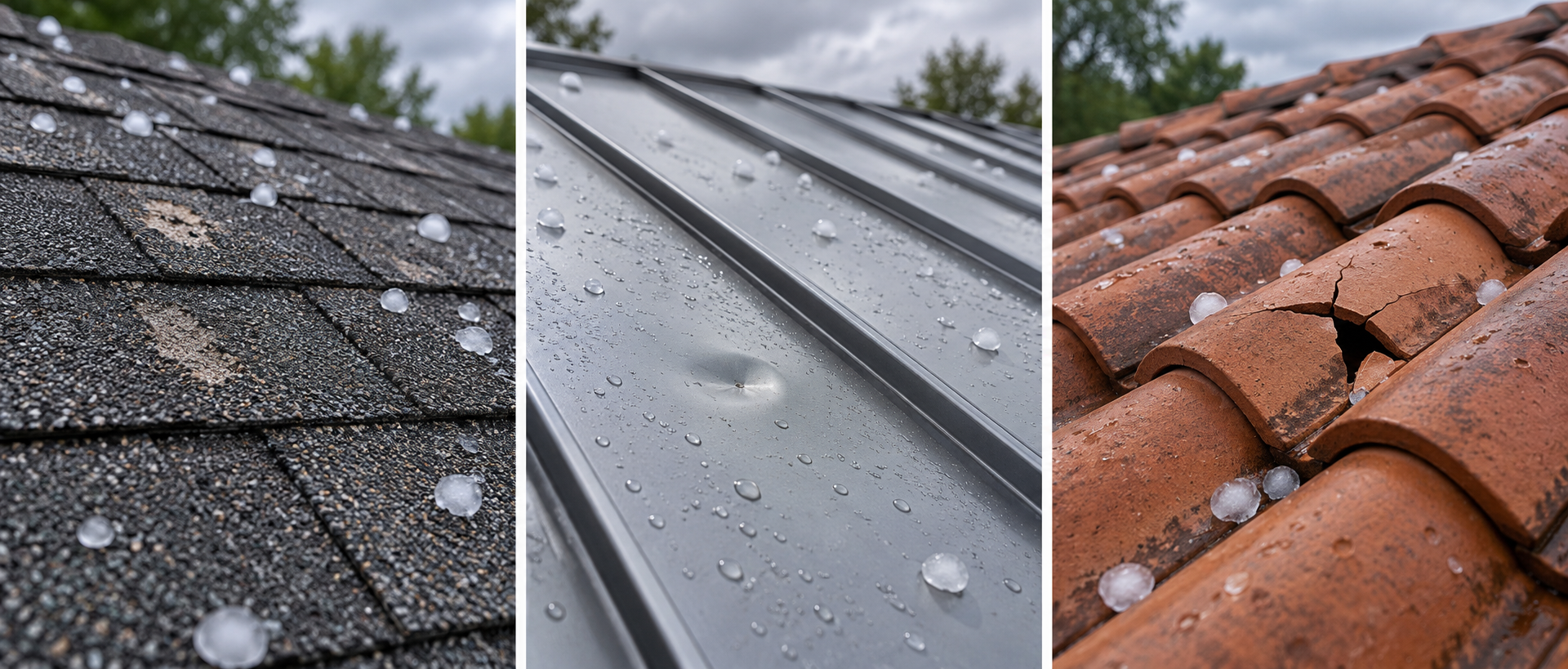
Repair versus replacement
Localized repair is strongest when damage is bounded, surrounding material is workable, matching stock exists, and the deck remains sound. Partial slope replacement may make sense when one exposure received concentrated damage and geometry creates a clean boundary.
Full replacement becomes stronger when functional damage is distributed, materials cannot be integrated, brittle surrounding covering expands every repair, or many penetrations and edges are affected. There is no universal mark count or percentage that applies to every product, storm, policy, or jurisdiction.
Cosmetic and functional uncertainty
A dent can be cosmetic on one assembly and material on another. Insurance policies may treat cosmetic damage differently and may impose endorsements, matching terms, deductibles, depreciation, deadlines, or documentation requirements. Read the actual policy and obtain claim guidance from appropriate licensed or authorized parties; a roofer cannot guarantee coverage.
Keep the physical scope and coverage decision separate. A covered amount does not prove replacement is technically required, and a denied claim does not prove the roof is sound.
Impact-resistant upgrade economics
If replacement is warranted, compare exact impact-rated products and complete assemblies. The incremental cost may include more expensive covering, accessories, labor, and local availability. Verify recognized product classification and installation requirements.
An impact rating reduces risk under defined testing; it does not make a roof hail-proof. Confirm any insurance credit in writing before using it in payback. Availability of matching replacement pieces after future storms also matters.
Canadian climate context does not establish an individual home’s hail risk. Canada’s 2026 assessment says evidence is insufficient to assess a national historical trend in severe hail of at least 2 cm. Reported regional trends in hail of any size differ between Alberta and Saskatchewan/Manitoba and have very low confidence; one projection for parts of western Canada also has very low confidence. These findings do not determine local exposure, product performance, damage, or insurance eligibility. Use product-specific impact evidence for material decisions and the actual property and policy for risk and coverage questions.
Three scenarios
Isolated breakage: Several tile or shingle units are damaged, field and lower layers are sound. Focused repair preserves useful roof life.
One-slope event: Damage is concentrated on the storm-facing slope. Compare partial replacement with full replacement based on transitions, matching, and other slopes’ condition.
Broad mature-roof damage: Hail effects, prior weathering, and brittle material overlap. A complete reroof may be economically coherent, but scope should not be justified by age alone.
Cost beyond the roof
Solar removal, gutters, screens, skylights, siding, interior water restoration, and temporary protection may be separate. Do not let a roof article or bid absorb broader insured-loss work without clear line items.
Quote and claim checklist
Document date/event, inspection method, mapped findings, repairability, matching, deck uncertainty, proposed material, impact classification, upgrade premium, roof-system details, and exclusions. Obtain multiple scopes when there is disagreement.
The sound decision buys the physical intervention the roof needs, then evaluates insurance and upgrade value using policy- and product-specific evidence.
Inspection timing and contractor incentives
Prompt documentation can preserve event evidence, but avoid unsafe access immediately after a storm. Contractors who sell full replacement may have different incentives from inspection-only providers. When repairability or functional damage is disputed, seek another qualified assessment rather than relying on door-to-door urgency.
Compare scopes, not claim totals
One proposal may replace damaged units, another one slope, and another the whole roof. Normalize mapped area, matching, flashings, vents, gutters, underlayment, deck allowance, and upgrade. The amount an insurer estimates and the amount a contractor bids may use different assumptions; resolve physical quantities and policy treatment separately.
Material-specific repair economics
Metal dents may create an appearance decision or require panel/detail work. Tile and slate breakage can be localized but replacement matching and access are specialized. Asphalt damage can be distributed across a slope and surrounding shingles may be brittle. Synthetic products depend on exact rating and stock. Do not apply one storm threshold across them.
Impact-upgrade alternatives
An exact rated product upgrade can be considered alongside deck sealing, edge, flashing, and other hazard measures where relevant. Replacing only the field covering may miss more consequential water paths. Named programs and local rules should guide packages; an insurance discount alone is weak design evidence.
Fraud and documentation risk
Do not permit intentional damage or accept a promise that a contractor will “cover” a deductible contrary to applicable law or policy. Contract and insurance rules are jurisdiction-specific. Preserve photographs, samples only where appropriately handled, invoices, product identity, and communications.
Long-term cost
Model upgrade premium, expected ownership, verified insurance difference, product availability, and the fact that rated roofing can still be damaged. The upgrade may be worthwhile as risk reduction without a short payback; state that rationale honestly.
Build the construction decision independently
Map observed conditions by slope, material, accessory, and interface. Distinguish confirmed damage, suspected damage requiring closer evaluation, prior wear, and cosmetic change. Then request a local repair, slope/section option, and full replacement only where each is technically plausible. The insurer’s estimate and contractor’s proposal can inform one another, but neither should substitute for a physical scope.
Normalize quantities, access, matching, surrounding-material workability, deck and flashing assumptions, gutters or metals, solar, temporary protection, and interior work. A repair quote for a few broken tiles and a replacement quote including drainage damage do not establish a repair-versus-replacement ratio.
If inspection methods or interpretations differ, ask what additional observation would resolve the dispute. Destructive testing should have a bounded opening and restoration plan. Avoid allowing repeated inspections to become damage themselves, especially on fragile material.
Low, typical, and complex storm cases
A low-complexity case has isolated repairable damage, available matching material, workable surroundings, and no indication of distributed loss of function. Mobilization may dominate, but local repair can preserve the roof.
A typical case has damage across one or more slopes, accessory or metal impacts, matching questions, and a need to distinguish appearance from water-control function. Partial or full replacement alternatives should state what retained areas and age differences remain.
A complex case combines several materials, solar, brittle or discontinued products, deck or interior damage, broad disputed observations, and code or policy questions. Stabilization, documentation, specialist scopes, and claim administration may proceed on different timelines.
Repair-versus-replace thresholds
Repair is strongest when the damage mechanism and quantity are bounded and retained material can be integrated without causing additional failure. Section work becomes relevant when damage clusters on a natural roof plane or matching and workability require a broader boundary. Replacement becomes credible when functional damage is distributed or the number of necessary openings leaves an incoherent system.
Do not use a universal storm mark count, roof age, or cost percentage as the decision. Material behavior and exact conditions control. Also separate technical feasibility from policy treatment: a repair can be technically sound even if appearance is disputed, and a covered scope can still contain construction choices the owner must understand.
Upgrade and ownership economics
Compare the exact installed premium for an impact-rated or other resilience option while holding deck, underlayment, flashings, accessories, and labor constant. Confirm classification, assembly conditions, accessory coverage, and actual local insurance treatment. Do not fund a field-product upgrade by omitting more consequential water-control details.
For short ownership, treat appearance and possible buyer preference honestly without guaranteeing recovery. For long ownership in repeated exposure, verified product features, repair availability, deductible structure, and retained documentation may justify the premium as risk reduction. Model more than one future storm outcome because no roof is damage-proof.
Keep pre-event records, post-event photographs, contractor scopes, exact products, samples where appropriately managed, and invoices. Good documentation reduces the economic cost of proving what changed without encouraging unsupported certainty.
Read storm quote language
“Hail damage throughout” should be supported by mapped material-specific observations, not only a conclusion. “Replace per insurance scope” does not state whether the physical scope is complete. “Impact-resistant upgrade” needs exact product, classification, accessory and installation conditions, installed increment, and separate confirmation of any insurance treatment.
For repairs, ask how matching and adjacent-material breakage are handled. For metal or other appearance disputes, state whether the purchased outcome restores function, appearance, or both. For replacement, keep gutters, siding, windows, solar, and interior restoration separate unless explicitly included.
Timing and repeat-event economics
Stabilize openings promptly, but avoid selecting a product or whole-roof scope solely under emergency pressure. A temporary measure can preserve time for inspection, policy review, and comparable bids. Its cost is not wasted if it prevents additional damage and improves purchasing control.
In repeated hail exposure, compare verified upgrade cost, deductible and policy facts confirmed independently, local repair stock, and ownership horizon under several future-event cases. The upgrade may reduce certain damage without eliminating claims or repairs. A robust decision remains acceptable even if no new hail event occurs during ownership.
Closeout for the next event
Keep pre-covering deck/flashing photographs, exact covering and accessory records, leftover repair stock where practical, invoices, warranties, and an elevation map. This baseline makes later impact easier to distinguish from installation, wear, and prior conditions and can reduce unnecessary replacement after the next inspection.
Final decision threshold
Select local repair when material-specific functional damage is bounded and integration is reliable. Select a slope or section when natural boundaries and concentrated damage make that outcome coherent. Select replacement when functional damage or workability problems are distributed. Treat cosmetic outcome, policy payment, and resilience upgrades as explicit parallel choices. This keeps uncertainty visible without converting it into a universal hail threshold.
Final storm-cost worksheet
List emergency work, assessment, local repair, slope/section work, full replacement, non-roof damage, interior restoration, and elective upgrade as separate totals. Add matching, concealed work, solar/accessories, and ownership horizon to the applicable rows. Then compare the physical outcome even if insurance payment is unresolved. This prevents claim administration from hiding what construction the owner is actually buying.
Low, expected, and difficult totals
The low case is a bounded repair with matching material and straightforward access. The expected case includes one or more slopes, accessory/metal damage, controlled deck work, and appearance decisions. The difficult case includes fragile specialty material, solar, distributed functional damage, interior restoration, and several trades. Keep elective impact upgrades separate across all three.
Uncertainty boundary
Assessment cannot turn every mark into a certain future leak or every cosmetic change into no consequence. Use material-specific observations, repairability, distribution, and controlled openings where justified. Separate physical uncertainty from policy treatment and let each influence the appropriate decision without false precision.