
Professional ice-dam response can cost hundreds to low thousands of dollars, depending on roof length, height, access, ice thickness, snow, urgency, equipment, and damage. Roof covering, gutter, deck, insulation, and interior repairs are additional. Recurrent problems often require attic/envelope work, which can exceed the removal cost but addresses the heat path.
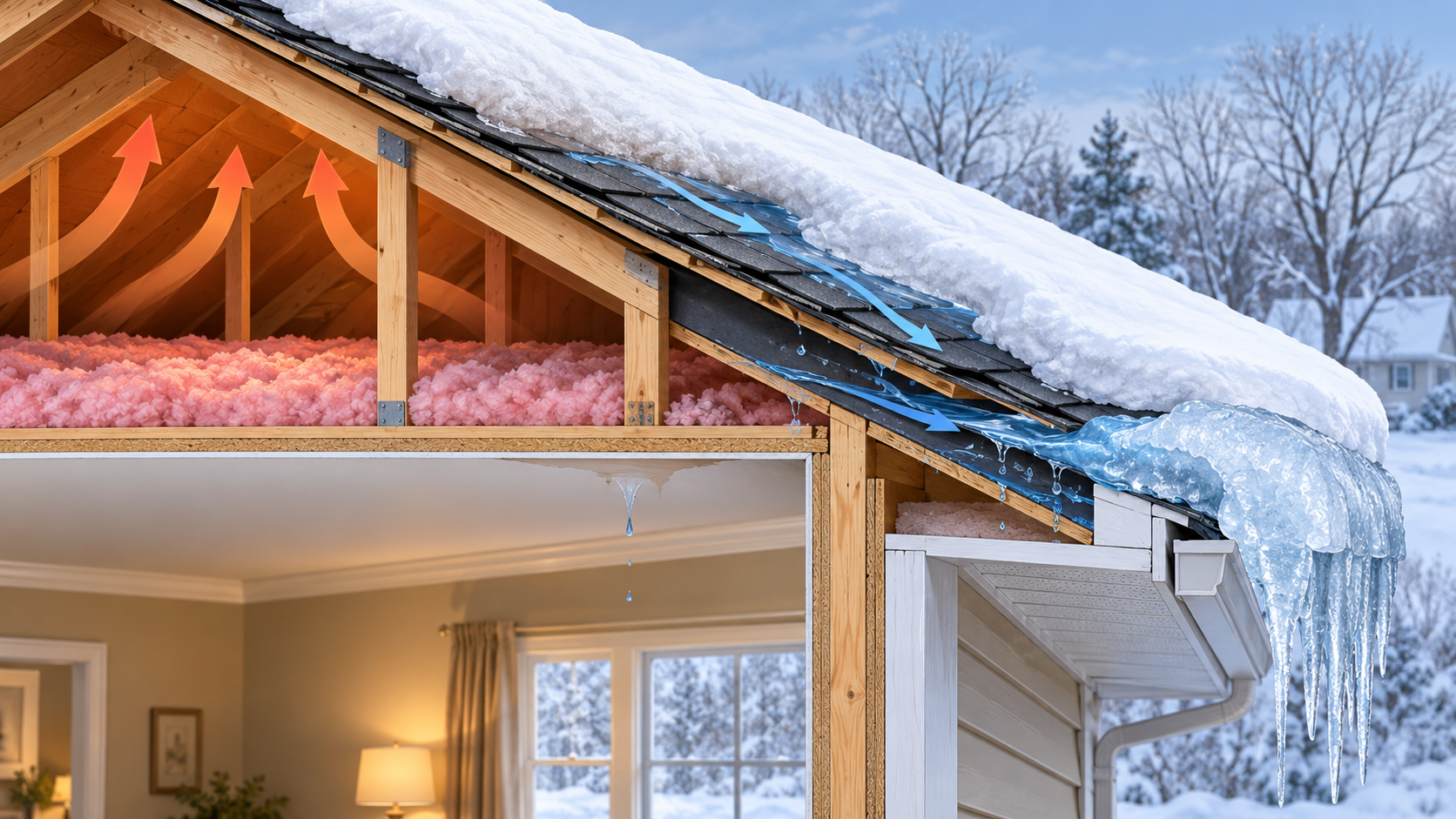
How an ice dam forms
Natural Resources Canada explains that heat can melt snow higher on a roof; meltwater reaches a colder overhang, refreezes, and forms a dam. Water can then back beneath shingles. Air leakage, insulation gaps, thermal bridges, valleys, dormers, and complex geometry can contribute.
The visible ridge of ice is a symptom. Gutters may collect ice, but they are not necessarily the root cause.
Immediate service scope
A professional may remove snow and ice in a controlled way, create drainage relief, protect vulnerable areas, and assess damage. Methods and equipment depend on roof material and conditions. NRCan warns that axes or ice picks can damage roofing; improvised roof access also creates fall and falling-ice hazards.
This article does not provide a DIY procedure. Active leakage, high roofs, heavy ice, electrical hazards, and uncertain structure justify professional response.
Repair costs after removal
Possible roofing work includes replacing damaged shingles, flashing, underlayment, or deck; repairing gutters and downspouts; and temporary dry-in. Wet insulation, ceiling finishes, and electrical or structural concerns are separate.
Do not assume every ice dam caused broad roof damage. Inspect after safe access is restored and price observed conditions.
Prevention has two layers
Consequence reduction: During reroofing, compatible self-adhered membrane at vulnerable locations can limit leakage if water backs up. It does not stop ice formation.
Source correction: Air sealing, insulation continuity, thermal-bridge work, and appropriate assembly ventilation can reduce uneven snowmelt. Whole-attic diagnosis belongs to building-envelope work, even though roofing must coordinate.
Heat cables may manage ice in limited configurations but are not universal source correction. Include electricity, maintenance, installation compatibility, and failure modes before treating them as the low-cost answer.
Recurring-cost scenarios
One unusual storm: Professional removal and inspection may be sufficient if no building defect is established.
Same eave every winter: Repeated removal fees indicate a predictable pattern. Compare several years of response with an attic/envelope investigation and targeted correction.
Leak despite membrane: Water may be entering elsewhere, coverage may be limited, or details may be damaged. More membrane is not automatically the answer.
Gutter damage: Repair drainage components after ice is gone, but still evaluate roof heat and water paths.
Quote checklist
Separate snow/ice removal, emergency water control, roofing repairs, gutter repairs, interior work, and source-correction assessment. Ask how roof material will be protected, what area is included, and what conditions could stop work.
The durable economic strategy pays for safe immediate control once, then determines whether recurring ice is a roof consequence, an attic heat-loss problem, or both.
Compare response methods by outcome
Professional proposals may use different equipment and removal extent. Ask how much roof edge is included, whether snow above the dam is addressed, how roofing and gutters are protected, where falling ice is controlled, and whether the service only opens temporary drainage. Do not choose based on hourly rate without crew, access, and expected scope.
Interior and envelope costs
Water may wet insulation, ceiling, wall, or electrical components. Investigation should follow observed exposure, not an automatic whole-room restoration package. Attic source correction can include air sealing and insulation continuity; complex roofs may require building-science assessment. Keep these costs separate from roof repair.
Reroof timing
If covering is already due for replacement, coordinate eave/valley membrane and damaged-material renewal. If the roof is sound, full replacement solely because an ice dam occurred may waste value. Source correction can reduce recurrence without discarding the covering.
Recurring-service economics
Add several winters of likely removal, emergency leak risk, heat-cable electricity/service where used, and roof/gutter repairs. Compare with a one-time diagnosis and targeted envelope correction. Use conservative scenarios because weather varies; do not promise a fixed payback.
Prevention claims to reject
Gutter removal, added ventilation, membrane, heat cables, or more insulation alone are not universal cures. Each can have a role under specific diagnosis. Ask what observed mechanism the proposal addresses and how success will be checked.
Records
Photograph ice patterns from the ground, record weather and leak locations, and keep attic/roof findings. Recurrence in the same area can help locate thermal bridges or drainage geometry more effectively than repeated emergency invoices.
Separate the emergency, repair, and prevention budgets
Emergency service controls immediate water or falling-ice risk. Roof repair restores damaged covering, flashing, deck, gutters, or interiors. Prevention addresses the heat-flow, airflow, insulation, roof-waterproofing, or drainage conditions supported by diagnosis. Put these in separate proposal sections so an urgent removal invoice is not presented as a permanent cure.
For removal, compare access, treated roof areas, method, protection of covering and gutters, snow/ice disposal, property protection, after-hours timing, and what happens if material is already damaged. For repair, require a mapped opening and concealed-damage process. For envelope work, identify the measured or observed source and the responsible trade.
Low, typical, and recurring scenarios
In a low-complexity event, unusual weather produces a bounded accumulation without interior leakage or repeated history. Safe observation, limited removal where justified, and later condition review may resolve the decision without a capital project.
In a typical event, eave ice and snow require controlled removal, a leak or gutter issue needs repair, and attic/envelope review identifies practical source work. The budget spans more than one trade but remains targeted.
In a recurring complex case, the same locations leak, access is difficult, roof geometry traps snow, interior finishes are repeatedly damaged, or several thermal and drainage conditions interact. Annual emergency service should be compared with a coordinated investigation, targeted envelope corrections, and roof-side measures during the next reroof.
Decide which work can wait for reroofing
Active leakage and unsafe conditions require timely response; they should not wait merely to combine costs. Some underlayment, eave, valley, flashing, or covering improvements are most economical when the roof is already open. Air sealing, insulation, exhaust correction, and other interior-access work may be independent of reroof timing.
Create a near-term stabilization plan and a capital coordination plan. State which temporary materials will be removed, which source work is expected to remain useful, and what observation would bring reroofing forward. This avoids both premature replacement after one weather event and endless temporary removal where a repeated mechanism is known.
Evaluate prevention without false precision
Compare several winters of plausible service, interior repair, and inconvenience with one-time diagnostic and corrective work, but allow mild and severe weather cases. A prevention project can be worthwhile as risk reduction even without a certain payback. It becomes a weak investment when the contractor cannot connect the proposed vent, cable, membrane, gutter, or insulation work to observed conditions.
After corrections, keep the same ground-level observation points and note weather severity. Improvement under comparable conditions is more useful evidence than a guarantee that ice will never form.
Read emergency and prevention quote lines
“Remove ice dam” should state treated locations, access, method, roof/gutter protection, disposal, and whether active leak stabilization is included. “Install heat cable” should state layout, controls, electrical work, inspection/maintenance, operating responsibility, and the diagnosed role. “Add ventilation/insulation” should identify the observed attic condition and boundaries of envelope work.
Avoid packages that combine removal, a roof patch, cables, vents, insulation, and full replacement without explaining which observed mechanism each line resolves. More interventions do not create a more certain cure when diagnosis is weak.
Example: same ice, different economics
A one-time accumulation after unusual weather on a sound roof may justify safe response and observation. Recurring ice at the same eave below known warm-air leakage can justify targeted envelope work and reroof-side membrane when timing aligns. Ice concentrated where a valley discharges may also require drainage/geometry analysis. The visible ice can look similar while the useful capital project differs.
When several causes coexist, phase them by consequence and evidence. Control active water, correct verified interior sources, coordinate concealed roof work with reroofing, then observe. This is more economical than demanding one product eliminate a weather-dependent phenomenon.
Compare capital alternatives
A service-only path funds condition-based removal, leak response, and repairs while preserving the existing building assembly. A source-correction path adds diagnosis and targeted air-sealing, insulation, duct, or other envelope work supported by observations. A roof-coordination path adds vulnerable-area underlayment and damaged eave/valley work during reroofing. A cable or other active system, where suitable, adds installation, electricity, inspection, and eventual service.
Use low, expected, and severe-winter cases. Do not assume every winter repeats the worst event or that corrective work eliminates all ice. Include interior restoration only where water damage occurred and avoid attributing unrelated moisture to the roof. The best alternative reduces either likelihood or consequence at a total the owner can support.
Ownership-horizon decisions
A short-horizon owner should control active leakage and correct verified high-consequence defects without assuming a full attic or roof project is recovered through sale. Documentation of the pattern and work remains valuable. A long-horizon owner can compare several cycles of emergency service and disruption with coordinated source work more directly.
If reroofing is far away, do not defer an evidence-supported interior source correction merely to combine it. If reroofing is imminent, avoid opening finished eave materials twice when safe stabilization can bridge a defined interval. Timing should follow the work layer, not a single “ice dam project” label.
Final decision threshold
The response is complete when immediate safety/water control, roof damage, source hypotheses, prevention options, timing, uncertainty, and observation are all addressed. One severe event does not automatically condemn the roof; repeated events with the same supported mechanism should not be treated as unrelated emergencies.
Final cost worksheet
Separate emergency removal, temporary water control, roof/gutter repair, interior restoration, diagnosis, envelope correction, active systems, reroof-side measures, and monitoring. State which observed mechanism each line addresses and which mild/severe weather assumptions affect it. The homeowner can then phase work by consequence without confusing a removal bill with prevention or a membrane option with source correction.
Low, expected, and difficult cost cases
The low case is one safe response with no confirmed damage and observation. The expected case includes removal, a bounded roof/gutter or interior repair, diagnosis, and targeted source work. The difficult case repeats under severe weather, requires complex access, and combines envelope, roof-side, and restoration scopes. Model several winters but do not assume the difficult case repeats every year.
Uncertainty boundary
Future winters and the effect of interacting corrections cannot be guaranteed. Use observation and mild/severe cases, but require every proposed measure to name its mechanism and maintenance. Uncertain payback does not make prevention valueless; it makes unsupported claims and one-product cures unacceptable.