
Repair is usually the better investment when one identifiable failure can be integrated into otherwise serviceable roofing. Replacement becomes stronger when defects are distributed, surrounding material is no longer workable, concealed layers are broadly compromised, or near-term projects will force you to pay for the same access twice.
There is no universal rule to replace at a certain age or damage percentage. Use age as one input, then test the economics of the actual scope.
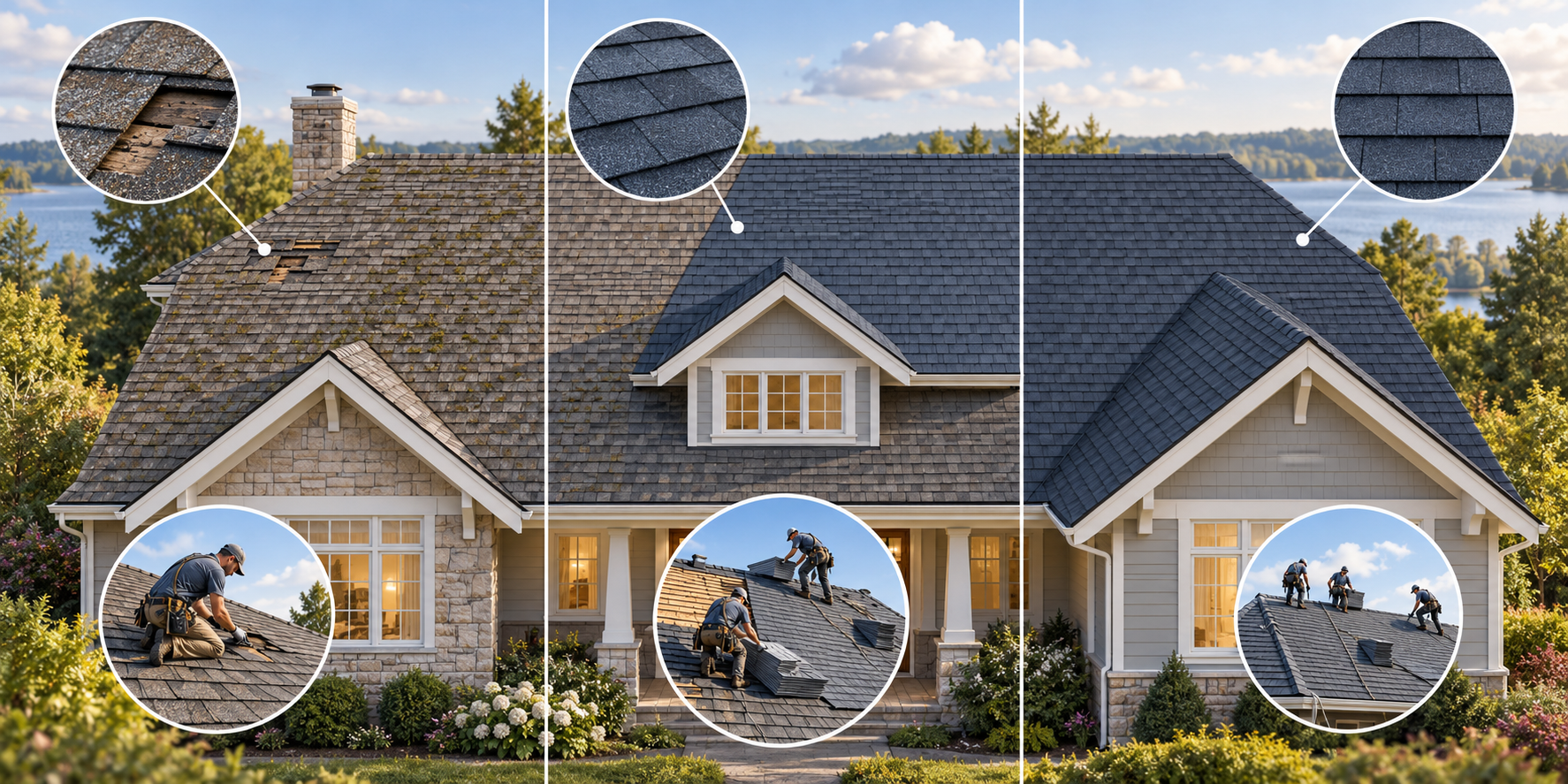
Compare three interventions, not two
Homeowners often receive a small repair quote and a complete replacement quote with nothing between them. A partial replacement—one slope, addition, porch, or other coherent section—may be viable when geometry creates a clean boundary.
| Option | Strongest case | Main economic risk |
|---|---|---|
| Localized repair | One defect, sound neighboring material, compatible replacement stock | Repeated mobilization if failures are distributed |
| Partial replacement | One separable area has different age or damage | Lost economies of scale and mismatched future replacement cycles |
| Full replacement | Broad deterioration, several leaks, unworkable materials, major assembly upgrade | High upfront cost and destruction of remaining useful material |
Conditions that favor repair
- The failure mechanism is identified rather than guessed.
- Damage is confined to one area or component.
- Surrounding shingles, tile, slate, wood, metal, or membrane can be opened and restored.
- Matching or compatible replacement material is available.
- Decking is sound or damage is limited.
- No major reroof-dependent project is imminent.
- Repair cost is small relative to the value of service life preserved.
A younger roof is more likely to meet these conditions, but age alone proves none of them.
Conditions that favor replacement
- Multiple slopes or interfaces are failing.
- Recurrent leaks have required separate repairs.
- Covering is brittle, delaminated, heavily weathered, or difficult to match.
- Opening a small area causes additional damage.
- Widespread wet decking or unsuitable substrate is likely.
- The roof system no longer works coherently even though individual patches are possible.
- Solar installation, major attic work, or another project makes near-term reroofing efficient.
- A hazard-resistance upgrade is best installed while the covering is removed.
Replacement can also make sense when a homeowner values predictable capital timing before a sale or long occupancy, but that is an ownership decision—not evidence that the roof has failed.
Calculate repeat-repair economics
Do not compare only today’s $800 repair with a $15,000 reroof. Compare the plausible sequence over your ownership horizon.
Suppose a localized repair is sound but other old interfaces are likely to need attention. Add expected service calls, repeated setup, interior risk, and the possibility that a later reroof removes today’s new work. Then compare that risk-adjusted path with replacement now. Do not automatically assume every possible future repair will occur; create low, likely, and high scenarios.
Likewise, a replacement does not eliminate all maintenance, storm risk, or workmanship problems. Its economic benefit is a renewed coherent assembly and fewer aging interfaces, not a guarantee of zero spending.
Matching and system coherence
Cosmetic mismatch alone rarely justifies discarding a sound roof. Technical mismatch is more important: dimensions, thickness, fastening, lap behavior, and product compatibility can determine whether a repair is durable. Specialty or discontinued systems may make salvage and contractor skill the deciding factors.
For tile and slate, surface units may outlast underlayment or flashing. For metal, system and fastener type matter. For low-slope membranes, trapped moisture and seam compatibility can matter more than visible age.
Hidden conditions and quote structure
A repair quote should identify the opening and concealed-condition allowance. A replacement quote should state roof area, tear-off, underlayment, flashings, penetrations, ventilation, deck pricing, disposal, and exclusions. Compare scopes before totals.
An unusually cheap reroof that excludes predictable flashing and deck work may not be cheaper than a comprehensive proposal. An expensive repair with no diagnostic basis may not preserve meaningful life.
Timing with solar and other work
Adding rooftop solar to a marginal roof can create future panel removal, storage, reinstallation, commissioning, and warranty coordination. DOE guidance supports assessing roof condition and coordinating replacement with solar where economical, but it does not establish a fixed “years remaining” cutoff.
Ice-dam recurrence may require attic air sealing or insulation work in addition to roofing. Chimney, skylight, structural, and site-drainage defects can also alter sequencing. Separate the roof investment from adjacent work while coordinating access.
Decision examples
Repair: A five-year-old roof loses a small cluster of shingles in wind. Matching stock exists, the deck is dry, and other slopes are sound.
Partial replacement: An older addition roof leaks and is separated by a clear wall transition, while the main roof remains serviceable.
Replace: Several valleys and penetrations leak, surrounding shingles crack during access, and previous repairs are distributed across the roof.
Investigate first: A ceiling stain appears below a skylight, but condensation, glazing failure, and roof flashing are all plausible. Neither repair nor replacement is ready to price.
A five-question decision test
- Is the cause known?
- Can the repair be integrated into sound material?
- How much useful life and coherent performance does the repair plausibly preserve?
- What repeat costs or near-term projects would make today’s work disposable?
- Which unknowns could change the decision after opening?
Choose the smallest scope that durably restores a coherent system. Sometimes that is a few shingles; sometimes it is one slope; sometimes replacement is the lower-risk long-term purchase.
Compare cash flow, not just total cost
Replacement concentrates spending now. Repair preserves liquidity and the option to replace later. If a $1,500 repair plausibly preserves several years of a serviceable roof, its value can be strong even when eventual replacement is certain. If the same repair is likely to be removed next season, deferral value is small.
Financing cost, emergency premiums, expected construction inflation, and the risk of interior damage can be modeled without pretending to know the future. Use a range of outcomes. Avoid sales formulas that subtract today’s repair from replacement as if every repair dollar is “wasted.” It buys time and performance when technically sound.
Scope alternatives that change the decision
Before selecting full replacement, consider a bounded flashing rebuild, one-slope replacement, lift-and-relay of serviceable tile, low-slope restoration, or coordinated attic/drainage correction. Before selecting repair, consider whether improved underlayment, deck attachment, edge work, or solar coordination can only be installed economically during replacement.
Alternatives should solve the same reader problem. A cosmetic coating is not an alternative to removing wet insulation; another surface patch is not an alternative to rebuilding failed step flashing.
Independent diagnosis and sales pressure
When a contractor offers only the product they sell, seek a second scope or inspection—especially when repairability is disputed. Ask repair advocates how they will integrate with aged material; ask replacement advocates which observed condition makes the larger scope necessary.
Storm, warranty, and insurance timelines can add pressure, but they do not change physical evidence. Stabilize active problems, document condition, then compare defined scopes.
After the decision
For repair, keep a map and set an inspection trigger based on the identified risk. For partial replacement, record transitions and future disturbance. For full replacement, retain product, deck, flashing, ventilation, warranty, and photograph documentation. That record reduces uncertainty in the next decision and helps distinguish isolated failure from a developing pattern.
Put repair and replacement on the same cost basis
A repair quote often covers one diagnosed location, while a replacement quote includes mobilization, removal, disposal, accessories, and broad risk transfer. Normalize what each includes before calculating any ratio. Add diagnosis, temporary work, interior restoration, excluded interfaces, and likely near-term companion repairs to the repair path. Add decking contingencies, solar work, gutters, permits where applicable, and financing to the replacement path.
Then identify the residual condition. After repair, most of the existing roof remains with its current age, details, and warranty status. After partial work, transitions and mixed ages remain. After replacement, chimneys, structure, drainage, rooftop equipment, and some concealed conditions may still be outside scope. The economically honest comparison prices the purchased work and names the risks retained.
Do not count an expense twice. If interior paint is required under every option, it does not favor replacement. If solar removal happens only with replacement, it belongs there. If the repair is credited into later replacement by the same contractor, confirm that commitment and its expiry rather than assuming the credit.
Model three ownership outcomes
In a successful-repair outcome, the defect is isolated and the repaired roof delivers the planned holding period with ordinary maintenance. The repair buys valuable time and preserves capital. In a repeat-work outcome, additional unrelated defects trigger new mobilizations and interior risk; add those plausible costs rather than declaring the first repair “wasted.” In a replacement outcome, the larger investment reduces covering-related uncertainty but still carries financing, construction, and non-roof exclusions.
For a short ownership horizon, consider reliability, disclosure, appearance, and what documentation a future buyer will receive. Do not assume replacement returns its full cost through resale. For long ownership, recurring access and coordination with insulation, ventilation, solar, or drainage can matter more than the first-year cash difference. Use conservative ranges, not a single forecasted service life.
A repair may also preserve option value: time to plan, obtain competing bids, select materials, or coordinate projects outside an emergency. Replacement may preserve a different option: completing solar or exterior work without reopening new construction. Include these scheduling benefits without converting them into invented dollar savings.
Evidence that should change the choice
Evidence favoring a bounded repair includes one credible mechanism, dry or sound surrounding areas, workable retained material, a detail that can be integrated, and no repeated pattern elsewhere. Evidence favoring broader work includes distributed moisture, multiple failing interfaces, pervasive fastening or substrate issues, material that cannot tolerate repair access, and several near-term projects that would repeatedly disturb the roof.
Age alone is weak evidence. A newer roof can fail systemically from poor installation; an older roof can have a repairable local defect. Warranty length alone is also weak: coverage, transfer, exclusions, and remedy differ. Ask the contractor to connect the proposed scope to observed conditions.
When uncertainty is the deciding factor, buy information in proportion to the decision. An independent condition assessment, attic review, moisture investigation, or controlled opening may cost less than choosing a whole roof from a ceiling stain—or repeatedly repairing a distributed failure as if it were local.
A practical decision worksheet
Write one line for each option covering upfront scope, likely contingencies, retained roof area, expected next intervention, disruption, warranty, appearance, and compatibility with planned projects. Add low, expected, and difficult cases. Finally, state the finding that would cause you to switch options after opening.
This worksheet does not manufacture certainty. It exposes whether replacement is being chosen for a system problem, convenience, or risk tolerance, and whether repair is being chosen because it is technically sound or merely has the smallest immediate invoice. Either choice can be rational when its assumptions are explicit.
Set a stopping rule before opening
When repairability depends on concealed conditions, define the finding that ends the repair path: distributed wet substrate, material that cannot be lifted and reinstated, several additional failed interfaces, or a repair boundary expanding beyond the selected section. Price the next option before mobilization where possible.
Replacement quotes need a stopping rule too. If the base scope assumes localized deck work and opening reveals structural movement or another system outside roofing, the contractor should pause rather than consume an undefined contingency. This symmetry prevents “repair” from becoming an uncontrolled replacement and “replacement” from being treated as a fixed cure for every concealed condition.
A final decision is sufficiently developed when the diagnosed mechanism, comparable totals, residual risk, ownership horizon, coordination effects, and change threshold are explicit. More age formulas or generic lifespan claims would add apparent certainty, not better support.
Compare warranties as remedies, not years
A repair warranty usually applies to a bounded workmanship area and may not cover another leak nearby. A replacement can carry contractor workmanship and manufacturer product terms with different exclusions, transfer, proration, maintenance, and remedies. Put the actual responsible party and covered work beside each cost path.
Do not credit replacement with the full headline term as guaranteed service or reject repair because its written term is shorter. Ask what happens if the same mechanism recurs, how causation is determined, and what labor/material is supplied. Warranty value is strongest when the scope and evidence are clear.
Final scenario test
Before committing, reverse the preferred choice. If repair is favored, describe the difficult case—another mobilization, broader hidden damage, or shortened holding period—and confirm it remains affordable. If replacement is favored, describe the case in which the old roof could have been repaired and quantify the capital, financing, and useful material advanced. A choice that remains acceptable after its regret case is stated is more resilient than one based on a single forecast.
Uncertainty boundary
Neither option offers a guaranteed service period. Use low, expected, and difficult cases, but keep technical feasibility separate from risk tolerance. The choice is mature when it can absorb a shorter repair holding period or an advanced replacement without becoming financially or operationally unacceptable.