
Replacing a few accessible asphalt shingles is usually a hundreds-of-dollars repair, not a miniature reroof priced only by the shingle bundle. The contractor still has to mobilize, access the roof safely, lift surrounding courses, integrate replacements, seal or fasten the repair correctly, and accept the risk of working around aged material. A larger wind-damaged area, difficult access, deck exposure, or brittle surrounding shingles can move the job into four figures.
What you are paying for
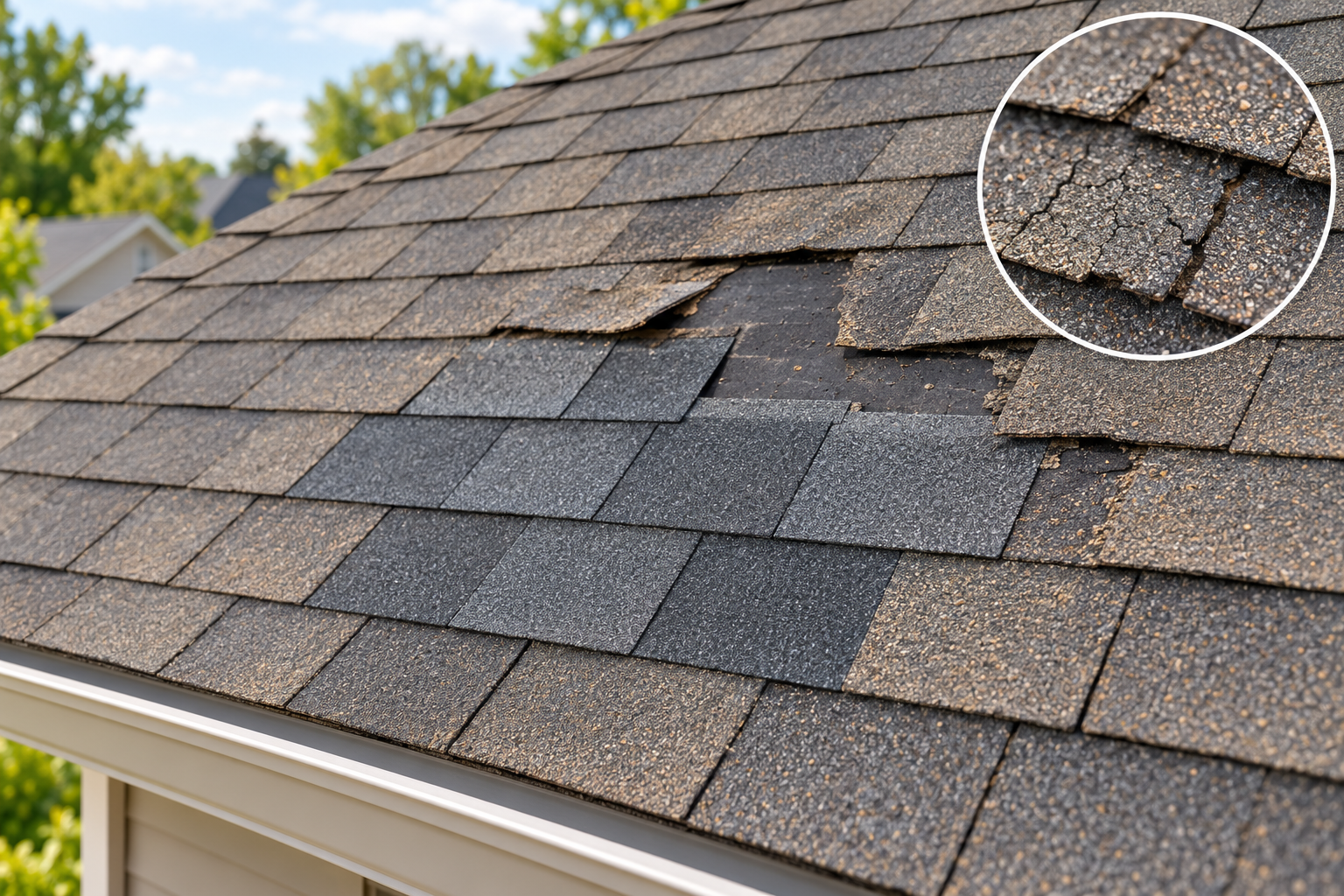
The visible defect may be a missing tab, torn or creased shingle, lifted edge, crack, puncture, or displaced ridge piece. A durable repair normally includes inspection of the area, removal of damaged units, review of underlayment and deck condition, compatible replacement material, and reintegration with neighboring courses.
Minimum service charges matter. Replacing two shingles may take little material but still require travel, setup, fall protection, matching, and cleanup. Adding nearby defects to the same visit can be economical if they are real; expanding a sound repair merely to make the invoice larger is not.
Cost drivers
- number and distribution of damaged shingles;
- one-story access versus steep, tall, or obstructed roof areas;
- field shingles versus ridge, hip, edge, valley, or penetration locations;
- availability of the same product, size, thickness, and color;
- brittleness of the surrounding roof;
- exposed or damaged underlayment and decking;
- wind, hail, branch impact, or an ongoing attachment problem;
- urgent temporary protection before permanent materials are available.
One cluster on an open slope is more repairable than the same count scattered across several roof planes. Damage at an edge or valley may involve more than surface replacement.
Matching is more than appearance
Weathered shingles rarely match new stock perfectly. A color difference can be acceptable if the system integration is sound, but a discontinued size, profile, or construction can make the repair technically awkward. “Close enough” should not mean forcing an incompatible product into the course.
Ask whether the contractor has identified the product or is proposing a functional substitute. If appearance matters, request a sample comparison from the ground. If an exact match is unavailable, partial slope replacement may produce a cleaner transition—but it also introduces more tear-off and mobilization.
Age and brittleness change the economics
Age is context, not an automatic replacement rule. The more important question is whether adjacent shingles can be lifted and refastened without cracking or losing adhesion. If a small repair damages a widening area, the quoted “few shingles” scope may not be realistic.
NRCA describes curling and splitting as deterioration signals, while missing or dislodged components need correction to preserve weathertightness. Those observations support inspection; they do not establish a universal age cutoff.
Wind damage needs a broader look
Wind may remove a few shingles, weaken seals without complete detachment, damage edges, or permit wind-driven rain. Asphalt shingle seals are product- and weather-dependent, and weathering can weaken them. A surface count alone does not reveal deck attachment or concealed water entry.
After a wind event, ask the inspector to map damage by slope and edge rather than quote only what is obvious from the yard. Insurance coverage and matching treatment depend on the policy and jurisdiction; the roofer can document physical scope but cannot promise coverage.
Three decision scenarios
Young roof, one localized event: A handful of compatible shingles were damaged by a branch, surrounding material is flexible, and the deck is dry. Focused repair preserves the remaining investment.
Older roof, exact match unavailable: The defect is repairable but visible, and opening the courses risks additional breakage. Compare a functional patch, a bounded slope replacement, and full replacement based on ownership horizon—not cosmetics alone.
Scattered storm damage: Missing and creased shingles appear on several slopes and at edges. Repeated localized repairs may approach partial or full replacement economics and still leave an uneven system.
What a useful quote states
Look for the repair area, number or approximate quantity of shingles, product or substitution basis, treatment of underlayment and fasteners, deck-repair allowance, ridge/edge work, cleanup, and workmanship terms. Ask what condition would trigger a change order.
Repair is economical when it restores a coherent water-shedding surface without sacrificing much sound material. When surrounding shingles are no longer workable or defects are broadly distributed, compare the repair with partial replacement and a complete reroof before approving repeated patches.
Repair pricing scenarios
A useful quote can separate mobilization from quantity. One accessible cluster may cost little more than the service minimum; several clusters on separate slopes add movement and setup; ridge or valley damage adds specialty components; an exposed deck may require temporary protection before matching stock arrives.
Ask for an alternate unit price if additional damaged shingles are discovered nearby. That allows a bounded expansion without turning the visit into unapproved open-ended work. Scattered defects elsewhere should be photographed and separately authorized.
Alternatives to exact matching
When exact stock is unavailable, options can include a functional compatible repair with visible difference, moving salvageable shingles from a less visible area and repairing that donor area, replacing a bounded slope, or advancing full replacement. Each creates different labor, appearance, and future matching consequences.
Salvage transfer is not automatically appropriate; weathered material may not tolerate removal. A contractor should explain why it remains workable.
Related damage and exclusions
Shingle replacement may not include ridge caps, starter/edge components, underlayment, flashing, gutter repair, interior staining, or fallen-tree removal. Wind damage at the edge and branch punctures can involve a broader opening than the missing surface suggests. Define those boundaries.
If the event affected solar mounts, electrical equipment, chimney, or structural framing, use the appropriate specialist rather than stretching a shingle allowance across unrelated systems.
Preserve the decision record
Keep photographs, approximate repair area, product used, color/lot if available, date, cause, and workmanship terms. A map of repeated repairs helps a future owner or inspector decide whether failures remain isolated or have become a system pattern.
Normalize quantity and access in the quote
Ask bidders to distinguish the number of visibly damaged shingles from the number they expect to remove to make the repair. Those quantities can differ because courses overlap and surrounding units must be lifted or released. A proposal should also say whether starter, ridge, hip, valley, or flashing pieces are involved and how unexpected breakage will be authorized.
Compare the same roof areas. One contractor may quote the obvious front-slope cluster while another includes a full storm walkover and several scattered defects. Use a location map or photographs to reconcile scope before comparing totals. If safe access is limited, state whether a drone or ground review is preliminary and whether hands-on confirmation changes the price.
For uncertain quantity, a service minimum plus a unit or small-area schedule can be more transparent than a single allowance. The schedule should still have a maximum authorized quantity and a rule for stopping when damage indicates a larger slope or system decision.
Low, typical, and complex repair cases
A low-complexity repair is a small accessible cluster, with identifiable compatible material and surrounding shingles that remain workable. Mobilization may dominate the invoice, so combining a check of similar exposed areas can be economical.
A typical repair involves several damaged locations, uncertain matching, or work near an edge, ridge, or simple penetration. Labor rises because setup and careful release repeat across the roof. The quote should explain whether each location receives the same repair detail or whether one is actually a flashing or deck opening.
A complex case includes brittle surrounding material, discontinued appearance, widespread unsealing, tree impact, valley involvement, or substrate damage. Here, “replace ten shingles” may be the wrong unit of analysis. Compare a bounded repair, a full-slope option, and whole-roof work while retaining the same assumptions about underlayment, deck, accessories, and disposal.
Repair, slope replacement, or full replacement
Choose a local repair when the cause and extent are local and retained material can survive integration. A slope replacement becomes relevant when damage or match concerns are concentrated on one plane and transitions can be detailed without creating a patchwork of incompatible ages. Full replacement becomes more credible when damage is distributed, repeated repairs reveal declining workability, or other near-term roof needs would require new mobilizations.
Do not decide only from the immediate repair-to-replacement price ratio. Compare what remains after each option: age distribution, visual outcome, warranties, vulnerable interfaces, and the probability of returning to adjacent areas. A modest repair can be excellent value on a serviceable system. A series of modest repairs can be poor value when each one consumes setup and damages increasingly fragile surroundings.
If an insurance claim is involved, keep the construction decision separate from assumptions about payment. Deductibles, scope, matching treatment, depreciation, and exclusions are policy- and jurisdiction-specific. The physical proposal should still identify the necessary work and alternatives clearly enough to purchase even if coverage changes.
A practical authorization sequence
Authorize the smallest investigation that can establish material workability and the repair boundary. If conditions match the quote, proceed with the mapped repair. If opening shows brittle surrounding material or a wider pattern, pause at the agreed threshold and compare the slope or replacement alternate. Require the same photographs and quantity basis for whichever path is selected.
This sequence protects against two opposite mistakes: committing to a whole roof because the exact shingle is unavailable, and repeatedly increasing a service call after the material proves unrepairable. The decision is resolved when the owner knows the functional scope, appearance outcome, retained condition, and next likely intervention—not when a contractor has counted the visible tabs.
Closeout and trigger for reassessment
Inspect the repaired area after appropriate weather from safe locations and keep a map of any unrepaired observations. A new isolated storm defect may remain another repair. Failures emerging across unrelated slopes, repeated loss at edges, or material that increasingly cannot be lifted without damage should trigger a fresh section-versus-replacement comparison rather than automatic expansion of the old service authorization.
Final homeowner worksheet
Record mapped quantity, likely cause, removal/integration quantity, matching outcome, surrounding workability, component and deck extras, local/slope/full alternatives, warranty, and next trigger. Then write the intended holding period. A proposal that cannot fill these fields has not established whether its low unit count buys a durable repair or only a short service visit.
Low, expected, and difficult totals
The low case covers one accessible cluster and a service minimum. The expected case covers several mapped locations, ridge/edge or simple interface work, and a controlled added-unit price. The difficult case reveals brittle surroundings, discontinued matching, deck damage, or a distributed pattern and switches to slope or replacement pricing. The contractor should state which finding moves the job between cases.
Uncertainty boundary
Matching stock and surrounding brittleness may not be known until careful handling. Price the visible repair, expected integration area, added units, and slope/replacement stop point. The owner can then choose a bounded repair without pretending the first visible count is the final technical scope.