
Replacing a few accessible clay or concrete tiles can be a hundreds-to-low-thousands repair. Opening a large area to renew underlayment or flashing can cost many thousands, even when most visible tiles are reusable. Complete new tile installation is a premium project; one US specialist model estimates builder-grade clay tile around $21 per square foot on a simple roof, but real scope varies widely.
Tile is the visible weathering layer, not the whole roof. The economic decision often turns on what lies beneath it.
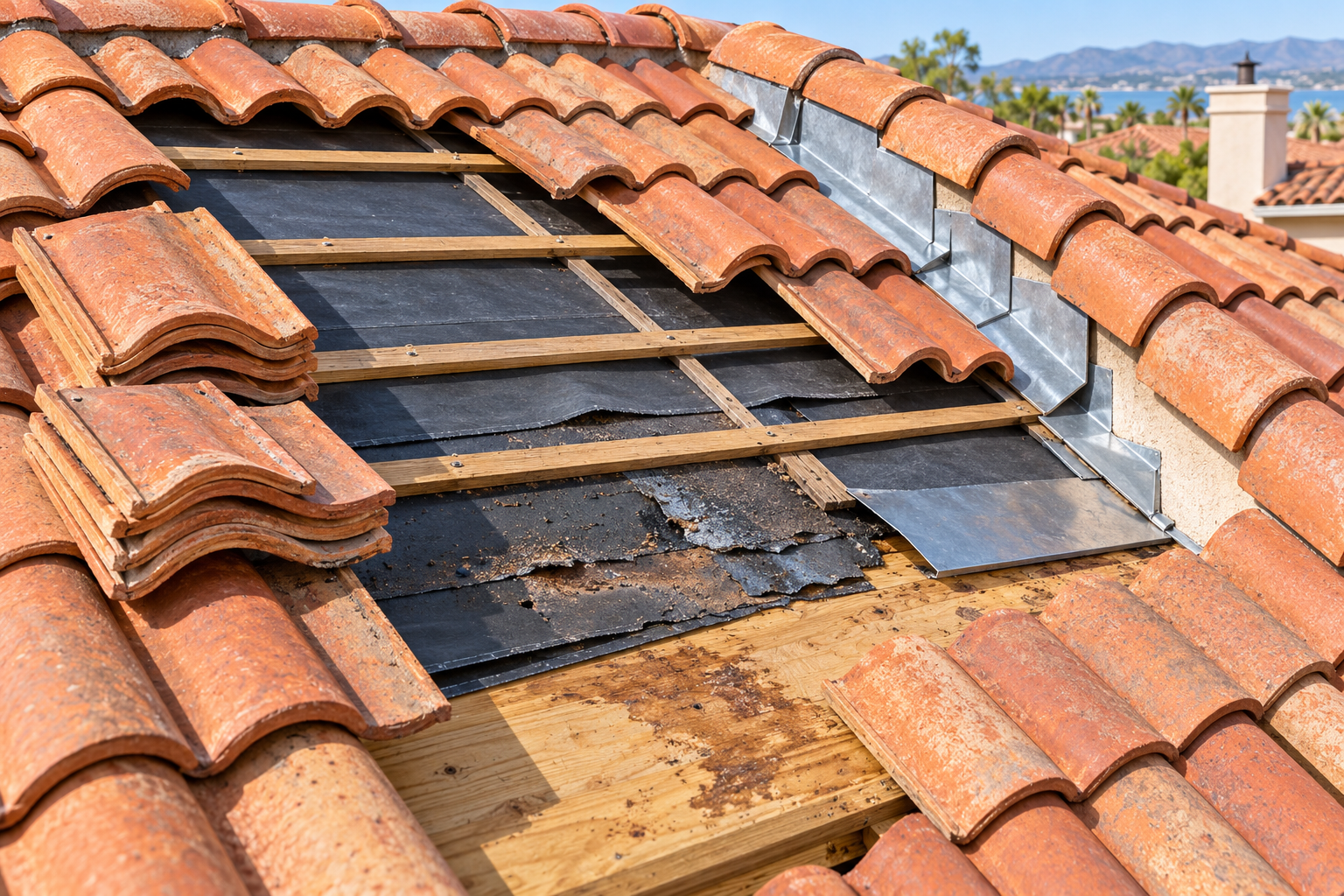
Four different tile projects
- Individual tile replacement for isolated breakage or displacement.
- Flashing or penetration repair requiring careful removal and reinstatement.
- Lift-and-relay or underlayment project where tiles are salvaged but lower layers are renewed.
- Full replacement with new tile and related assembly work.
Quotes should identify which project is proposed. “Tile repair” can describe any of them.
Individual repairs
Cost depends on matching profile and color, attachment, access, fragility of surrounding units, and whether replacement stock is available. The material quantity may be tiny while specialist labor and breakage risk set the price.
Ask whether spare or salvaged tile will be used, how neighboring units are protected, and whether the repair includes the underlayment or flashing below. Surface replacement does not cure a concealed failure automatically.
Underlayment-driven work
Tiles can remain serviceable while underlayment, flashings, fasteners, or battens need attention. A contractor may need to remove and stage many tiles, replace the lower assembly, and reinstall salvageable units. Breakage allowance, sorting, storage, and replacement availability then become major cost lines.
This explains why a roof with “good-looking tile” can have an expensive leak. It also explains why complete new tile is not always necessary.
Structural boundary
Tile weight and attachment vary by product and system. Switching from a lighter covering or changing the assembly can require site-specific structural evaluation. Existing sagging, damaged framing, or uncertain support is not routine tile labor.
Do not accept a generic statement that every house can or cannot carry tile. The actual structure and product loads control.
Wind, breakage, and access
Modern mechanically attached tile systems can behave differently from loose or aged assemblies in wind. Exact attachment and local design requirements are product- and jurisdiction-specific. Walking tile can cause damage, making staging and access part of repair cost.
Hail or impact can create obvious breakage, but material name alone does not establish storm resistance. Insurer treatment also varies.
Scenarios
Few broken tiles, sound lower layers: Replace compatible units and correct the cause of displacement. Focused repair preserves the roof.
Leak at valley or penetration: Remove a broader field, rebuild flashing or membrane, replace limited deck, and reinstall tile. The water-control repair—not tile count—sets cost.
Aged underlayment, reusable tile: Lift-and-relay may preserve valuable tile while renewing concealed layers. Compare labor, salvage rate, new accessories, and warranty with complete replacement.
Material switch: If matching tile is unavailable or structural, fire, wind, or budget factors favor another system, compare tear-off, deck preparation, appearance, and future maintenance.
Quote checklist
Require tile type, repair area, salvage and breakage assumptions, replacement source, attachment method, underlayment, flashing, deck allowance, staging, structural exclusions, cleanup, and responsibility for cracked units discovered during work.
Do not judge the roof by tile age alone. The right economic decision separates durable surface units from the condition of the water-control layers, support, and interfaces beneath them.
Cost anatomy for lift-and-relay
This scope can include layout and access, careful removal, sorting, storage, underlayment and flashing removal, deck repair, new lower layers, replacement tile procurement, reattachment, and cleanup. Ask for assumed salvage percentage and a unit price or allowance when breakage exceeds it.
The least expensive bid may assume every tile is reusable; the most conservative may charge for all new tile. An inspection and representative opening can narrow the range.
Clay versus concrete and product variation
Clay and concrete are not interchangeable, and profiles, interlocks, fastening, coatings, and regional practices differ. Replacement stock must suit the actual assembly. Avoid generic weight, fire, wind, or life claims based only on the word “tile.”
Alternatives
Selective repair preserves the most value when lower layers are sound. Lift-and-relay renews underlayment while retaining viable tile. Full new tile changes appearance and accessory system. Switching to asphalt, metal, or synthetic can reduce weight or cost but may require deck/detail changes and sacrifice architectural value.
Ownership and future work
Keep spare units, product records, flashing photos, underlayment specification, and attachment documentation. Coordinate solar, skylights, and chimney work before relay so new tile is not reopened. Establish how future access is performed without unnecessary breakage.
Comparing proposals
Normalize area, salvage, new-tile quantity, staging, underlayment, flashings, battens/fasteners where relevant, deck allowance, structural scope, broken-tile handling, warranty, and material storage. The decisive price difference is often labor and lower-layer reconstruction, not tile purchase.
Price the four scopes separately
A service visit to replace isolated units, a flashing opening, lift-and-relay, and full new-tile replacement are different capital decisions. Ask contractors to label which one they are pricing and identify the evidence supporting it. A few cracked tiles do not establish failed underlayment; a surface that still looks attractive does not establish sound concealed layers.
For local repair, normalize access, mapped quantities, matching source, fasteners or attachment, adjacent breakage, and flashing work. For lift-and-relay, identify the area lifted, expected salvage percentage or allowance, new replacement units, staging and storage, underlayment, battens where used, flashings, deck contingency, and how weather protection is maintained. Full replacement adds the exact new tile system and may change structural or edge details.
Use provisional quantities where condition is genuinely concealed, but require a counting and approval method. An unexplained “tile allowance” exposes the owner to both quantity and unit-price uncertainty.
Low, typical, and complex economics
A low-complexity case has a few serviceable matching units, safe access, and a local failure that does not require broad lower-layer work. Specialist mobilization can still dominate the cost.
A typical capital repair involves a valley, chimney, or bounded underlayment area. Tile must be lifted and sorted, flashings renewed, damaged lower layers corrected, and viable units relaid. The visible repair area understates the handling area.
A complex case includes brittle or discontinued units, widespread lower-layer failure, distributed deck damage, structural questions, solar, difficult staging, or historic/aesthetic constraints. Salvage yield and replacement sourcing become project risks, and switching materials becomes a real alternate rather than a generic suggestion.
Repair, relay, replace, or switch materials
Local repair is strongest when the failure and working area are bounded. Lift-and-relay is attractive when much of the tile remains viable but underlayment or flashings require broad renewal. New tile is more credible when existing units cannot be salvaged in useful quantity or the owner wants a changed system. A material switch can reduce weight, specialist exposure, or capital cost but may change structure, fire/wind treatment, appearance, drainage, and future repair availability.
Compare what remains after each option. A low repair bill may preserve an old but coherent field for meaningful time. Repeated small repairs across many locations can incur high staging and breakage. A relay preserves material value but is poor economy if fragile units or incompatible lower work will force another broad opening soon.
For a short ownership horizon, document condition and avoid assuming that premium restoration is fully recovered at sale. For long ownership, spare units, specialist availability, solar coordination, and the next underlayment intervention matter. No universal age or repair percentage replaces a roof-specific condition survey.
Control opening risk
Before work, define the breakage allowance, salvage standard, deck unit price, authorization threshold, and dry-in plan. Require photographs of lower-layer condition. If opening changes the recommended scope, the contractor should be able to close safely while the owner compares the priced alternate. That control is especially important when material is scarce and every exploratory movement can consume viable tile.
Read tile quote assumptions
“Replace broken tiles” should include a mapped base quantity, source and profile, attachment, access, and added-breakage rule. “Lift and relay” should state the exact area, sorting standard, expected new-unit allowance, underlayment and flashing scope, storage, and what happens to rejected tile. “New roof” should not assume structural adequacy or local acceptance without verification.
Ask whether ridge, hip, eave, valley, wall, chimney, and penetration units are included and whether mortar, mechanical attachment, battens, or system-specific accessories are being renewed. Field-unit prices cannot represent these labor-heavy details.
Example: attractive tile over failed lower layers
A roof can have many visually serviceable units but repeated leakage at valleys and aged underlayment. Replacing scattered tile addresses breakage, not the concealed water-control path. Full new tile may also be unnecessary if a specialist can lift, sort, renew lower layers, and relay a useful portion.
Compare the relay total—including new-unit contingency and broad flashing—with a complete material replacement and a suitable material switch. The decision turns on salvage yield, lower-layer extent, structure, specialist labor, appearance, and how much of the new work survives future intervention.
Value of a condition map
Record broken and slipped units, leak zones, underlayment findings, flashings, deck work, and relay boundaries. A map makes phased preservation coherent and shows when repeated local work has become distributed. It also prevents the next contractor from treating every weathered tile as an unexplained replacement risk.
If uncertainty about salvage or underlayment still drives a major decision, a sample opening can be justified when it changes the priced path. It cannot establish the entire roof, but it can replace a sales assumption with a controlled range.
Compare cash flow across interventions
A local-repair path carries today’s mapped repairs, specialist mobilization, likely additional unit work, and a separate reserve for lower-layer or capital renewal. A relay path concentrates labor now to renew underlayment and flashings while preserving viable tile. A new-tile or material-switch path adds complete material and may change structure, approvals, details, appearance, and future service.
Test each with a low, expected, and difficult salvage or concealed-condition case. Do not credit relay with perfect reuse or charge replacement with every hypothetical structural change. Use bidder-observed quantities and controlled allowances. Include financing if the capital options are financed and repeated staging if repair or phasing is likely.
A local repair can be the lowest ownership cost when the field and lower layers remain coherent. Relay can outperform replacement when salvage is strong and lower layers are the actual failure. Replacement can outperform both when salvage, matching, underlayment, flashings, and distributed repairs would consume most of the reconstruction effort while leaving uncertainty.
Adjacent-project economics
Solar removal, skylights, chimney work, structural review, gutters, and interior restoration should remain separate but coordinated. If any will require broad tile lifting soon, include duplicated handling in today’s decision. Conversely, do not expand the tile project merely because another trade is already mobilized; shared access matters only where the work boundaries actually overlap.
Final decision record
State which layers are serviceable, which fail, the mapped work boundary, salvage and new-unit assumptions, structural status, selected attachment/underlayment/flashing approach, and the threshold for switching scope. Keep the rejected alternatives and why they lost. That record supports the next repair and prevents “tile roof age” from replacing evidence.
Compare warranties and future service
A local repair warranty covers the rebuilt location, not every concealed underlayment path. Relay workmanship may cover a broad reconstructed area while retained tile remains existing material. A new system adds product terms but may still exclude structure, impact, foot traffic, or adjacent trades. Read remedy, transfer, exclusions, and who diagnoses recurrence.
Ask how one broken unit, penetration, valley, or solar intervention will be serviced after each option. A technically sound system with no locally available matching units or qualified access can carry high repeat-work cost. Retained spare tile, source records, and installation photographs reduce that risk.
Final regret test
If repair or relay is preferred, budget the difficult salvage and recurrence case. If replacement or material switch is preferred, acknowledge the value of serviceable tile being discarded and test whether the larger scope still makes sense without guaranteed lifespan or resale. The selected path should remain acceptable when its principal downside is made explicit.
Uncertainty boundary
A sample opening and condition survey cannot establish perfect salvage or every lower-layer defect. Use them to set a defensible base, expected, and difficult range with a stopping point. This permits a preservation decision at full depth without inventing a salvage percentage or assuming every attractive tile remains reusable.
Decision thresholds after opening
Continue a local repair when removed units confirm workable surroundings and lower damage remains inside the mapped area. Convert to a broader relay when underlayment or flashing failure extends along a natural slope or water path but salvage remains credible. Reprice full replacement or a material switch when salvage falls below the contract assumption, deck or structural work becomes broad, or several planned phases would repeatedly handle the same tile.
The threshold should use documented quantities and conditions rather than one universal percentage. Require the crew to sort and photograph representative reusable and rejected units, map the expanded boundary, and price the next option before consuming the entire contingency. A safe dry-in gives the owner time to choose without leaving the building exposed.
If the owner stops after discovery, define storage, temporary closure, and credit for unused planned work. This downside is part of sample-opening economics and should be known before the first tile moves.