
Standing seam normally costs more because it combines concealed attachment, clips or system-specific seams, more specialized fabrication, and detailed trim. Exposed-fastener panels can be materially cheaper on simple roofs because panels attach directly through the weather surface. Neither label alone establishes quality, life, or suitability.
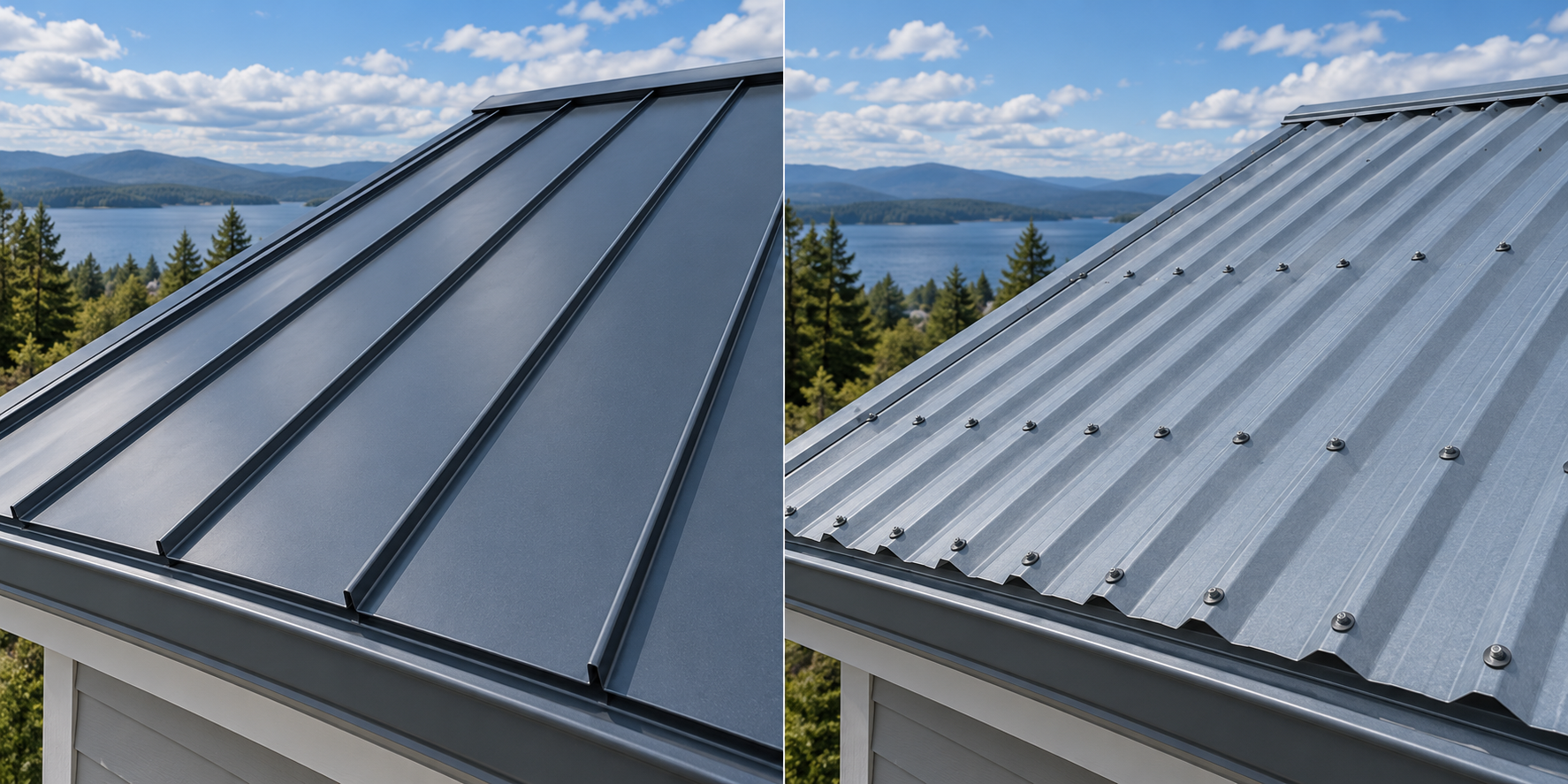
The construction difference
In a typical standing-seam assembly, raised panel seams form long continuous water paths while clips or concealed fasteners secure the panels. Systems differ in snap-lock or mechanically seamed profiles, clip design, substrate, and slope limits.
Exposed-fastener systems use fasteners with sealing washers through panel faces. Panel profile, fastener placement, support spacing, and trim are product-specific. Those exposed points are visible and inspectable, but they also become part of the maintenance surface.
Why standing seam costs more
- more specialized panel production or site forming;
- concealed clips and seam hardware;
- skilled layout and seaming;
- custom details at valleys, hips, walls, and penetrations;
- more exact substrate and geometry requirements;
- premium coating and architectural options common in this market segment.
On a complex residence, detailing can widen the gap. On a simple long-span roof, both systems can install more efficiently.
Maintenance tradeoff
Exposed fasteners, washers, and penetrations should be inspected according to system guidance because weathering and movement can affect them. That does not mean every fastener leaks or requires a fixed replacement interval. Standing seam removes many field fasteners from direct exposure, but seams, clips, coatings, edges, flashings, and penetrations still require sound design and maintenance.
Do not compare a poorly specified low-cost panel with a premium standing-seam assembly and conclude that fastening method alone caused every difference.
Thermal movement and detailing
Long metal panels expand and contract. Standing-seam clip systems may be designed to accommodate movement, but the actual performance depends on panel length, clip, seam, fastener placement, substrate, temperature range, and manufacturer requirements. Exposed-fastener systems address movement differently.
Penetrations interrupt the panel field and deserve special attention. A roof crowded with skylights, chimneys, vents, and dormers may reduce the efficiency of either approach.
Where each may fit
Standing seam: Strong candidate for a visible residence, long ownership horizon, complex water-shedding expectations, or a homeowner willing to pay for concealed attachment and architectural finish.
Exposed fastener: Strong candidate for a simple roof, outbuilding-like or rural aesthetic, tighter upfront budget, and an owner prepared for product-specific inspection and maintenance.
Slope, structural support, local wind/snow conditions, and product listing can rule choices in or out. Confirm rather than generalize.
Cost scenarios
For a simple gable, exposed-fastener pricing may be substantially below standing seam because labor and component count are lower. Add several dormers and valleys, and both rise; the standing-seam premium can grow through custom fabrication. Add remote delivery or very long panels, and logistics can dominate.
Ask for lifecycle scenarios that include inspection, probable maintenance, repair access, coating or finish expectations, and eventual replacement. Reject claims that one system is “maintenance free” or universally lasts a specified number of decades without product evidence.
Quote checklist
Compare exact panel profile, metal, thickness, finish, attachment, substrate, underlayment, panel fabrication, seams, fasteners, trim, penetrations, snow-retention scope, deck allowance, workmanship, and product warranty. Verify installer experience with the proposed system.
Standing seam is worth the premium when its specific attachment, detailing, appearance, and ownership advantages matter on the actual roof. Exposed fastener is not automatically a false economy; it is a different system whose lower initial price comes with different details and maintenance exposure.
Control the comparison
Obtain proposals using the same metal, finish quality, underlayment, substrate, trim, tear-off, deck allowance, snow accessories, and workmanship. If standing seam is premium coated steel and exposed fastener is thinner economy material, the price gap cannot be attributed to fasteners alone.
Ask for panel width and seam/profile, attachment, clips or fasteners, finish system, closure details, and treatment of penetrations. Confirm minimum slope and local wind/snow suitability from exact product documents.
Ownership scenarios
A seasonal or remote building may favor a locally serviceable exposed-fastener system if inspections can be scheduled and replacement parts are common. A primary residence with high roof visibility and long uninterrupted panels may justify standing seam’s concealed field attachment and architectural finish. A cut-up roof may weaken both economic cases because custom details dominate.
Snow and accessories
Both systems can shed snow depending on surface, slope, weather, and geometry. Snow retention, entrances, lower roofs, gutters, and solar equipment need site-specific design. Accessories add material, attachment, and maintenance cost; they should be integrated with the system rather than improvised later.
Future interventions
Solar mounts, new penetrations, panel damage, and coating repair require system-compatible work. Ask whether local contractors can service the exact seam or panel and whether opening one area affects long runs. Retain panel and finish information.
Avoid universal lifecycle math
Exposed fasteners are service items, but no single tightening or replacement schedule fits every system. Standing seam has fewer exposed field fasteners but is not maintenance-free. Use manufacturer inspection guidance and actual condition in the cost model rather than assigning unsupported decades to either choice.
Compare complete assemblies, not panel prices
Ask the same bidder, where qualified, to price both systems over the same roof boundary with the same tear-off, deck preparation, underlayment, ventilation, edge and valley functions, penetrations, site protection, and accessories. Then list what changes: panel profile and gauge or thickness, finish, clips or exposed fasteners, closures, fabrication, labor, and maintenance access. This isolates the system choice from unrelated scope differences.
Panel pricing alone is misleading. Standing-seam labor and detailing can be a larger share of installed cost; exposed-fastener proposals may vary in purlin or deck assumptions, fastener quality, washer exposure, and finish. Confirm whether each exact product is approved for the roof slope, substrate, wind exposure, and residential application.
Geometry also changes the comparison. Long uncomplicated planes use either panel efficiently. Hips, valleys, dormers, and penetrations create cutting, flashing, and short runs; the nominally less expensive panel may retain an advantage, but custom work consumes a larger share of both totals.
Low, typical, and complex project cases
In a low-complexity outbuilding or simple residence, locally supported exposed-fastener panels may meet the owner’s budget and maintenance plan. The decision should include safe future access to inspect and replace affected fasteners or sealants, not assume neglect.
In a typical long-horizon residence, standing seam may justify its premium through concealed field attachment, appearance, and reduced exposure of routine fastener points. The exact clip, seam, finish, edge, and penetration design still controls performance; the label alone does not.
In a complex roof, neither system escapes expensive custom transitions. Standing-seam panels may be difficult to replace once interlocked across long runs. Exposed-fastener roofs have more visible attachment points and can concentrate maintenance at laps and penetrations. Obtain a repair demonstration in words: how would one damaged panel, valley, or future vent be handled?
Maintenance and repeat-work economics
For exposed-fastener metal, ask the manufacturer and installer what inspection observations matter, who can service the system, and how isolated fastener or washer problems are corrected. Avoid budgeting a universal interval, but recognize that many exposed field points create an ownership task that must be accessible and documented.
For standing seam, include inspection of seams, clips where symptoms warrant, edges, snow accessories, sealant-dependent details, finish, and penetrations. Concealed attachment reduces one exposure; it does not make flashings and accessories permanent. Long panels can also make a localized intervention labor-intensive.
Calculate repeat-work by plausible mobilizations rather than by a marketing claim. A remote steep roof can make even modest service expensive. A simple accessible roof with strong local support may make maintenance manageable. The owner who cannot reliably arrange inspection should value reduced service points differently from an owner with an established local contractor.
Decide where to spend the premium
Choose exposed-fastener construction when the exact product is suitable, upfront capital matters, appearance is acceptable, and future inspection and component service are realistic. Choose standing seam when concealed attachment, architectural appearance, long continuous planes, and reduced field-fastener exposure justify the installed increment.
Before upgrading the panel system, fund suitable substrate, underlayment, water-control details, ventilation integration, safe access, and qualified labor. A premium seam cannot correct a poor valley or incompatible penetration. Conversely, do not assume a lower-price panel is false economy if it is specified coherently and maintained as intended.
Write down the deciding assumptions: ownership horizon, service access, exact exposure, snow and gutter interfaces, future solar, local repair capability, and tolerance for visible fasteners or oil canning. If the conclusion changes when one assumption changes, request priced alternates rather than relying on a universal winner.
Read common sales comparisons
A contractor may compare a thin commodity exposed-fastener panel with a premium architectural standing-seam system and attribute the entire difference to concealed attachment. Normalize metal and finish specification, substrate, underlayment, trims, closures, geometry, and contractor scope first. The products need not be identical, but the differences must be visible.
Claims that exposed fasteners “always leak” ignore design, product, installation, inspection, and repair. Claims that standing seam is “maintenance free” ignore edges, penetrations, sealant-dependent details, coatings, movement, and damage. Replace both slogans with the exact service plan and local repair path.
A final comparison worksheet
For each system, record installed total, system-specific increment, planned inspections, accessible service points, one-panel repair method, snow/solar accessory integration, warranty remedy, installer availability, appearance, and likely next intervention. Add a low-service and difficult-service case without assigning universal intervals.
Then ask what the premium prevents or improves on this building. Fewer exposed field fasteners and a desired architectural seam can be valid benefits. Easier local sourcing and lower capital can also be valid. The decision is complete when those tradeoffs remain persuasive after scope and ownership assumptions are controlled.
Compare difficult-case repairs
Model a damaged field panel, a failed penetration, a finish/coating concern, and a future solar mount for each exact system. Ask how much trim or adjacent panel work must be removed, whether replacement stock can be formed or sourced, and which details depend on sealant or exposed service points. This does not predict failure; it tests whether a bounded failure stays bounded.
Standing seam may make one long interlocked-panel repair labor-intensive even while reducing exposed field attachments. Exposed-fastener panels may be more individually accessible while presenting more attachment points to inspect. Roof geometry and local tools/skills determine which repair path is actually simpler.
Cost assumptions to keep explicit
Carry the same tear-off, deck, underlayment, ventilation, snow/gutter accessories, and site work. State panel length and handling, forming, waste, trim, clips/fasteners, finish, and contractor warranty. Add financed cost and realistic planned ownership without assigning a guaranteed service period.
For a short horizon, appearance and documentation may dominate, but neither premium is assured at resale. For a long horizon, inspection access, compatible repair, finish care, and provider continuity deserve greater weight. Select the exact system whose difficult case remains acceptable, not the one whose best-case brochure is strongest.
Compare warranty remedies and closeout
Separate metal/finish coverage, panel or fastener product terms, contractor workmanship, sealant/detail exclusions, wind conditions, transfer, and service labor. A long finish term does not cover a poorly integrated valley; a workmanship term may not cover storm impact. Ask how a claim is diagnosed and whether another local provider can complete repair.
Retain profile, metal/finish, forming information, clips/fasteners, trims, closures, underlayment, concealed details, snow/solar attachments, installer, and spare material. These records reduce the greatest long-term uncertainty shared by both choices: performing a compatible local intervention years later.
Final regret test
If standing seam wins, state whether the owner accepts higher capital and potentially broader panel access for fewer exposed field fasteners and preferred appearance. If exposed-fastener wins, state whether inspection and service access are realistic. A decision that records its maintenance tradeoff is stronger than one that assumes the chosen system has none.
Uncertainty boundary
Neither inspection intervals nor future panel repair can be predicted universally. Exact products, exposure, geometry, provider depth, and owner access determine them. Use documented service points and difficult-case repairs to compare risk; do not convert uncertainty into “standing seam forever” or “exposed fasteners always fail.”