
Roof decking—also called sheathing—is the board or sheet layer fastened to rafters or trusses beneath the roof system. During a reroof, contractors commonly price replacement per sheet, per square foot, per board-foot, or as time and materials. A few sheets may add hundreds of dollars; widespread replacement can add several thousand or materially change the entire project.
The uncertainty is unavoidable because the covering and underlayment hide much of the deck until tear-off.
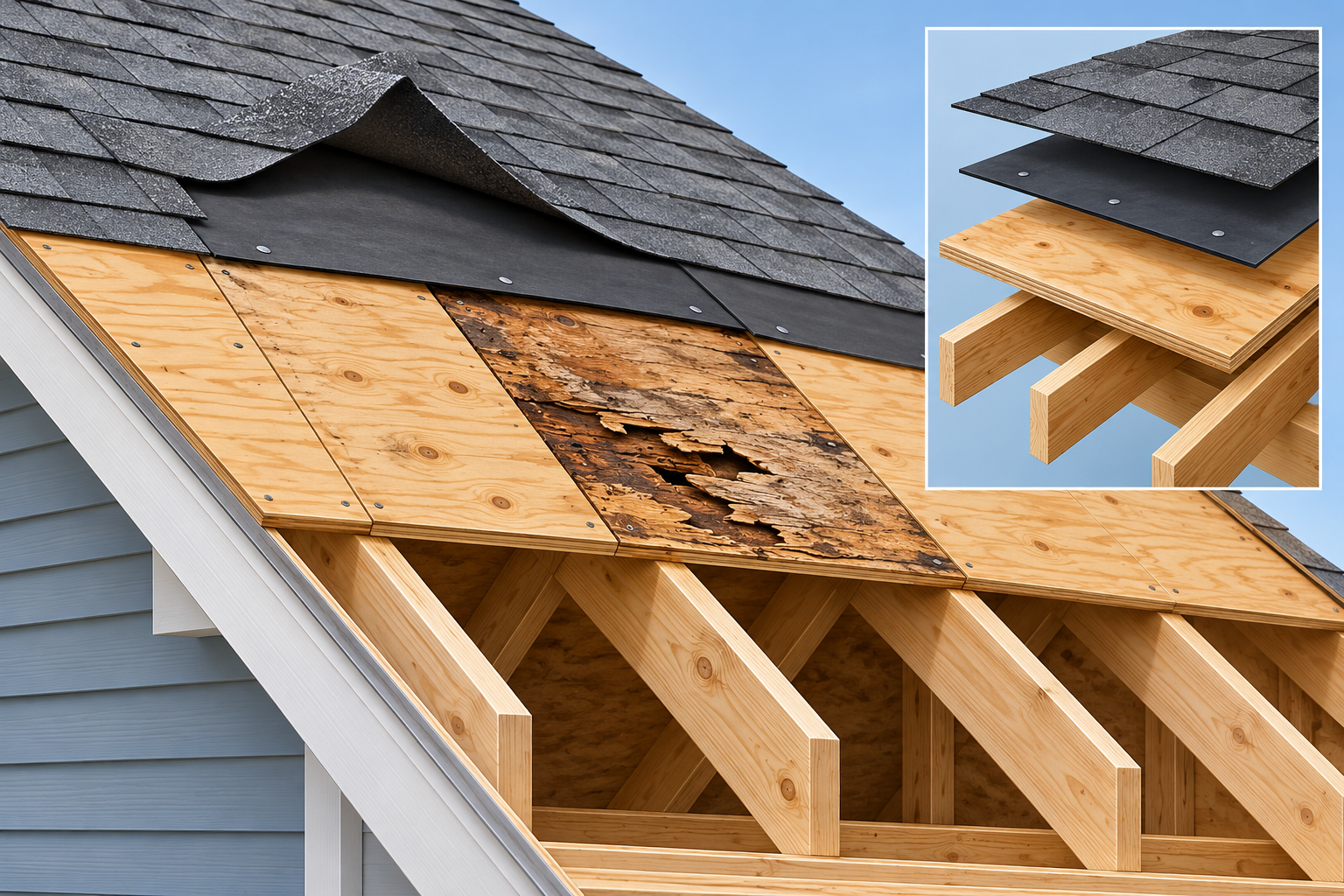
What deck replacement is—and is not
Replacing plywood, OSB, or boards directly beneath the roof covering is roofing-related carpentry. Repairing sagging rafters, trusses, beams, widespread structural movement, or inadequate load capacity is a separate structural project.
A roofer may identify structural warning signs, but the proposal should not blur a sheathing unit price into an undefined promise to repair framing.
Why damage appears late
Leaks can wet one localized area while leaving most decking sound. Repeated water entry, condensation, trapped moisture, failed drainage, or old gaps and unsuitable substrates can create broader problems. Surface inspection may reveal staining or deflection, but complete quantity often becomes visible only after removal.
That makes a transparent change-order mechanism essential. “Replace bad wood as needed” is not enough without a price basis and documentation.
Common pricing methods
| Method | Best use | Risk to watch |
|---|---|---|
| Per standard sheet | Plywood/OSB replacement in discrete areas | Sheet size, thickness, labor, and disposal inclusions may differ |
| Per square foot | Widespread sheet or overlay scope | Minimum areas and edge blocking may be excluded |
| Per board or time/material | Older board decks and irregular repairs | Final quantity is less predictable |
| Fixed allowance | Budgeting before tear-off | Must state quantity and unit price after allowance is exhausted |
Ask whether the unit includes removal, new material, fastening, edge support or blocking, disposal, and contractor markup. Exact thickness, span, fastening, and product compatibility must be determined for the actual roof and local requirements.
Cost drivers
- localized leak damage versus widespread unsuitable substrate;
- sheet goods versus plank or historic board deck;
- access to the work area and material handling;
- roof pitch and geometry;
- removal of multiple covering layers;
- matching thickness and transitions to retained deck;
- required fastening or reinforcement at edges;
- mold, insulation, framing, or interior finish issues outside the basic deck scope.
Three scenarios
Localized penetration leak: Tear-off reveals one or two soft sheets around a failed boot. The roofing crew replaces the area under an agreed unit price, then installs new underlayment and covering.
Scattered deterioration: Multiple old leaks created separated patches. The homeowner should compare many small repairs with replacing a continuous bounded area, which can improve installation efficiency and substrate consistency.
Broad board-deck compatibility issue: The existing spaced or uneven boards may not be a suitable substrate for the selected new system without additional work. This is not “rot,” but it can be a major scope addition that should be identified before bidding where possible.
If opening reveals damaged framing, stop treating the issue as a routine sheathing allowance. Structural assessment may affect sequencing and cost.
Build the contingency into the contract
Request photographs before replacement, agreed unit prices, authorization thresholds, and a process for large discoveries. For example, a contract can allow the crew to replace a small included quantity, require approval beyond it, and pause for structural review if framing damage appears.
Avoid both extremes: a zero contingency that makes a predictable discovery feel like an emergency, and a large prepaid allowance that is not reconciled to actual quantities.
Repair versus reroof implications
For a localized leak repair, deck work expands the opening but may still preserve a sound roof. During full replacement, deck repairs create the substrate for the new system and should be evaluated before underlayment hides them again. In a roof-over proposal, concealed decking is a key tradeoff because the existing covering limits inspection.
The right budget separates known base scope from concealed-condition pricing. You may not know the exact deck quantity before tear-off, but you can know how it will be measured, documented, approved, and paid.
Estimating before tear-off
Attic observations, soft areas, prior leak maps, deflection, visible board gaps, and selective openings can improve an allowance but do not create complete certainty. Ask the bidder to state the evidence behind the included quantity. A zero-sheet assumption and a whole-deck assumption may both be sales tactics when neither is supported.
For a mature roof with several known leaks, create low, expected, and high decking cases. Confirm that labor, material, fasteners, disposal, and overhead use the same basis in each.
Substrate suitability versus deterioration
Sound old boards may still have spacing, surface, thickness, or fastening conditions incompatible with the selected covering. New sheet overlay or other preparation can be required without rot. Keep this “system suitability” scope separate from damaged-deck replacement so the homeowner understands why it is predictable rather than a surprise.
Likewise, discoloration is not automatically structural deterioration. The crew should reach sound material and document why replacement is needed.
Sequencing and weather risk
Deck work happens while the roof is open. Large discoveries extend schedule and exposure, so the contract should define temporary dry-in, material availability, and what happens if structural consultation pauses work. A low unit price has little value if the project cannot be protected while decisions are made.
Alternatives
Localized replacement preserves sound deck. Continuous replacement or overlay can improve uniformity when defects are scattered or system requirements demand it. Structural repair may precede either. Roof-over avoids exposure but preserves uncertainty. Compare these options based on the actual failure or compatibility problem, not a preference for “all new wood.”
Normalize unit prices and allowances
A deck unit price is useful only when its unit and inclusions are clear. Confirm whether it applies by sheet, board, square foot, or labor hour; whether partial sheets round up; and whether removal, material, fasteners, disposal, overhead, and tax are included. Board decking and specialty structural panels should not be silently charged under an ordinary sheet assumption.
Record how quantity will be established. Crew photographs, marked roof plans, retained counts, and homeowner approval above an agreed threshold can turn an unavoidable unknown into an auditable change. A low unit rate paired with an undefined quantity is not necessarily a low-risk proposal.
Also separate three reasons for wood scope: replacement of deteriorated substrate, preparation required by the new roof system, and structural modification. They may use similar materials but answer different problems and may require different design or inspection.
Three budget cases for the same reroof
The low case assumes observed trouble is local and most exposed deck is sound and suitable. The base contract carries a modest allowance or unit schedule. The expected case uses leak history and accessible observations to include several bounded areas. The complex case anticipates distributed deterioration, unsuitable spaced boards, fastening problems, or framing questions that can slow dry-in.
Price the roof covering and accessories consistently across all three cases. Otherwise a “high decking” scenario may accidentally include unrelated upgrades and become impossible to compare. Include schedule and temporary-protection effects where extensive substrate work would keep the building open longer.
When added investigation pays
Attic access, moisture observations, leak maps, and selected openings can narrow a large allowance when the decision depends on deck condition. Investigation has value when it changes bidding, financing, structural planning, or the repair-versus-replacement choice. It has less value when full tear-off is already committed and a fair, controlled unit-price process can manage the uncertainty during work.
Do not ask investigation to promise complete quantity. The objective is to identify whether the project is likely to remain local, become a compatibility overlay, or require structural involvement—and to ensure the contract can respond safely to each outcome.
Final homeowner check
Before signing, identify the included deck quantity, added-work unit, evidence standard, approval threshold, dry-in responsibility, and structural escalation. Ask whether unused allowance is credited and whether predictable overlay/preparation work is fixed rather than charged as “rot.” These controls resolve the decking-cost decision as far as is possible before tear-off without pretending the concealed roof has been fully measured.
Ownership-horizon effect
On a localized repair, replace only material needed to reach sound support and integrate the repair. On a full reroof intended for long retention, broader substrate preparation can be worthwhile when it is required for the selected system or scattered defects would create repeated change. For a short planned holding period, structural and assembly suitability still cannot be deferred, but elective uniformity should not be justified by assumed resale recovery.
Deck work has value when it creates sound attachment, corrects verified deterioration, or makes the new assembly suitable. New wood has no independent payback when it merely replaces serviceable compatible substrate without a stated reason.
Uncertainty boundary
Deck quantity remains concealed until opening, but pricing need not remain vague. A shared low/expected/high allowance, clear measurement unit, photographs, and approval threshold let homeowners finance the project without paying a worst-case quantity upfront or relying on a zero-damage promise.