
A roof leak can be a few-hundred-dollar localized repair or a multi-thousand-dollar opening and reconstruction project. The spread is real because “leak” names the symptom, not the failed component. Pricing depends on the time required to find the entry point, the area that must be opened, the condition of concealed decking, and whether the surrounding roof can be repaired coherently.
Paying for diagnosis before choosing the intervention is often the cheapest part of the decision.
Why the ceiling stain is not the repair location
Water may enter at a wall, valley, fastener, pipe boot, skylight, chimney, roof edge, low-slope seam, or damaged covering. It can then travel along underlayment, sheathing, framing, or a penetration before becoming visible indoors. Wind direction, snowmelt, and rainfall intensity can change the path.
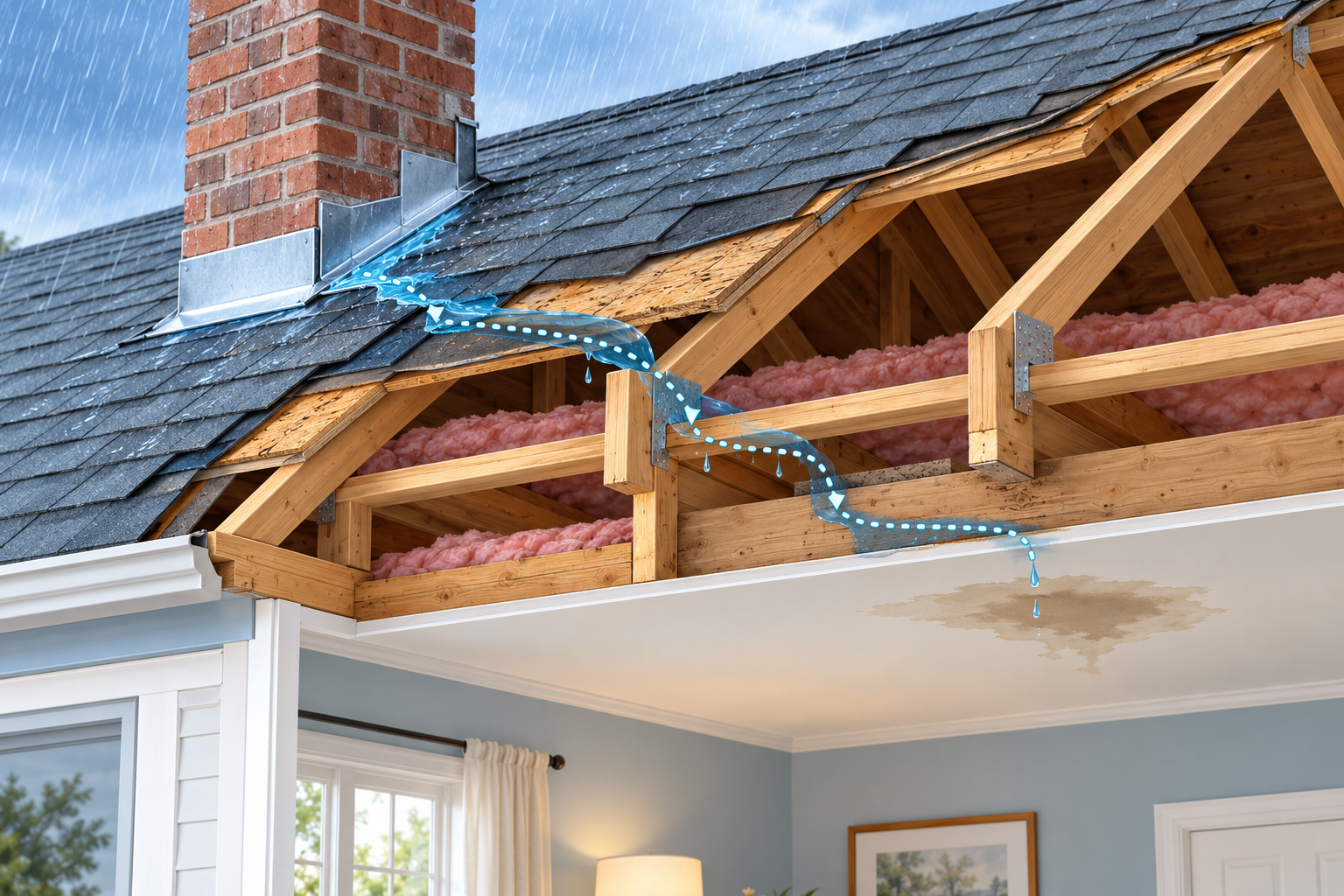
That is why patching directly above an interior stain can fail. A competent proposal identifies the suspected entry mechanism, describes how it will be confirmed, and states what happens if opening the area reveals a different condition.
Typical cost paths
| Scenario | Likely scope | Planning magnitude |
|---|---|---|
| Simple accessible defect | Replace a boot, limited flashing, or a few compatible shingles | Hundreds of dollars, often governed by a service minimum |
| Focused opening | Remove surrounding covering, rebuild an interface, replace limited decking, reinstall materials | High hundreds to several thousand dollars |
| Difficult intermittent leak | Investigation, controlled testing, repeat visit, opening finishes or roofing | Diagnosis can become a meaningful part of total cost |
| Broad failure | Multiple leaks, widespread brittle covering, wet substrate, failed low-slope assembly | Partial or full replacement economics |
These are decision bands, not bids. Specialty materials, difficult access, emergency weatherproofing, and interior restoration can move the total higher.
Common repair scopes
Covering damage: Missing or displaced shingles and broken tile may be localized if matching material is available and the surrounding roof can be worked without causing more damage.
Flashing and penetrations: Step flashing, valleys, pipe boots, roof vents, skylights, and chimneys often require removal of surrounding material. Surface sealant may be temporary if the water-control detail beneath it has failed.
Low-slope drainage or seams: Ponding, a blocked drain, edge failure, a penetration, or a membrane defect can share the same interior symptom. Repairability depends on membrane type, moisture, attachment, and substrate condition.
Decking damage: Wet or deteriorated sheathing adds carpentry and material. Framing damage below the deck is a separate structural scope.
Temporary stabilization versus permanent repair
After active storm damage, temporary dry-in or tarping may limit further water entry until safe permanent work can be scheduled. It is not the finished repair, and the contract should say whether removal of temporary material is included later.
Avoid treating repeated caulk applications as permanent diagnosis. Sealant can be appropriate within a designed detail, but it cannot substitute for missing flashing, failed underlayment, broken covering, or a wet substrate.
Hidden costs after water entry
The roof contract may exclude wet insulation, ceiling and wall finishes, electrical evaluation, mold assessment, or structural repair. Those costs are not inevitable, but they should be investigated when evidence supports them. Do not let a roofer’s broad warning turn every stain into a full interior-remediation allowance; equally, do not assume the visible finish is the only affected layer.
Ask whether the price includes:
- diagnostic time and photographs;
- removal and replacement area;
- new flashing, underlayment, or membrane detail;
- a unit price for deck replacement;
- matching limitations;
- temporary weather protection;
- cleanup and disposal;
- workmanship coverage and exclusions.
When repair is economically sensible
Repair is strongest when the failure is localized, the surrounding material remains serviceable, compatible replacement material exists, and the underlying deck is sound. A relatively young system damaged by one branch or one failed boot is different from an aging roof with repairs on several slopes.
Replacement becomes more credible when leaks are distributed, the covering is brittle or cannot be matched, several interfaces are failing, opening the repair area approaches a large share of one slope, or concealed moisture is widespread. There is no universal age or damage percentage that resolves the choice.
Decision scenarios
One failed pipe boot: Diagnosis identifies cracked boot material; nearby shingles and decking are sound. The repair is small, and replacement would destroy useful roof life.
Recurring chimney-area leak: Prior sealant work failed. Proper repair requires removing shingles, coordinating step and counterflashing, and possibly involving a mason. The price is higher because two systems meet there.
Several leaks on an old complex roof: Each location can technically be patched, but access, brittle material, repeated mobilization, and future mismatch make a larger reroof economically competitive.
Low-slope ponding and wet insulation: Replacing one drain may not correct inadequate slope or wet assembly materials. The project moves from a drain service call to restoration or replacement analysis.
What to do first
Document when leakage occurs, but do not climb onto a wet, icy, steep, storm-damaged, or fragile roof. Protect the interior if it can be done safely and arrange a roof-specific diagnostic visit. If there are signs of sagging, electrical exposure, falling materials, or major storm damage, keep people away from the affected area and seek appropriate professional help.
The least expensive durable result comes from matching the repair to the entry mechanism—not from choosing the smallest patch before the cause is known.
Emergency, scheduled, and investigative pricing
An after-hours call during rain may include a premium for response and temporary stabilization. That price should not be treated as the permanent repair estimate. Once conditions are safe and dry enough to inspect, request a separate scope for diagnosis and final work.
Scheduled repairs can be cheaper because materials, matching, crew, and adjacent trades are coordinated. Intermittent leaks may require the opposite: more diagnostic time, weather observation, or controlled testing before anyone can responsibly fix-price the repair. Paying for investigation is better than cycling through unverified sealant patches.
Compare repair proposals by mechanism
Two bids are not equivalent if one replaces surface shingles and the other rebuilds step flashing behind siding. Ask each contractor to state:
- the suspected entry point and supporting observation;
- the layers opened and the boundary of removal;
- whether deck, insulation, or interior investigation is included;
- new materials and how they integrate with retained work;
- the price mechanism if the cause or damage differs after opening;
- what workmanship commitment applies to the repaired interface.
If diagnoses conflict, an independent inspection or small exploratory opening may be worth the cost before selecting the lowest intervention.
Insurance and warranty context
Sudden storm damage may be treated differently from wear, maintenance, or long-term leakage. Policy language, deductible, notice, matching, depreciation, and jurisdiction control; no repair contractor can promise coverage. Mitigate active damage where safe, document conditions, and keep temporary and permanent invoices.
Manufacturer or contractor warranties may cover a specific defect but often exclude consequential interior work or unrelated interfaces. Notify the responsible party without delaying necessary stabilization, and preserve evidence before materials are discarded where practical.
The cost of delay
Delay does not automatically create catastrophic damage, but ongoing water entry can enlarge deck, insulation, and finish scope. Conversely, approving a full reroof during an emergency can destroy bargaining and diagnostic time. The balanced approach is safe stabilization, prompt diagnosis, then a defined permanent decision.
Build a leak budget in layers
Treat diagnosis, exterior repair, concealed damage, and interior restoration as separate budget layers. The first layer pays to locate the mechanism and may include controlled testing or an exploratory opening. The second restores the water-control detail. The third covers deck, insulation, or framing discovered after opening. The fourth addresses drywall, paint, flooring, or contents after the source is controlled and materials are dry.
This structure prevents two common errors. One is comparing a surface patch with a proposal that includes opening and rebuilding the failed interface. The other is using a low exterior repair quote as if it caps all water-damage cost. Ask which layers each proposal includes and whether allowances are estimates, unit prices, or fixed commitments.
For concealed work, establish an approval threshold and evidence requirement. A contractor can photograph the opened area, measure additional removal, and price deck or material units under agreed terms. That gives the homeowner control without requiring the contractor to pretend the concealed condition is known.
How project conditions change the economics
A single recent stain below an identifiable damaged boot on an otherwise serviceable accessible roof supports a bounded diagnosis-and-repair path. The same stain below a chimney, wall, valley, or solar attachment may require a larger opening because water can travel through several layers. Multiple stains across slopes after widespread weather raise a different question: whether isolated repairs still address the pattern.
Material matters too. A few asphalt shingles may be removable with limited disturbance; brittle, interlocked, adhered, tile, slate, wood, or metal assemblies can require specialist labor and a broader salvage area. The visible opening may be small while the technically sound integration area is not. Ask the contractor to price the access and reinstatement method, not merely the suspected hole.
Ownership horizon changes the choice but not the need for a sound repair. A homeowner expecting a planned reroof soon may choose durable stabilization that coordinates with that project rather than premium restoration of every finish. A homeowner retaining a relatively serviceable roof should favor a repair whose materials and detail avoid recurring access. Temporary sealant is not made permanent by a short ownership plan; it simply transfers the unresolved risk.
Decision thresholds after diagnosis
Continue with repair when the mechanism is bounded, surrounding material can be integrated reliably, and the cost buys a reasonable period of service. Request a repair-versus-larger-scope option when opening reveals distributed deck damage, repeated failed interfaces, incompatible past layers, or material too fragile to reinstate. Consider replacement when the same failure pattern is spread across the system or when several necessary openings consume a large share of a planned replacement while leaving the remaining roof near the same decision.
There is no universal percentage at which replacement wins. Compare like-for-like totals, the amount of roof and warranty each option leaves, repeat-access risk, planned solar or insulation work, and how soon retained sections are likely to require another mobilization. The written diagnosis is what makes that comparison more than a guess.
Final leak-repair record
Keep symptom timing, entry hypothesis, tests and limitations, opened layers, photographs, repair detail, deck/insulation findings, materials, interior drying/restoration, warranty boundary, and conditions for reassessment. If the leak recurs, this record prevents another contractor from starting with the same unsupported ceiling-to-roof assumption and shows whether the mechanism or a different interface failed.