
Slate repair is priced around specialist labor, safe access, matching, and preservation—not only the number of pieces. Replacing a few slates may cost hundreds to low thousands once staging is included. Flashing renewal or a broad opening can cost much more. Complete natural-slate replacement is a premium project whose price can exceed common asphalt work several times over.
Why slate economics differ
Natural slate varies in geology, thickness, size, quality, weathering, and remaining serviceability. Fasteners and flashings can fail on a different timeline from the slate itself. A knowledgeable inspection therefore distinguishes broken or slipping units, widespread stone deterioration, fastener issues, flashing failure, and deck or structural problems.
A generic “old roof” conclusion can discard reusable material. A generic preservation promise can also postpone necessary assembly work. Condition controls.
Localized repair
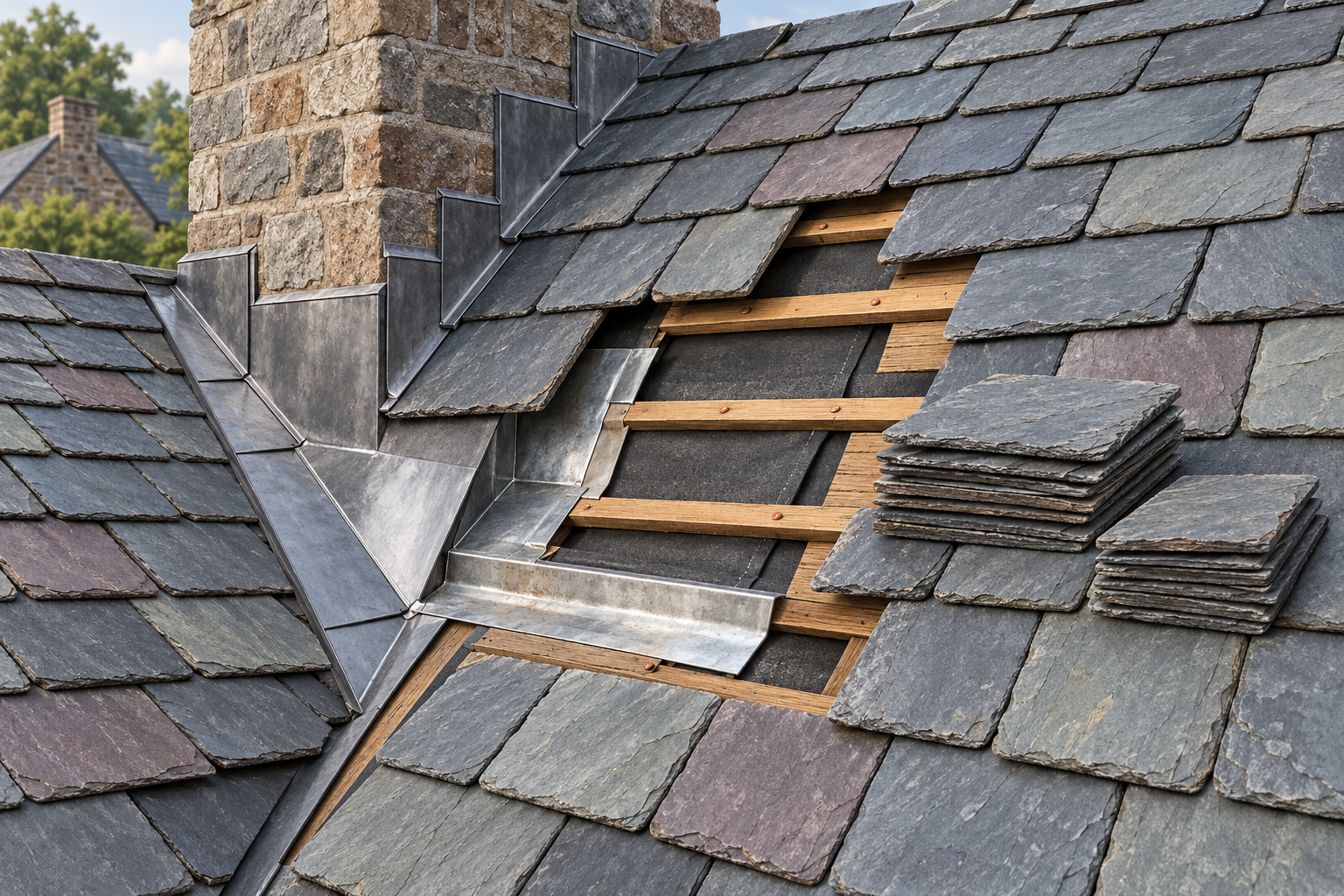
A specialist may remove and replace damaged slates using methods compatible with the installed system. Price rises with steep or high access, fragile neighboring units, custom dimensions, color matching, and scattered locations. Mobilization makes one repair expensive per piece; grouping verified defects can be efficient.
Ask whether replacement is new or salvaged slate, how dimensions and thickness were matched, and what visible repair hardware or method will be used. Avoid ordinary shingle patches that compromise water paths or future serviceability.
Flashing can be the capital project
Valleys, chimneys, walls, ridges, and penetrations may need renewal while much slate remains good. Reflashing requires careful removal, storage, and reinstatement over a wider area. Copper or other premium metals can increase material cost, but specialist handling and access are often larger drivers.
Separate chimney masonry from roof flashing and structural framing from deck repairs. Coordinated contracting can avoid gaps, but each trade’s scope should be explicit.
Salvage and matching
Salvaged slate can preserve appearance and dimensions, but quality and source matter. Not every old piece is serviceable, and one quarry or grade should not be assumed equivalent to another. Build a breakage and rejection allowance into the scope.
For a large project, document which slate is retained, stored, discarded, or transferred to the owner for future repairs.
Preserve or reroof
Preservation is strongest when most slate is sound, failures are localized to flashings or individual units, and specialist labor is available. Replacement becomes stronger when stone deterioration is widespread, fastener and substrate problems are broad, matching is impractical, or the total opening approaches a coherent reroof.
Alternative materials may lower upfront cost but change weight, appearance, detailing, historic character, and future repair pattern. On designated or legacy properties, separate preservation and approval requirements from basic roofing economics.
Scenarios
Scattered broken slates: Specialist replaces a limited mapped quantity and checks adjacent areas. Repair preserves substantial useful material.
Chimney and valley flashing failure: Slate is salvaged while extensive metal and underlayers are renewed. The project costs much more than the failed visible area suggests.
Mixed condition after decades of repairs: Competing scopes may include staged preservation, one-slope replacement, or full reroof. Compare serviceable material retained, future mobilizations, and matching risk.
Quote checklist
Require condition basis, slate type and source, repair map, access/staging, removal and salvage method, flashing metals, underlayment, deck allowance, adjacent masonry, replacement breakage, workmanship, and exclusions. A contractor’s slate-specific work history is economically relevant because avoidable breakage and poor detailing can erase a low bid.
The key decision is not whether slate is “long lasting.” It is how much of this roof remains serviceable, which supporting components are failing, and what intervention preserves value without multiplying specialist mobilizations.
Condition survey before a capital decision
Map failures by slope and type rather than accepting a roof-wide label. Representative slate testing or specialist assessment may distinguish isolated breakage from a material that is broadly deteriorating. Flashings, fasteners, deck, and previous repair methods should be evaluated separately.
A written survey costs money but can prevent full replacement based on a few visible slips or, conversely, repeated repairs to a failing field.
Phased preservation
One valley or chimney zone may be rebuilt while sound slopes remain. Phasing can preserve capital and historic material, but repeated staging is expensive. Establish natural boundaries, sequence the most consequential water paths, and plan whether new flashings will remain when later phases occur.
Alternatives and tradeoffs
New natural slate best preserves material character but carries premium material, structural, and specialist costs. Salvaged slate can match but requires quality control. Synthetic slate-look products may reduce weight and cost but change material authenticity, repair ecosystem, and approval questions. Asphalt or metal can reduce upfront cost while changing appearance and detailing.
Compare complete assembly, historic requirements, remaining ownership, and installer supply. Do not calculate payback from unsupported century-long lifespan claims.
Contractor and documentation value
Specialist references, prior comparable projects, staging plan, salvage procedure, and repair method are part of economic quality. Keep a roof map, slate source, metal details, photographs, and retained pieces. Future service becomes cheaper and less destructive when the system is documented.
Normalize a slate proposal
Map the slopes, valleys, ridges, flashings, and known repair areas. For each proposal, record access and staging, slate quantity and source, salvage standard, fastening method, underlayment or deck opening, metal type and extent, masonry or carpentry interfaces, temporary protection, disposal, and retained material. A per-slate price is meaningful only for comparable locations and surrounding conditions.
Separate field-slate condition from flashing condition. A large valley or chimney project can cost more than replacing many individual slates because it requires broad careful lifting, custom metal, and relay. Conversely, a contractor should not use failed flashing alone to imply the whole slate field has lost serviceability.
For unknown quantities, agree on mapped base work, added-unit prices by relevant difficulty, photographs, and a stop threshold. Fragile surrounding material can expand the working area; the contract should not pretend that risk is zero or leave it unlimited.
Three preservation cases
In a low-complexity case, a limited number of slipped or broken slates can be repaired by a specialist without broad disturbance. Mobilization and safe access may exceed the material cost, so grouping verified items is economical.
In a typical preservation project, a valley, eave, ridge, or chimney zone is opened, metal and lower layers are renewed, viable slate is relaid, and matching replacements are blended. The owner is buying careful disassembly and reconstruction, not merely new pieces.
In a complex case, several slopes show distributed deterioration, fasteners or substrate are problematic, salvage is uncertain, staging is extensive, or historic requirements constrain changes. A condition survey, sample opening, and phased capital plan can be less risky than either endless service calls or immediate whole-roof replacement.
Preservation versus replacement economics
Preserve when the slate field is materially serviceable and failures are concentrated in repairable units or interfaces. Phase work when natural boundaries allow the highest-risk water paths to be renewed without sacrificing sound slopes. Consider replacement or a material switch when deterioration is distributed, retained slate cannot be worked reliably, structural or substrate work requires broad removal, or specialist service cannot be sustained.
Price at least one preservation path and one complete alternative from compatible assumptions. Include staging, salvage, deck and flashing scope, structural work, historic review where relevant, and future maintenance. Do not credit natural slate with an unsupported extraordinary lifespan or debit synthetic/asphalt alternatives with assumed failure. Compare the documented current assembly and exact proposed systems.
Repeat access matters. Several inexpensive-looking repairs on different high slopes can cost more than one planned phase and damage additional material. Yet a broad project is not automatically efficient if it removes serviceable slate merely to avoid future mobilization. The roof map should reveal whether work is isolated, clustered, or system-wide.
Ownership and uncertainty
A short-horizon owner may value a documented sound repair and transferable condition record more than a speculative premium restoration. A long-horizon owner may value preservation, matching inventory, and a stable specialist relationship. Resale and heritage value are property-specific and should not be booked as guaranteed payback.
When the condition remains uncertain, commission only investigation that can change the choice: hands-on mapping, attic observation, selected opening, or metal assessment. The deliverable should state limitations and next thresholds, not simply assign an age-based replacement verdict.
Read preservation quote language
“Replace loose slate” needs a mapped quantity, size/thickness/source, fastening or repair method, access category, and added-unit price. “Reflash valleys” needs removal width, metal and joint details, salvage/relay quantities, deck allowance, and treatment at ridge and eave. “Replace slate roof” should identify whether viable material is salvaged, credited, retained, or disposed.
Ask how the method avoids face nailing or inappropriate exposed patching where those would not match the intended system. Do not prescribe one universal detail; require the specialist to document the chosen compatible method and references on comparable assemblies.
Example: repeated slips near one valley
Several slipped slates near a valley can arise from local fastener/material issues, failed valley metal, or a broader field condition. Paying only per slate may repeat until the interface is rebuilt. Replacing the whole roof may discard sound slopes. A survey and priced valley phase can define the middle path.
Compare that phase with several years of likely service calls and with full replacement under the same staging, salvage, deck, and historic assumptions. The phase is strong when the new metal and relaid field form a natural durable boundary that later work will not immediately disturb.
Risk allocation on scarce material
Set who owns breakage during careful removal, what quality is acceptable for relay, who approves substitutions, and how unused salvage is stored. Uncertainty should produce a controlled range, not either a guaranteed perfect salvage percentage or an unlimited purchase order. This commercial discipline is part of technically responsible preservation.
Compare capital paths over a planning horizon
For local service, total mapped repairs, safe staging, likely recurrence based on the condition survey, and any interface work that cannot wait. For phased preservation, include repeated or shared staging, metal and deck scope, salvage, matching slate, temporary protection, and whether each completed phase remains through the next. For replacement, include full removal, substrate and structural work, new assembly, historic or architectural constraints, and any value or cost from retained slate.
Run conservative, expected, and difficult cases without assigning a universal life. The preservation case weakens if it depends on no additional slips, perfect salvage, or indefinitely available specialists. The replacement case weakens if it assigns all existing slate zero serviceability and assumes the new system eliminates future repair. Use mapped distribution and workability.
A large upfront preservation phase can still be economical when it renews the failing water paths and keeps sound fields. A series of small repairs can still be economical when failures remain sparse. The number of invoices matters less than whether each intervention reduces a coherent known risk.
Historic, appearance, and resale context
Material authenticity, local historic requirements, appearance, and buyer preference can influence the choice, but they are property-specific. Verify applicable approval before pricing a material switch. Do not book a guaranteed resale premium for natural slate or assume a substitute has no market value. State aesthetic and stewardship goals as explicit preferences.
Final decision record
Keep the condition map, hands-on limitations, slate type/source, salvage inventory, metal and deck details, phase boundaries, photographs, warranty/workmanship contacts, and next inspection triggers. A new owner or specialist should be able to understand why repair, phasing, or replacement was selected without repeating the entire diagnostic expense.
Compare warranty and remedy boundaries
A specialist may warrant a repaired valley or slate field while existing adjacent material remains outside scope. Replacement adds new product and workmanship terms, but natural material variation, salvaged pieces, historic substrate, and adjacent masonry can remain. Ask who diagnoses a repeat leak and what labor, metal, slate, or interior work the remedy includes.
Warranty length should not replace contractor continuity and method. A shorter clear commitment from an established slate specialist can be more actionable than a long generic roof term that excludes the retained assembly.
Final regret test
If preservation is preferred, describe the difficult case of additional phases, scarce matching material, and repeated staging. If replacement is preferred, describe the chance that mapped sound slate and repairable metals could have delivered meaningful service. Include financing and material stewardship without inventing resale. Choose the path that remains supportable when its main downside is visible.
Uncertainty boundary
Hands-on mapping and selected openings improve but do not eliminate uncertainty about fasteners, substrate, metal, and salvage. Price natural phases, added units, difficult staging, and a switch threshold. The evidence gap limits exact quantities, not analysis of preservation, replacement, ownership, and stewardship tradeoffs.
Decision thresholds after opening
Continue local or phased preservation when surrounding slate remains workable, metal/substrate findings remain within the mapped phase, and matching/salvage can support a durable close. Expand the phase when a natural valley, ridge, or eave boundary contains related failure. Reprice replacement or a material switch when distributed field condition, substrate, structure, or unavailable material makes preservation increasingly destructive.
Do not use one salvage percentage as a universal rule. The contract can define representative sorting, photographs, mapped quantities, added units, and a monetary or area threshold that triggers owner review. The specialist should explain whether rejected pieces fail for structural integrity, fit, previous damage, or another project-specific reason.
If work pauses, temporary protection and secure labeled storage preserve both the building and valuable material. Pricing that fallback before opening prevents a preservation investigation from becoming an emergency commitment to the largest scope.