
Small accessible flashing corrections may cost several hundred dollars. Rebuilding flashing at a long wall, dormer, chimney, valley, or complex transition can run into the low thousands because the contractor must remove and reinstall surrounding roofing—and sometimes siding or masonry work—to restore the water path.
Flashing is not simply visible metal with sealant on top. It is a set of overlapping components that moves water back onto the roof surface at joints, walls, valleys, penetrations, and changes in plane.
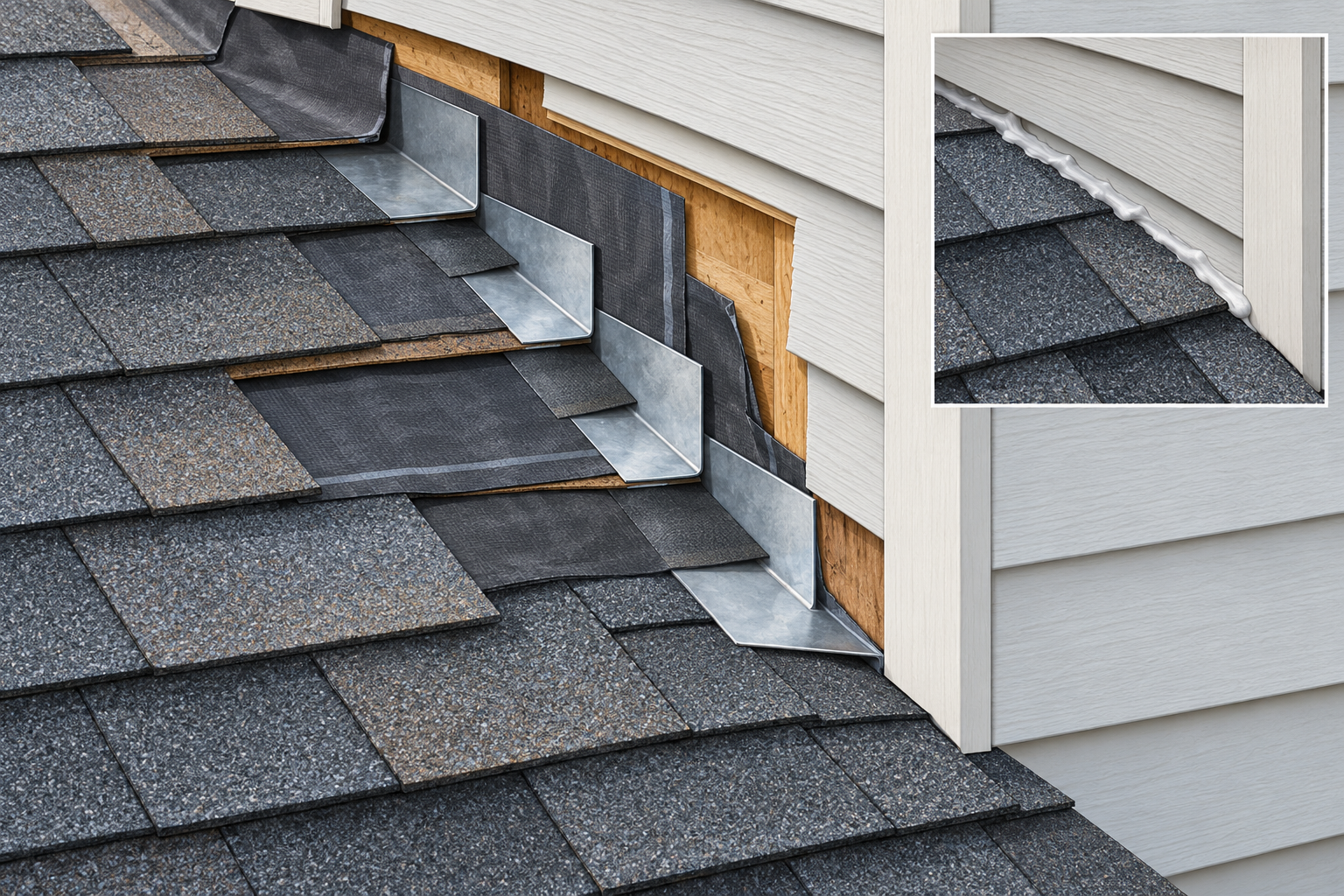
Repair, reseal, or replace
Localized maintenance may be reasonable when a compatible exposed joint or accessory seal has deteriorated but the underlying flashing layout is sound.
Partial repair may replace one damaged piece and the nearby covering. This works when the defect is isolated and the surrounding assembly can be opened safely.
Flashing replacement usually means removing shingles, tile, slate, panels, siding, counterflashing, or another adjacent material so new pieces can be layered correctly. The visible line of caulk may be the least important part of the scope.
NRCA technical guidance illustrates that step flashing at roof-wall interfaces is installed course by course and directs water onto the covering. It also notes that details differ: asphalt, slate, wood, and tile systems do not all use the same configuration.
Main price drivers
- length and type of interface;
- roof covering and how much must be removed;
- wall cladding, masonry, or trim access;
- one-story open access versus steep, high, or tight locations;
- custom metal fabrication and material compatibility;
- deteriorated decking behind the failed detail;
- whether matching replacement covering is available;
- sequencing with reroofing or another trade.
A short pipe flashing is not comparable to a long sidewall. A chimney detail can involve both roofer-installed step flashing and counterflashing integrated into masonry. A valley carries concentrated runoff and may require a broad opening.
Why surface sealant often disappoints
Sealant has legitimate uses when specified within a flashing system. It is a weak substitute for missing kickout flashing, poorly layered step flashing, corroded metal, a failed boot, or an interface trapped behind siding. Smearing exposed joints can temporarily alter the symptom while leaving water a path behind the materials.
Ask the contractor to explain the drainage path and show which component is failed. A proposal that says only “seal flashing” should identify the location, preparation, material, and reason that sealing is appropriate.
Adjacent-trade boundaries
At a wall, siding may need removal and proper reinstallation. At a chimney, deteriorated mortar, crown, cap, or flue work belongs to masonry or chimney specialists. At a skylight, failed glazing or frame seals may require unit repair or replacement. At an exhaust penetration, the roof flashing may be sound while the duct or equipment is not.
The homeowner benefits from one coordinated scope but should know who owns each layer. Otherwise, two contractors can each exclude the interface where the leak actually occurs.
Scenarios
Isolated boot or small penetration: Surrounding shingles are sound and the deck is dry. A focused repair is governed by service minimum and access.
Sidewall leak: Correct work requires lifting siding and several shingle courses, installing properly integrated step flashing, and restoring the wall. The price reflects two finished surfaces, not a strip of metal.
Chimney leak on an aging roof: Flashing and masonry both show defects, and old shingles are brittle. Coordinated masonry work plus a larger roofing opening may be more durable than repeated sealant visits.
Flashing during reroof: Because covering is already removed, renewing flashings can cost less incrementally than reopening a finished roof later. The quote should distinguish reused components from new ones.
How to compare quotes
Require a location-specific description, adjacent materials removed, new flashing type, treatment of counterflashing, underlayment, deck repairs, replacement covering, finish restoration, and responsibility if the leak persists from another source. Code and manufacturer requirements must be checked for the actual jurisdiction and product.
The best flashing repair restores a continuous drainage relationship. Its value comes from correct integration and access—not from the amount of exposed metal in the finished job.
Cost scenarios by interface
An accessible pipe or short headwall can remain near a contractor’s minimum. A long dormer sidewall requires multiple shingle courses and perhaps siding removal. A valley or chimney uses more custom metal and concentrates water. Tile, slate, wood, and metal coverings increase salvage, breakage, fabrication, or specialist labor.
For each interface, compare repair now with renewal during a planned reroof. Opening sound recently installed covering can be expensive; renewing marginal flashing while covering is already removed often has a low incremental cost.
Material and service-life coordination
Flashing should be compatible with adjacent metals, sealants, masonry, siding, and roof covering. Its anticipated durability should make sense relative to the roof it serves. A short-lived surface patch on a premium long-lived roof creates repeated access; an expensive complete rebuild may be wasteful if the whole roof will be replaced soon.
Exact metal type and thickness are system-specific. Ask what is proposed and why, without turning one NRCA detail into a universal prescription for every roof.
Exploratory opening and change orders
When the detail is concealed, a contractor may reasonably price an initial opening, then confirm the permanent scope. Agree on photographs, deck unit price, adjacent-material responsibility, and approval threshold. This is more honest than a suspiciously low fixed price or a broad worst-case charge collected upfront.
Preventing scope gaps
At wall and chimney interfaces, ask who removes and reinstalls siding, stucco, masonry joints, trim, or counterflashing. At roof penetrations, ask who verifies the pipe or equipment. One party should coordinate sequence and weather protection even if several trades invoice separately.
A warranty split should be explicit: roofer for roof-side water control, adjacent trade for its component, and a named process if the source remains disputed.
Normalize the opening, not just the metal
Most of the economic difference between flashing proposals lies in access and integration. Record the length or number of interfaces, roof covering to be removed, siding or masonry work, deck allowance, temporary protection, and reinstatement. Then note whether the proposed metal is a new integrated assembly, a retained component with localized work, or a surface-applied repair. Those are different products even if every proposal says “flashing.”
Ask where the new water-control path begins and ends. Replacing a short visible piece while leaving the failed concealed transition can preserve the leak. Rebuilding far beyond a verified defect can waste sound work. Photographs or a simple annotated detail help establish the priced boundary and make later change orders auditable.
When the wall or chimney finish conceals the counterflashing, obtain responsibility and an allowance from the appropriate trade before opening. Otherwise the roofing quote may appear complete while excluding the work required to expose and close the assembly.
Three economic cases
In a low-complexity case, the failed component is accessible, the surrounding covering is workable, and the correct integration can be renewed in one mobilization. The minimum service charge and safe setup may be a large share of cost.
In a typical case, several courses or a length of wall must be opened, retained materials need careful handling, and an adjacent trade may be needed. A base scope plus stated deck and finish allowances usually describes uncertainty better than a single unexplained lump sum.
In a complex case, water crosses a chimney, valley, stucco, specialty roof, multiple metals, or an earlier concealed repair. Diagnosis, temporary protection, custom fabrication, and restoration can become separate phases. The homeowner should know the decision point after opening and the cost of closing safely if a broader project is deferred.
Repair now or coordinate with larger work
Repair now when leakage is active or the interface can be renewed without sacrificing substantial sound material. Coordination is attractive when a reroof, siding project, chimney work, or equipment replacement is already scheduled and the same layers would otherwise be opened twice. The saving comes from shared access and one correctly sequenced integration, not from leaving a known leak untreated.
For a short remaining roof horizon, compare a durable bounded repair with the incremental cost of renewing the interface during replacement. For a long horizon, favor a detail and material compatible with retained service. Repeated caulking may have a low invoice but a high lifetime cost when it triggers recurring calls, interior repairs, or disputes between trades.
A sound final proposal states the diagnosed mechanism, work boundary, compatible materials, adjacent-trade sequence, concealed-damage process, exclusions, and workmanship responsibility. Price becomes meaningful only after those elements match.
Read common quote lines economically
“Remove and replace as needed” leaves both quantity and decision authority undefined; request an area or linear boundary and added-work rule. “Seal all flashing” describes a maintenance action, not proof that concealed step, base, counter-, valley, or penetration flashing is sound. “New flashing included” should identify which interfaces and whether adjacent finishes are opened.
Allowances are reasonable for hidden deck or masonry, but the contractor should state the unit, included labor and disposal, photographs, and approval threshold. A fixed price is stronger only when the visible and concealed boundaries are sufficiently known. Otherwise it may carry an expensive worst case or lead to disputes after opening.
Finally, distinguish a repair warranty on one rebuilt interface from a promise covering every possible leak nearby. If water can also enter through masonry, siding, a skylight, or equipment, identify the diagnostic process for a repeat symptom. Clear boundaries make the repair more—not less—valuable.
Final decision threshold
Choose resealing only when the sealant-dependent joint and retained materials are confirmed appropriate. Choose integrated replacement when concealed flashing, laps, corrosion, or surrounding integration has failed. Coordinate broader roof or adjacent-trade work when access would otherwise be repeated. The chosen quote should identify the evidence that placed the project on that path and the finding that would move it to another.
Closeout and reassessment
Keep the interface map, removed layers, compatible metals/products, adjacent-trade work, deck findings, concealed photographs, water observation/testing limits, and divided warranties. If symptoms recur, test the repaired interface and the originally identified alternative sources before applying more sealant or expanding to reroofing. The record makes that diagnostic sequence possible.
Low, expected, and difficult totals
The low case renews one accessible compatible component near the service minimum. The expected case opens several covering courses or a wall/chimney length and includes local deck and adjacent-finish controls. The difficult case involves specialty material, custom metal, masonry/siding coordination, or concealed earlier work. Using these scopes prevents a surface reseal price from being compared with a full integrated rebuild.
Uncertainty boundary
Concealed laps, deck, and adjacent finishes may expand work. Define the initial interface, expected opening, units, photographs, adjacent-trade sequence, and stop threshold. This keeps a durable repair possible without either pricing the worst case upfront or stopping analysis at a superficial seal.