
Professional roof cleaning is commonly a several-hundred-dollar service, while a large, steep, heavily colonized, fragile, or specialty roof can reach the low thousands. Use that only as a planning band: pricing varies by roof area, access, material, buildup, containment, gutter cleanup, and whether treatment requires more than one visit. Canadian and US contractors should price in their own markets.
The economic risk is choosing a cheap method that shortens the life of the covering. “Roof washing” is not one interchangeable process.
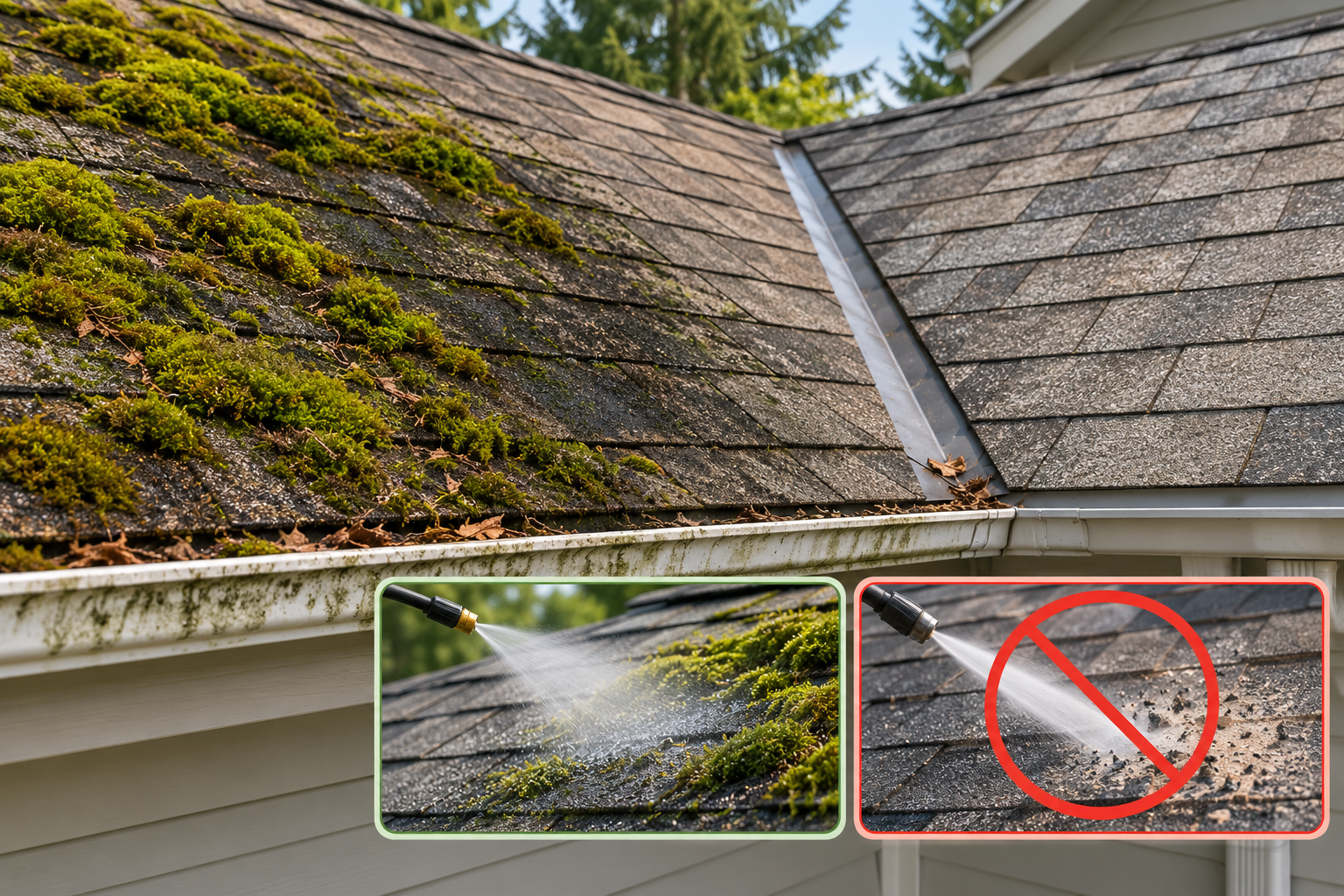
Cleaning, treatment, and repair are different scopes
Cleaning removes surface dirt, debris, biological growth, or staining. Treatment applies a product intended to kill or suppress growth. Repair replaces covering or details that are already split, lifted, cracked, eroded, displaced, or leaking.
Moss can trap moisture and lift or disturb some unitized coverings, but dark streaks may be mostly cosmetic biological staining. Lichen can be tightly attached. A provider should identify what is present and explain whether the proposed method removes it immediately, kills it for gradual weathering, or merely improves appearance.
Main cost drivers
- Roof area and number of planes: more setup, application, rinsing, and cleanup.
- Pitch, height, and access: steep or multi-level roofs require additional safety controls and labor.
- Material sensitivity: asphalt shingles, tile, slate, wood, coated metal, and membranes have different surface and breakage risks.
- Severity: heavy mats of moss and accumulated debris take longer than light staining.
- Water and runoff control: landscaping, siding, gutters, and neighboring property may require protection.
- Treatment plan: product dwell time, repeat application, and return visits change the price.
- Repairs discovered: loose shingles, cracked tile, open flashing, or soft decking are not cleaning work.
Why method compatibility matters
There is no universal safe pressure, chemical, brush, or treatment for every roof. Aggressive washing can remove protective surface material, drive water into laps or joints, damage coatings, or break fragile units. A product that is acceptable on one membrane or tile may be unsuitable for another. The installed covering manufacturer’s care instructions and the contractor’s system-specific experience should control.
Ask the contractor to name the method and cleaning product, identify the covering, and state how runoff will be managed. Be cautious when a proposal promises that high pressure is harmless to all materials or that one treatment prevents regrowth for a guaranteed universal period.
Three likely scenarios
Light staining on an accessible asphalt roof: The service may be primarily a compatible treatment with modest setup and cleanup. The economic question is cosmetic value versus the cost and risk of intervention.
Moss around valleys and shaded areas: The project may include debris removal, gutter cleanup, careful treatment, and a later check. If growth has displaced shingles or obscured flashing, budget for a separate repair decision.
Fragile tile, slate, or wood roof: Access and movement can be the dominant cost. A specialist may charge more but reduce breakage and recognize when surface growth is secondary to material deterioration.
When cleaning exposes a larger problem
Cleaning cannot restore missing granules, delaminated shingles, split shakes, cracked slate, deteriorated underlayment, corroded flashing, or wet decking. If the roof leaks, has widespread brittle material, or cannot tolerate normal service access, inspection should precede cosmetic cleaning.
For wood roofs, the decision may involve material condition, local fire rules, product-specific treatment, and whether compatible replacement pieces remain available. For tile, surface units may be intact while underlayment or flashing is failing. Do not use a clean appearance as evidence that the whole assembly is sound.
Recurring prevention economics
Tree pruning by a qualified provider, improved debris management, and periodic drainage cleaning may reduce recurrence, but site conditions remain decisive. A shaded north-facing slope in a damp climate will not behave like an exposed sunny roof. Zinc, copper, chemical, or proprietary preventive systems should be evaluated for the specific material and runoff context, not treated as universal add-ons.
Compare the annualized cost of repeat cleaning with the effect on appearance, drainage, and covering condition. If repeated service is mainly cosmetic, the homeowner may reasonably accept staining. If growth obstructs drainage or hides defects, periodic service has greater functional value.
Questions for the proposal
- What material and type of growth did you identify?
- Is the goal immediate removal, treatment, or both?
- What manufacturer or system guidance supports the method?
- How will fragile areas, gutters, siding, landscaping, and runoff be handled?
- Which repairs are excluded?
- Does the quoted price include a return visit?
The best-value cleaning is not necessarily the lowest bid. It is the least invasive compatible scope that solves the actual appearance or drainage problem without turning maintenance into premature replacement.
What should be excluded or separately priced
Cleaning proposals often leave ambiguity around gutter debris, siding rinse-down, landscaping protection, detached structures, stain removal, preventive treatment, broken covering, and return visits. Ask for these boundaries before comparing totals. A proposal that includes a second treatment after biological growth releases gradually is different from one promising an immediate like-new appearance.
Interior leaks, deck deterioration, flashing repair, and replacement of damaged roof units should be separate. If the contractor cannot see the covering condition under heavy moss, an inspection allowance and stop-work decision are more responsible than a guaranteed fixed repair price.
Economic alternatives
Accept cosmetic staining: If the covering is sound and the issue is appearance only, doing nothing can be rational.
Targeted treatment: Treat the affected shaded slope or bounded areas where the product permits, rather than clean the entire roof automatically.
Tree and moisture management: Appropriate pruning or debris control can reduce recurrence, though it may have separate arborist cost and should not harm the tree or create new sun/heat exposure assumptions.
Repair or replacement: When growth accompanies widespread splitting, erosion, displaced units, or end-of-system problems, cleaning can be money spent on material soon to be removed.
How to compare lifetime cost
Estimate the cleaning interval from the property’s actual history, not a product promise. Add return treatment, gutter work, access premium, and possible surface wear. Compare that sequence with accepting appearance, changing site conditions, or advancing replacement. Discount claims of a permanent one-time cure in a shaded damp exposure.
Take dated ground-level photographs before and after service. They help distinguish gradual treatment results from incomplete scope and give the next inspector evidence of recurrence.
Normalize cleaning quotes before comparing price
Put each proposal into the same scope table: roof areas treated, access method, debris removal, cleaning or treatment method, product compatibility, plant and property protection, gutter handling, rinse or cleanup, expected appearance after the first visit, return treatment, and responsibility for broken or already-deteriorated material. A cheap “wash” and a staged treatment with a documented follow-up are not the same service.
Ask contractors to state the condition assumption behind a fixed price. Light surface staining on an accessible slope is different from thick growth concealing fragile units. If the amount of hand work or damaged material cannot be known until growth releases, use a base scope plus an authorization process rather than accepting either an unrealistically low total or a blanket worst-case allowance.
Also separate access-related work from appearance promises. Steepness, height, setbacks, landscaping, solar panels, and brittle roofing can change labor and protection even when the treated area is small. A contractor who prices those constraints explicitly is easier to compare than one who promises a uniform per-square-foot result without inspecting the property.
Low, typical, and complex ownership cases
In a low-complexity case, discoloration is cosmetic, the covering is compatible with the proposed method, access is straightforward, and gutters or minor debris can be handled during one mobilization. The homeowner is mainly choosing between accepting appearance and paying for restoration.
In a typical recurring case, shaded areas accumulate debris and biological growth faster than exposed areas. The sensible scope may combine selective treatment, drainage cleaning, observation of affected units, and a realistic recurrence plan. The price decision is not one visit versus no visit; it is the expected sequence of visits versus changing the contributing site conditions or accepting some staining.
In a complex case, heavy growth hides split, loose, or eroded material; solar or difficult access fragments the work; or runoff protection is demanding. Inspection and stabilization may need to precede cleaning. The contractor should have a stop-work threshold if cleaning would damage the roof or reveal a repair/replacement condition.
Decide what success means
Define whether the objective is drainage, material preservation, reduced recurrence, or appearance. Those goals can require different methods and endpoints. Complete visual uniformity may demand aggressive work that is not justified for an aging surface, while a gentler staged treatment may meet the functional goal without producing an immediate “new” appearance.
When replacement is already planned within the homeowner’s short ownership or capital horizon, compare the cost of safe debris removal and water control with a full cosmetic program. When the roof otherwise has a useful planning horizon, compatible preventive work and site management may avoid repeated heavy cleaning. The decision should be tied to retained serviceability, not to a sales claim that cleaning either restores roof life to new or has no value at all.