
A straightforward pipe-boot or small roof-vent flashing repair usually lands in the several-hundred-dollar range. Expect more when the penetration is high or steep, the surrounding covering must be opened broadly, the deck is deteriorated, or the vent equipment—not only its roof flashing—needs replacement.
The service minimum often matters more than the cost of the boot. Correct integration with the roof is the value.
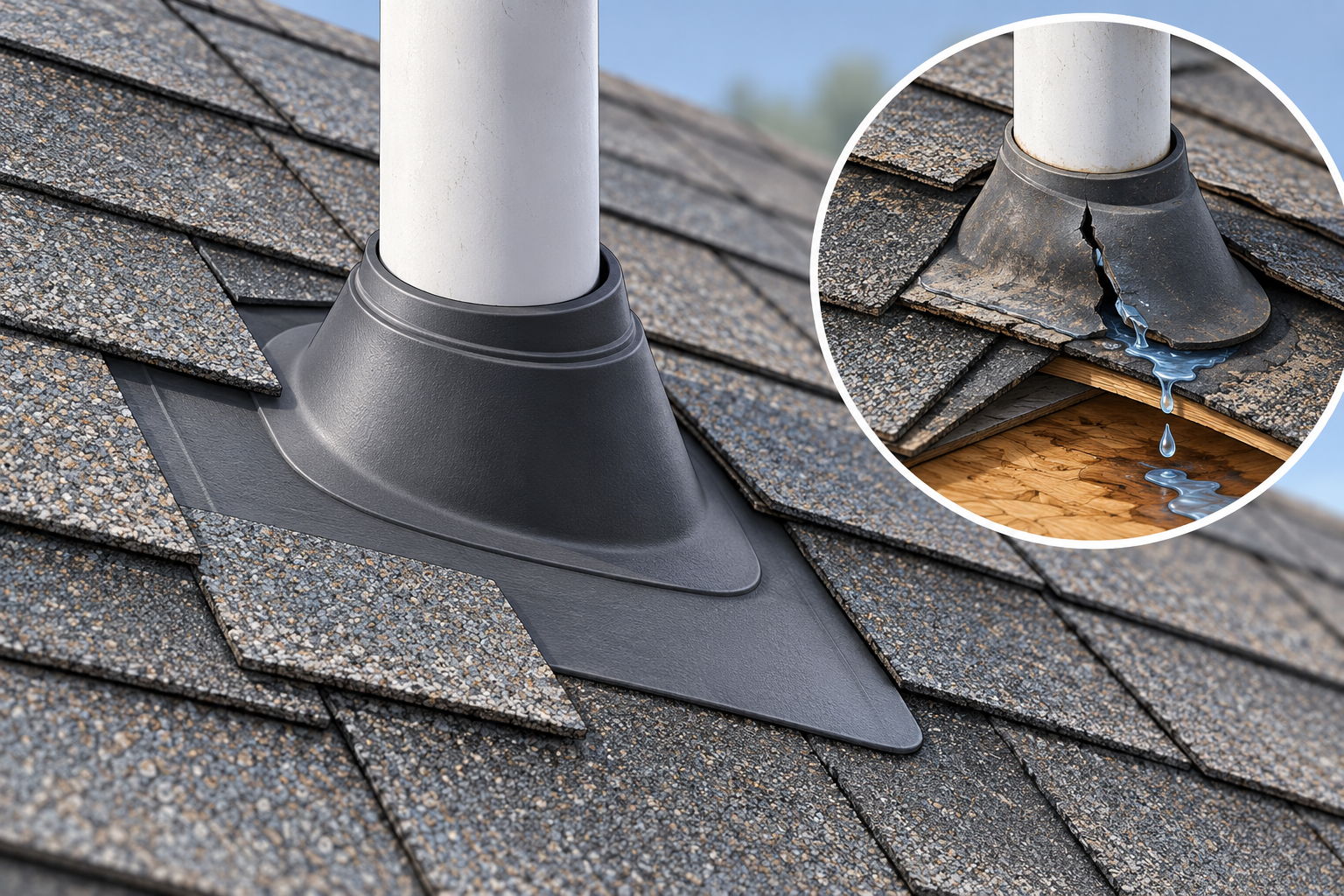
What can fail around a penetration
Plumbing vent boots can crack, split, deform, or separate around the pipe. Metal or plastic flanges can corrode or break. Fasteners and sealants can deteriorate. Roof vents may have damaged caps, flanges, or surrounding shingles. Wind or movement can disturb the detail.
But a stain near a pipe does not prove the boot failed. Water can travel from uphill flashing, a valley, a fastener, condensation on a duct, or a plumbing leak. Diagnosis should separate the roof-side water-control detail from the pipe, duct, or ventilation equipment.
Typical scopes
| Scope | Work involved | Cost effect |
|---|---|---|
| Compatible collar or limited repair | Address a localized defect without broad removal | Lowest when the existing flange and roof remain sound |
| Full boot/flange replacement | Remove nearby covering, install compatible flashing, restore courses | Common durable repair; governed by access and integration |
| Vent assembly replacement | Roofing plus replacement of the roof-side vent component | More material and possibly another trade |
| Deck repair | Open a wider area and replace deteriorated sheathing | Can turn a small penetration repair into a larger project |
Surface sealant may be a temporary measure or a designed part of a detail. It should not be used to hide a split boot or improperly layered flange.
What changes the price
- penetration type and diameter;
- asphalt shingles versus tile, slate, metal, or membrane;
- pitch, height, and access;
- number of penetrations handled in one mobilization;
- matching surrounding covering;
- wet insulation or deck damage;
- whether the pipe or equipment itself is damaged;
- work performed alone versus during reroofing.
If several aging boots need replacement, grouping them can reduce repeated setup. The contractor should still inspect each location rather than assume all leaks share one cause.
Roofing versus plumbing or HVAC
The roofer owns the water-shedding interface they contract to repair. A cracked plumbing stack, disconnected bathroom exhaust, corroded appliance vent, or failed powered ventilator may require a plumber, HVAC contractor, or electrician. Moving or resizing a penetration is different from replacing its flashing.
Ask who disconnects, modifies, or verifies equipment and whether the roofer’s warranty covers only water entry at the flashing. This is especially important for combustion vents and powered equipment, where technical and safety requirements are product- and jurisdiction-specific.
Repair during a reroof
Reroofing is usually the best time to renew aged penetration flashings because the surrounding covering is already removed. Reusing an old boot can save little relative to the cost of reopening the finished roof later. Conversely, automatic replacement of sound specialty equipment may be wasteful.
The reroof proposal should inventory penetrations and state which flashings or components are new, reused, or excluded.
Decision scenarios
Cracked boot, dry deck: Replace the boot and limited surrounding shingles. This is a focused repair with strong economics.
Recurring leak after sealant patches: Open the detail and inspect layering, flange, and decking. Paying once for proper integration may cost less than repeated service calls.
Stain below an exhaust vent: Roof flashing appears sound; condensation or duct leakage remains plausible. Do not approve roof replacement before the system boundary is diagnosed.
Several deteriorated penetrations on an aging roof: Bundled repair may make sense, but compare its cost and disruption with planned reroof timing.
Quote checklist
Confirm the identified penetration, diagnostic basis, component being replaced, area of covering removed, new underlayment or flashing, deck unit price, treatment of pipe/equipment, finish matching, and exclusions. A good proposal also states what happens if opening reveals that the water came from elsewhere.
The goal is not merely a new rubber ring or metal flange. It is a durable transition between the moving, weather-exposed penetration and the roof system around it.
Service-call economics
Because setup dominates, ask whether the contractor can inspect all similar penetrations during the same safe mobilization. Replacing additional verified aging boots can be efficient; automatically replacing every vent regardless of condition is not. Request a base price and per-additional-component option.
Emergency leak response may add temporary protection and after-hours premiums. Keep it separate from the permanent boot or equipment scope.
Product choice and compatibility
Boot materials, flange shapes, retrofit collars, high-temperature components, and metal details differ. The correct component depends on pipe material, movement, roof covering, slope, exposure, and equipment. A generic collar may be a useful repair on one sound flange and an inadequate patch on another.
For tile, slate, metal, and membranes, the surrounding integration can cost much more than the penetration component. Obtain a detail-specific proposal instead of applying asphalt-shingle unit pricing.
Related interior and equipment costs
Water entry can stain ceilings or wet insulation; condensation can mimic it. Plumbing stacks can move with temperature. Exhaust ducts can leak warm moist air. Powered vents can fail electrically. These possibilities justify diagnosis, not speculative replacement of every adjacent system.
Ask which trade verifies each component and whether access from the attic or interior is included. If combustion or electrical equipment is involved, use appropriately qualified professionals.
Future reroof planning
Record the component and repair date. At reroof, provide that history and require an inventory of penetrations. New covering should not be installed around unidentified aging flashings merely because a recent surface collar stopped a leak.
Compare the repair boundary
Put proposals into three categories. A surface or retrofit repair retains most of the existing flashing and addresses a verified limited failure. A boot replacement opens surrounding roofing and installs a new integrated component. A penetration rebuild also corrects pipe movement, damaged deck, unsuitable prior work, or an equipment condition. Their prices should not be compared as if they buy the same result.
Ask how many shingles, panels, tiles, or membrane layers will be disturbed; how they will be reinstated; and what happens if adjacent material cannot be reused. For concealed damage, request photographs and an agreed approval process. The component itself is inexpensive relative to an uncontrolled opening on a difficult assembly.
Check whether the proposal includes attic observation, exterior water-control work, pipe or duct correction, interior drying, and finish repair. Usually these should be identified as separate boundaries rather than hidden in one “leak repair” allowance.
Decision thresholds for a narrow defect
A localized boot repair is sensible when the source is credible, surrounding roof material remains workable, and the pipe or equipment is sound. Replace the integrated flashing when the flange, surrounding seal, or retained detail cannot provide a reliable water path. Involve another trade when movement, condensation, plumbing, exhaust, electrical, or equipment failure is part of the mechanism.
Escalate beyond a single component when several penetrations of similar condition are failing, deck damage extends outside the opening, or the covering breaks during careful access because it is no longer workable. That does not automatically require a whole reroof; it does justify comparing a grouped penetration scope, a bounded roof section, and planned replacement.
For owners planning a reroof soon, ask what part of the component work will be discarded and what is necessary to keep the building dry until then. For owners retaining the roof, ask whether the proposed repair avoids another mobilization and opening during the expected planning horizon. This ownership test keeps a small repair from being either underbuilt as a disposable patch or overbuilt without regard to imminent replacement.
A final quote test
A complete small-repair quote should still name the penetration, diagnosed failure, repair type, surrounding-material assumption, access, related-trade exclusion, concealed-damage rule, and workmanship terms. If those elements are absent, a low total is not yet a low-cost solution; it is an undefined service call.
What not to buy with a boot repair
Do not approve replacement of plumbing, powered ventilation, or interior finishes merely because water appears near a penetration. Do not accept a surface collar as equivalent to new integrated flashing without an explanation of retained-condition assumptions. And do not expand one localized component into full reroofing unless surrounding material, repeated penetration failures, or distributed conditions support that decision.
This is a deliberately bounded service decision. Once the quote has resolved diagnosis, integration, access, adjacent-trade responsibility, and future reroof timing, adding generic whole-roof cost discussion would duplicate broader guides rather than improve this repair choice.
Low, expected, and difficult totals
The low case is an accessible retrofit or boot replacement in workable asphalt covering with a sound pipe and dry local deck. The expected case opens more surrounding material, replaces integrated flashing, corrects local deck, and inspects similar penetrations under one mobilization. The difficult case involves tile, slate, metal, membrane, pipe movement, equipment, condensation, or broader substrate damage and brings another trade.
Keep the roof-side repair, pipe/equipment correction, interior drying, and finish work separate. Shared diagnosis does not make one contractor responsible for systems outside their qualification.
Alternatives and repeat-work economics
A compatible retrofit can preserve sound integrated material when failure is limited. Full replacement buys new integration when the flange or surrounding detail has failed. Grouped replacement of verified similar aging components can share access; automatic replacement of every penetration wastes serviceability. Reroof coordination can avoid reopening, while a temporary patch before imminent replacement must still bridge a defined interval reliably.
Final homeowner worksheet
Record penetration type, source evidence, roof material, retained/replaced component, removal area, deck assumption, pipe/equipment responsibility, similar-component check, warranty, and reroof timing. Once those narrow variables are resolved, broader leak, attic, plumbing, and whole-roof analysis belongs elsewhere.