
Professional gutter cleaning commonly costs about $100–$350 for a straightforward US home, with tall, large, complex, heavily blocked, or guard-covered systems reaching several hundred dollars more. Treat this as a planning range; Canadian pricing should be quoted in CAD locally.
What the service may include
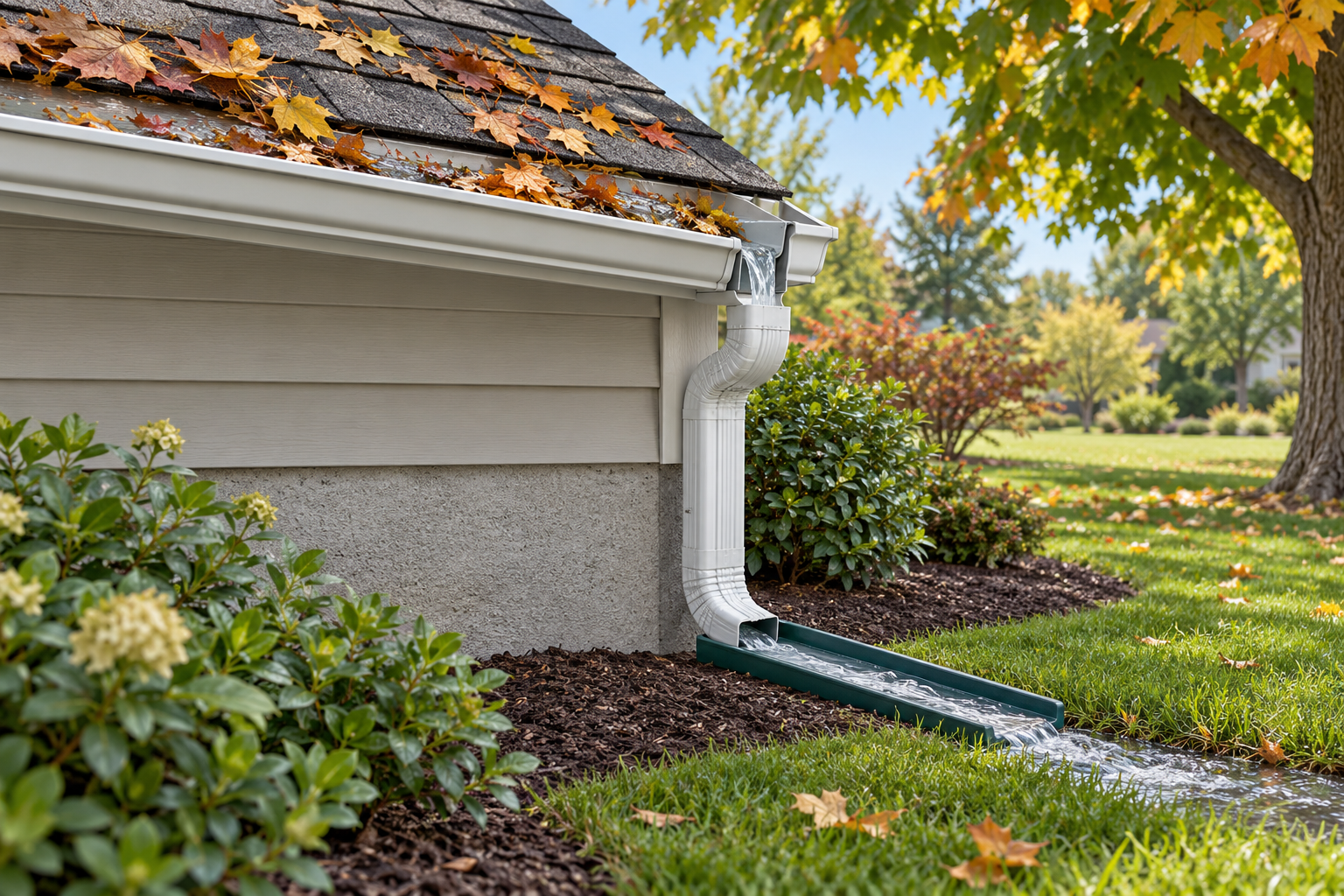
A basic service can remove debris from gutter runs and collect waste. More complete scope may flush or test downspouts, clear outlets, inspect hangers and slope, remove debris from valleys, clean exterior staining, or provide photographs. Those items are not automatically included.
Ask whether the contractor bags debris, uses water, clears underground connections, removes guard panels, and reports defects. Buried drain clearing is usually a separate service.
Main cost drivers
- gutter length and number of roof levels;
- two- or three-story access and steep roofs;
- heavy wet debris, roof valleys, and tree exposure;
- gutter guards that must be opened and replaced;
- blocked downspouts and difficult outlets;
- detached garages, additions, and multiple mobilization points;
- ice, storm damage, urgent timing, or limited setup space.
Linear footage alone misses access and debris condition.
How often is worthwhile?
Government of Canada guidance recommends checking in spring and fall and more often after severe weather or ice. That is useful maintenance guidance, not a rigid paid-service requirement. A home without nearby trees may need less; a valley below pines or deciduous canopy may need more.
Use actual debris accumulation and overflow history. Schedule before predictable heavy-rain or freeze periods, not simply by calendar subscription.
Downspout clearing
A clean trough can still overflow if outlets or downspouts are blocked. Confirm whether flushing is included and where water discharges. If a downspout connects to a buried line, the cleaning contractor may stop at that boundary.
Repeated blockage at one outlet may indicate layout or capacity issues, not just cleaning frequency.
Guards and maintenance
Gutter guards can reduce some debris entry but do not make a system maintenance-free. Fine material can collect on or beneath products, and valleys may overwhelm the surface. Guard removal increases cleaning labor. Compare the installed guard cost plus remaining service with the cleaning spend it actually avoids.
When cleaning becomes repair
Leaks, separated joints, loose hangers, sagging, poor pitch, damaged outlets, fascia deterioration, and chronic clean-system overflow need diagnosis. A cleaner may document them, but repair should be separately priced.
Scenarios
One-story open access: Modest recurring cost; bundle downspout check and photographs if useful.
Tall tree-covered home: More frequent service, higher access cost, wet debris, and guard handling can justify a seasonal agreement.
Clean gutters still overflow: Stop buying extra cleanings and evaluate outlet count, gutter/downspout capacity, concentrated valleys, and downstream discharge.
Quote checklist
Confirm all buildings and levels, guards, debris removal, downspout testing, water use, buried-line boundary, photographs, repair reporting, and cancellation/weather terms. The economic goal is clear roof runoff at an interval justified by the property—not the maximum possible cleaning frequency.
Bundling and minimum charges
Cleaning detached garages, lower additions, roof valleys, or a second property during the same visit may reduce unit cost. Adding high or difficult areas can instead change equipment and crew needs. Request alternates rather than assuming one per-foot rate.
Minor joint seal or hanger work may be offered during cleaning. Pre-authorize a small cap and require photographs so convenient repair does not become uncontrolled scope.
Cleaning method and property protection
Ask whether debris is removed by hand, vacuum, air, or water at a high level; how siding, landscaping, roofs, and occupants are protected; and where waste goes. Method should fit roof/gutter material and site. Downspout flushing should not knowingly force debris into an uncertain buried line.
Seasonal agreement economics
A fixed annual plan can reduce scheduling friction for tree-heavy or absentee properties. Compare included visits, storm callouts, guard work, cancellation, and repair response. A subscription is weak value when service occurs even though gutters are clear.
Alternatives
Tree management, added outlets, corrected slope, larger downspouts, or guards may reduce a specific burden. None eliminates inspection, and tree work must be appropriate for tree health and property context. If cleaning history is low, continued on-demand service may beat capital upgrades.
Evidence of value
Before/after photographs, outlet testing, debris description, and defect notes make the service reviewable. Track which areas clog and how quickly. After two or three cycles, adjust interval rather than repeating a generic schedule indefinitely.
Normalize service prices
Compare building levels and run lengths, access method, roofs or gutters walked, debris removal, downspout clearing and testing, guard lifting/reinstallation, valley or roof-surface debris, waste disposal, photographs, minor repair authorization, travel, and weather/rescheduling terms. A low “whole house” price may exclude upper runs, guards, detached garages, or buried-line problems.
Ask how the provider responds to a blocked downspout. Flushing an above-ground leader, dismantling an elbow, and diagnosing a buried drain are different services. The contract should stop before forcing debris into an unknown receiving line.
Low, typical, and complex service cases
A low-complexity case is an accessible one-level perimeter with light debris and open above-ground discharge. Mobilization may be the largest price component.
A typical case includes multiple levels, tree exposure, several downspouts, moderate accumulation, guards that need surface care, and before/after documentation. Repeated problem outlets can be identified for redesign rather than simply cleared again.
A complex case involves steep/high access, fragile roofing, roof valleys packed with debris, difficult guard removal, blocked buried leaders, or deteriorated gutters/fascia. Cleaning, drainage diagnosis, repair, and specialist roof access may need separate scopes.
Choose an interval economically
Start from debris type, tree cycles, roof geometry, past clog timing, occupancy, and consequence of overflow. One property may need more than one targeted seasonal visit; another may need only condition-based service. No universal calendar replaces observation.
Compare on-demand service with an agreement using actual visits, response terms, included outlets, photos, and repair pricing. Add the owner’s safe time only if do-it-yourself work is realistically appropriate; roof and ladder hazards can make professional access the rational cost.
After several cycles, calculate total cleaning and recurring repair cost by location. If one valley/outlet/downspout repeatedly drives service, an added outlet, slope correction, larger leader, guard change, or tree/site response may be the better capital decision. If debris is light and service rare, a guard investment may never recover its cost.
Stop cleaning when the problem is not debris
Persistent overflow with clear gutters calls for capacity, pitch, outlet, valley-flow, roof-edge, or downstream diagnosis. Leakage through corroded material calls for repair or replacement. Water returning at a foundation calls for discharge/site review. A cleaning invoice is good value only when obstruction is the mechanism it resolves.
Read low-price offers carefully
Confirm whether the price is a booking minimum, one-level allowance, or complete mapped property. “Downspouts included” can mean checking visible outlets rather than clearing and testing full leaders. “Minor repairs included” needs an authorization boundary; otherwise it can mean either unapproved extras or no meaningful repair.
Ask how damage observed during cleaning is documented and whether the provider is qualified to repair it. A cleaning service can route roof, fascia, or buried-drain problems without claiming expertise across every trade.
Ownership decision after several visits
Add actual visits, difficult-access premiums, repeated outlet calls, and any guard removal. Compare that total with a guard, added outlet, larger leader, tree/site action, or leaving the system unchanged. Capital work is justified only if it addresses the recorded burden. Cleaning can remain the lowest-cost strategy indefinitely when it is predictable, safe, and effective.
Example service plans
A lightly exposed property can begin with inspection-based service: clean when observations show accumulation and keep outlet photographs. A tree-heavy property can schedule around the actual debris cycle, then add a post-storm check only when events justify it. An absentee high-access property may choose a documented agreement because monitoring and reliable response have value beyond labor time.
For each plan, state the trigger, included runs, downspout treatment, evidence, and repair authorization. Review after actual cycles. The cheapest theoretical frequency is not economical if clogs occur between visits, and the most frequent plan is wasteful if technicians repeatedly document clear gutters.
Final service checklist
Confirm the property boundary, upper and lower runs, guards, roof/valley debris, downspout testing, buried-line stop point, method, protection, waste, photographs, defects, and price for authorized extras. Then identify the next decision if one area blocks again. A cleaning plan is sufficiently deep when it manages both today’s debris and the evidence needed to avoid unnecessary future visits.
Uncertainty boundary
Weather and debris cycles vary, so the plan should use observations rather than promise a fixed annual need. That uncertainty affects timing, not the depth of the decision: the owner can still define service scope, evidence, repair boundaries, alternatives, and the trigger for changing frequency.