
The useful comparison is the incremental installed price between products on the same roof. Basic, architectural, and premium are market labels, not a universal technical classification. Two “architectural” products may differ in construction, weight, rating, accessory requirements, and warranty.
Because tear-off, decking, underlayment, flashing, access, and disposal are largely shared, paying more for the shingle does not necessarily raise the whole project in the same proportion.
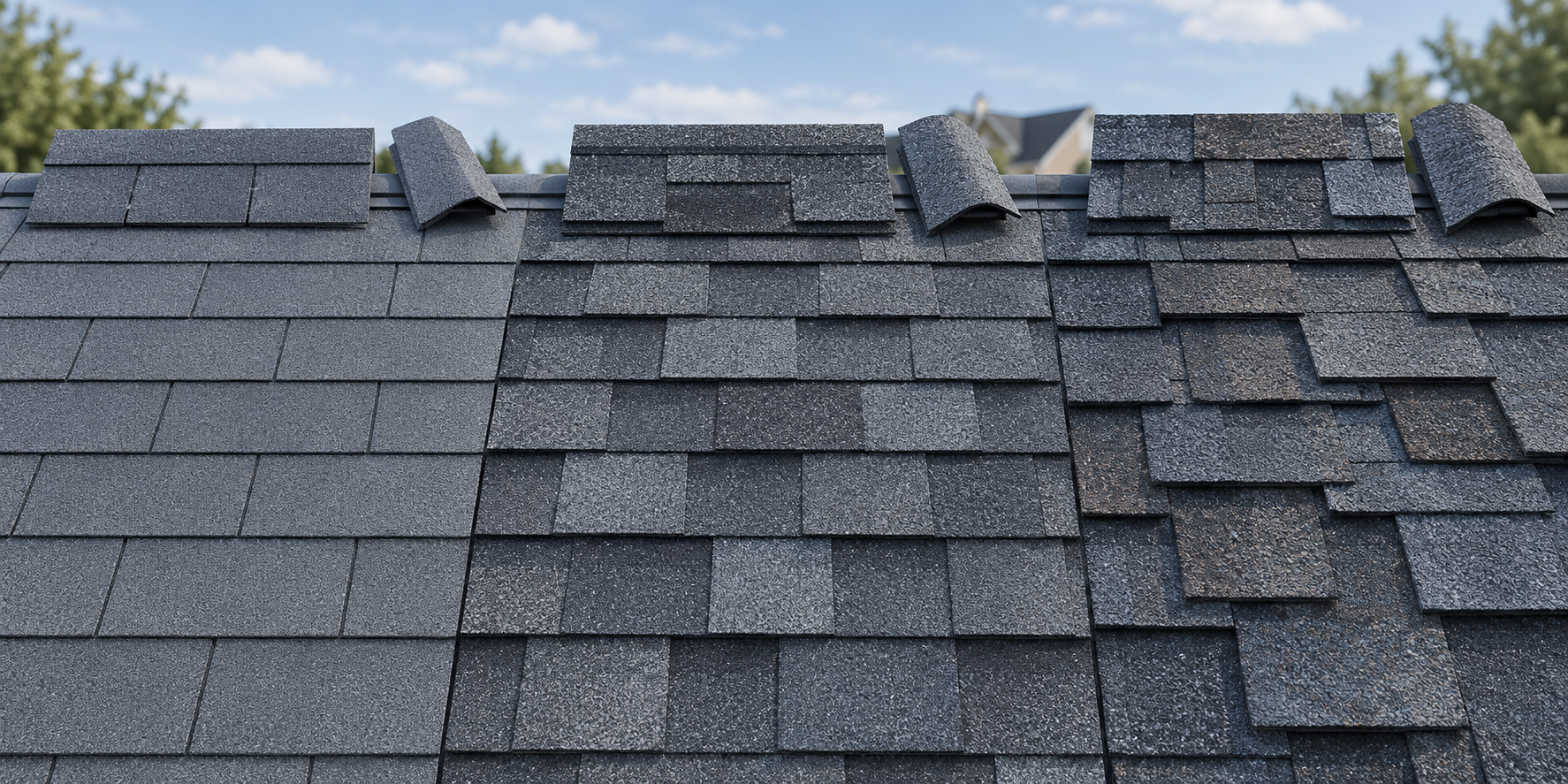
What the labels usually mean
| Market tier | Typical purchase rationale | Questions to verify |
|---|---|---|
| Basic/standard | Lowest material cost, simple appearance | Local availability, rating, accessory system, future matching |
| Laminated/architectural | Dimensional appearance and broader mainstream product choice | Exact construction, weight, wind/impact options, installer familiarity |
| Premium/designer | Distinct profile, heavier look, specialty color or performance package | Added labor, waste, structure, repair stock, real tested attributes |
Do not infer service life from the tier name. Installation, climate, ventilation, maintenance, weather exposure, and product specifics matter.
Where the upgrade changes the budget
Ask the contractor to price identical scope with two or three exact products. The difference should isolate field shingles, matching starter/ridge components, waste, handling, and any changed labor. If the “premium upgrade” also includes better underlayment, flashings, or workmanship terms, separate those values.
On a simple roof, a product upgrade may be a manageable fraction of total cost. On a cut-up roof with high waste, expensive premium material magnifies waste. On a small roof, minimum labor and setup can make material differences less important.
Performance attributes
Wind and impact ratings can matter, but they must be tied to the exact product and installation. IBHS notes that asphalt shingle sealing is temperature-activated and weathering weakens sealant over time. Overall wind performance is not determined by a tier label.
Likewise, an impact classification does not guarantee that hail will leave no cosmetic or functional damage. Storm size, impact conditions, roof age, assembly, and insurer treatment vary. Verify local requirements and any claimed premium discount before paying for an upgrade solely on insurance savings.
Appearance and resale
Dimensional or designer products may better fit a visible steep roof or architectural style. That value is subjective but real. If most of the roof is barely visible, spending on flashing, deck repairs, drainage, or installation quality may produce more functional value than a premium profile.
Avoid assuming the most expensive shingle creates a proportional home-value increase. Choose the appearance for your ownership preferences and local market, not a guaranteed return.
Warranty interpretation
Long marketing terms do not equal predicted roof life. Read material coverage, prorating, wind or algae provisions, installation-system requirements, transfer terms, exclusions, and contractor workmanship coverage. A premium package may improve coverage only if every condition is met.
Ask who registers the warranty, what documentation you receive, and whether maintenance or ventilation conditions matter. Treat any “lifetime” label as contract language to examine, not a durability measurement.
Repairability and future matching
Mainstream locally stocked products may be easier to repair later. A distinctive premium color or profile can be harder to match if the line changes. Retaining a small quantity of properly stored material may help, but storage does not guarantee future suitability.
Heavier or more complex products can also change cutting, handling, and ridge details. Confirm installer experience with the exact line.
Decision scenarios
Budget-constrained rental or short ownership: A compliant mainstream product with sound assembly scope may be more rational than a designer upgrade.
Long ownership on a visible roof: A moderate architectural upgrade can spread a relatively small incremental material cost across many years of appearance value.
Hail-prone location: Compare exact tested impact options, installed premium, local availability, and verified insurance treatment. Do not buy the tier name alone.
Complex roof with hidden-condition risk: Preserve contingency for decking and flashing before committing the entire budget to surface cosmetics.
Bottom line
First buy a coherent installed roof: sound substrate, compatible underlayers, correct flashing, drainage, and workmanship. Then compare exact shingle products by incremental cost and attributes that matter to your property. The middle tier is not automatically the value winner, and premium is not automatically wasteful; value depends on the roof, exposure, ownership horizon, and verifiable product differences.
Keep the bid comparison controlled
Ask one contractor—or competing bidders—to price exact products on the same measured roof, waste, underlayment, flashing, ventilation, tear-off, deck allowance, and workmanship scope. Otherwise the apparent shingle premium may include unrelated assembly changes.
Calculate both total-dollar and percentage difference. A $2,000 product upgrade on a $20,000 project is a different decision from a $2,000 upgrade on an $8,000 simple roof, even if marketing describes both identically.
When basic can be the rational choice
Basic can make sense on a modest, low-visibility, short-ownership, or budget-constrained project when it meets actual product, climate, and local requirements. Preserve money for substrate, flashing, access, and contractor quality. Cheap becomes false economy only when the product is unsuitable or the low tier forces sacrificed assembly scope.
When premium can be rational
A visible architectural roof, strong preference for appearance, verified impact or wind option, long ownership horizon, or limited cost difference after shared labor can justify premium. The rationale should survive without assuming guaranteed resale or service life.
Questions about ratings and warranties
Request the exact test classification, installation conditions, and exclusions. Ask whether ridge and accessory components share the claimed rating. Confirm local insurer treatment directly. Read whether warranty coverage is full or prorated, material-only or labor-inclusive, and conditioned on an approved component system.
Future repair scenario
Price is not the only lifecycle factor. Ask how common the product is, whether the color/profile is likely to remain stocked, and how a damaged section is serviced. A visually complex premium line can create matching risk; a mainstream architectural line may balance appearance and repair availability.
Compare the upgrade as an installed increment
Ask one qualified bidder to price the same roof assembly with each eligible product tier. Hold tear-off, underlayment, deck assumptions, flashing, ventilation, accessories, disposal, and workmanship constant. The resulting difference is closer to the installed cost of the shingle choice. Quotes from different contractors with different scopes cannot isolate grade value.
Then check whether the upgrade changes labor, waste, starter or ridge components, fastening, warranty registration, or delivery. A heavier or more complex product may affect more than the field-material allowance. Conversely, a large total-project premium should not be attributed to shingles if it also includes deck or ventilation work.
Calculate the incremental dollar cost over the ownership period you can reasonably plan, but avoid dividing by a promised lifespan as if it were guaranteed. The useful question is whether the upgrade’s verified attributes and appearance justify the additional capital under the property’s exposure and the owner’s priorities.
Three controlled comparisons
In a budget-led case, every eligible option meets the roof’s actual slope, exposure, and local requirements. The basic or mainstream product preserves funds for substrate and interfaces. The decision is mainly appearance and verified feature preference, not whether the roof will be “good.”
In a performance-led case, the exact premium product carries a relevant tested classification or assembly feature and all required accessories and installation conditions are included. The owner compares the installed increment with exposure, insurance treatment confirmed separately, and the cost of other resilience measures.
In an appearance-led case, profile, shadow line, color blend, and visibility drive the choice. Use actual samples on the property and accept that weathering, batch variation, and future matching limit certainty. Resale value should be treated as a preference benefit, not booked as guaranteed recovery.
Tradeoffs beyond the product label
A basic line may have fewer aesthetic options but be common and easier to source for repair. A premium line may offer a desired profile but require more expensive matching accessories or make a future patch conspicuous. Local contractor familiarity can matter: an ordinary product installed as a coherent system may be a lower-risk purchase than a specialty line treated as interchangeable.
Wind and impact language needs careful boundaries. A test classification describes performance under specified conditions; it does not promise that every installed roof avoids storm damage. Confirm substrate, fastener pattern, edge and ridge components, and whether the warranty or insurer attaches conditions to the claimed feature.
Warranty comparisons should separate manufacturing defects, workmanship, wind terms, algae or appearance provisions, labor, transfer, proration, and exclusions. The longest headline term can deliver less useful protection than a shorter, clearer remedy.
A decision threshold that avoids false economy
Do not downgrade required assembly work to reach a premium product. If the budget forces a choice between known deck/flashing needs and a higher field-shingle tier, correct the assembly first. Upgrade after the base roof is complete and suitable.
Do not reject a premium option solely because it does not guarantee payback. It can be a rational discretionary purchase when the installed increment is clear and the owner values a verified attribute or appearance over the planned horizon. The quote should make that preference visible rather than hiding it inside an undifferentiated roof total.
A quote-normalization example
Suppose the basic bid is lower but reuses several flashings and specifies a simpler underlayment, while the premium bid includes new flashings and a ventilation change. The difference cannot be called a shingle-grade premium. Ask the same contractor to substitute the exact eligible basic, mainstream, and premium shingle into one constant assembly, then add any product-required accessory or labor difference.
Now the owner can decide whether the installed increment pays for appearance, a relevant tested classification, a warranty remedy, or another documented feature. If the reason is mainly personal preference, say so; not every rational upgrade needs a financial return.
Avoid false precision in lifecycle comparisons
Do not divide each quote by the longest advertised warranty term or a universal service-life estimate. Weather, deck and attic conditions, installation, maintenance, storm exposure, repairability, and product continuity all affect outcome. Model a conservative holding period shared by all options, then test whether the premium conclusion changes under a longer and shorter case.
If the premium only wins under an optimistic life extension unsupported by the exact product and assembly, treat it as discretionary. If it remains affordable and valued without that assumption, the decision is more robust.
Compare difficult-case repair and replacement
Model one bounded storm repair for each tier: matching availability, accessory compatibility, surrounding workability, and visible outcome. Then model replacement under the same deck and flashing assumptions. A premium profile may be more expensive or conspicuous to patch; a basic line may be easier to source but offer fewer desired attributes. Exact local stock matters more than the tier name.
For a long ownership plan, retain repair stock and product records and include inspection after significant events. For a short plan, choose an eligible coherent system whose installed increment is acceptable without assuming buyer reimbursement. This closes the grade decision at the level of real future interventions rather than warranty headlines.
Final comparison record
Keep the constant base assembly, exact products and accessories, installed increments, verified classifications, samples, warranty remedies, repair availability, ownership horizon, and reason for selection. If the premium grade wins, identify the attribute or appearance valued. If basic wins, confirm that eligibility and complete assembly were not sacrificed. This record prevents a future reader from interpreting “cheaper” or “better” without the controlled assumptions.
Regret test
For premium, accept the case in which the roof needs an ordinary repair or replacement without delivering a measurable financial return; the owner still receives the chosen verified feature or appearance. For basic, accept fewer aesthetic or optional features while retaining required performance. If either downside is unacceptable, the mainstream middle tier may be the more robust choice even when it does not maximize one attribute.
Uncertainty boundary
Future storms, matching stock, product continuity, and actual service period cannot be guaranteed. Keep those variables as conservative and difficult scenarios shared by every tier. The selection should turn on today’s verified installed increment and valued attributes, not a forecast that makes one grade appear mathematically certain to pay back.