
Chimney flashing repair often costs $1,000 to several thousand dollars because the roofer opens covering around four sides, fabricates or installs layered flashing, and coordinates counterflashing with masonry. Add a cricket, broad deck damage, steep access, slate/tile, or masonry reconstruction and the total can rise considerably.
A “leak around the chimney” is not automatically a flashing-only problem.
The interface
Step flashing commonly integrates course by course along the sides. Apron and back-pan details manage the downhill and uphill sides. Counterflashing protects the upper flashing termination at masonry. A cricket or saddle may divide water on the upslope side in applicable configurations.
Exact details vary with chimney width, roof slope, covering, wall construction, and local requirements. Surface cement or caulk is not equivalent to a rebuilt layered system.
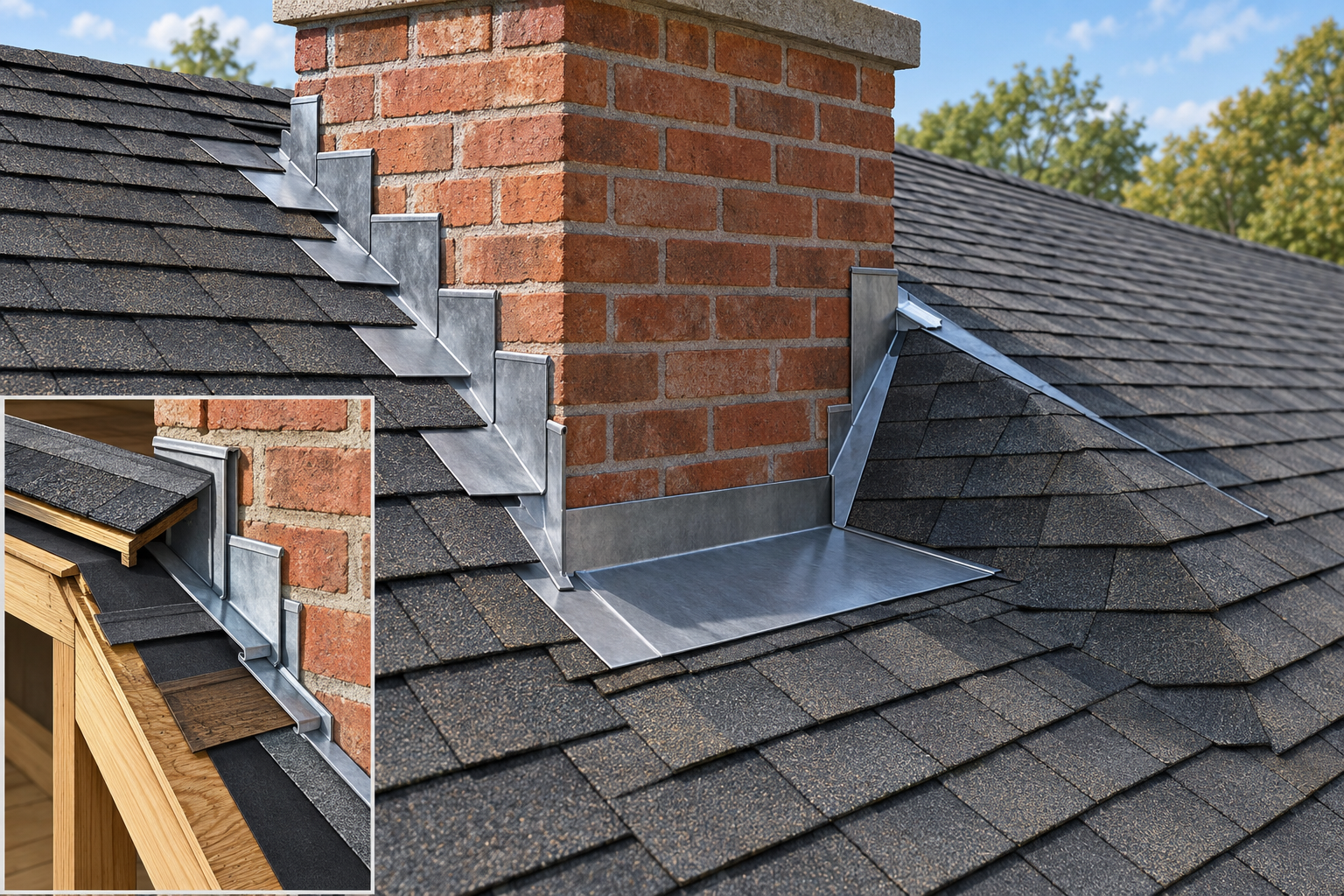
Roofing versus masonry
The roofer can own covering, underlayment, step/apron/back-pan components, and local deck work. A mason or chimney specialist may need to repair mortar joints, masonry units, crown, cap, or flue-related components and integrate counterflashing.
If cracked masonry admits water above sound roof flashing, reroof work alone will not solve it. If counterflashing is sound but step flashing is missing, masonry-only coating will not restore the roof path.
Cost drivers
- chimney width and location on the roof;
- steepness, height, staging, and access;
- asphalt, wood, metal, tile, or slate covering;
- new custom metal and counterflashing method;
- cricket/saddle construction;
- deck and framing condition;
- masonry cutting, repointing, or reconstruction;
- interior staining and restoration outside roof scope.
Repair during reroofing
Reroofing removes surrounding covering, creating the best opportunity to inspect and renew flashing. Reusing inaccessible old flashing can save little relative to reopening new roofing later. If masonry work is also required, schedule it so completed roof details are not damaged or left unprotected.
The reroof proposal should state whether existing counterflashing is reused and why.
Scenarios
Localized failed step flashing: Masonry is sound, deck damage is small, and surrounding shingles are serviceable. Roofer opens and rebuilds a bounded area.
Masonry and flashing failure: Repointing or counterflashing work and roofing must be sequenced. Two coordinated scopes cost more but address both water paths.
Wide upslope chimney with repeated leaks: A properly designed cricket may be part of the durable solution, adding framing/decking, underlayment, and metal work.
Old slate roof: Salvage, specialist staging, custom flashing, and matching make the project far more labor-intensive than an asphalt repair.
Quote checklist
Require all four sides, covering removal, new flashing components and metal, counterflashing ownership, cricket scope, deck allowance, masonry exclusions, finish restoration, and diagnostic basis. Ask who warrants the roof-masonry interface.
The right project may be roofing, masonry, or both. Paying for one trade to repeatedly seal the other trade’s failed component is the most expensive path.
Diagnostic clues and limits
Leak timing, chimney face exposure, attic staining, masonry cracks, crown condition, and flashing layout can help narrow the path. Water can enter masonry above the roof and emerge at the interface; it can also bypass step or back-pan flashing while masonry appears sound. Controlled testing may be useful, but one hose result does not represent every wind-driven condition.
Scope alternatives
Maintenance/reseal: Appropriate only for a sound designed joint whose sealant has reached service need.
Localized reflash: Open one or more sides where the defect is bounded.
Complete four-side rebuild: Renew the coordinated system when details are broadly deficient.
Cricket plus reflash: Change the upslope water path when technically indicated.
Masonry/chimney project: Repair source conditions above or within the chimney, coordinated with roof work.
Materials and future access
Metal choice, soldered or joined details, reglet/counterflashing method, sealants, and compatibility are assembly-specific. Pay for durability aligned with expected roof and chimney life. If the roof will be replaced soon, temporary stabilization may make more sense than reopening twice; if new roofing is being installed, renewing marginal flashing is usually efficient.
Change-order planning
Agree on deck unit price, concealed masonry response, framing escalation, and temporary dry-in. If two trades are involved, establish sequence and protection between visits. A roofer should not leave an open interface waiting indefinitely for a mason.
Closeout
Keep photos before covering, metal/detail description, masonry work, water-test or observation results, and warranty contacts. Future diagnosis is faster when the concealed interface is documented.
Normalize the interface opening
Compare chimney perimeter, upslope geometry, roof covering removed, step/base/counterflashing treatment, cricket or diverter work, masonry joint or surface responsibility, deck allowance, interior/attic observation, temporary protection, and reinstatement. “Reflash chimney” is incomplete unless the proposal states how new roof-side water control terminates into or against the chimney.
A surface reseal, localized metal repair, complete perimeter rebuild, and cricket-plus-reflash solve different conditions. Ask each contractor to identify the observed mechanism and why the priced boundary reaches sound material. If roofing and masonry diagnoses conflict, a controlled opening or joint site meeting may cost less than repeated callbacks.
Three economic cases
A low-complexity case is a bounded defect in an accessible interface with sound surrounding covering and masonry. Safe setup may dominate the component material.
A typical case requires removing several courses, fabricating or installing integrated flashing, opening masonry joints or siding-like finishes, correcting localized deck damage, and coordinating two trades. The bid should show which contractor provides temporary weather protection between steps.
A complex case combines large upslope flow, a missing or failed cricket, irregular or deteriorated masonry, several roof planes, specialty covering, or concealed earlier work. Water may also enter through the chimney above the roof. Investigation and masonry repair can become as important as roofing metal.
Repair now or coordinate later
Repair now when active leakage or deterioration can be corrected without sacrificing broad sound work. If reroofing or chimney reconstruction is already imminent, price a safe durable stabilization and the incremental coordinated rebuild. Avoid paying twice for finished flashing that must be removed, but do not let a known opening remain under an undefined future plan.
For a long retained-roof horizon, favor complete compatible integration and clear divided warranties. For a short horizon, do not reduce the project to exposed sealant if the concealed water path is known to be defective; select a bounded scope that can actually bridge the planned interval.
This page remains focused on the chimney interface. Distributed roof leakage, whole-roof replacement, and masonry reconstruction beyond the junction should be evaluated under their own scopes rather than folded into an oversized flashing allowance.
Read warranties and exclusions
A roofer may warrant the new roof-side integration while a mason warrants counterflashing joints or chimney repairs. Ask how a repeat leak is assigned and tested before either trade excludes the other. Interior stain repair should usually wait until the source is controlled and materials have dried. Clear divided responsibility is more useful than one vague promise to “fix the chimney leak.”
This bounded decision is complete when source hypotheses, roofing and masonry scope, opening assumptions, timing, and repeat-leak process are explicit. Extending it with generic whole-roof cost material would not improve the interface choice.
Compare roof-only, masonry-only, and coordinated scopes
A roof-only proposal is appropriate when the leak mechanism is confined to failed roof-side integration and the chimney above is serviceable. A masonry-only proposal is appropriate when water enters through caps, crowns, joints, or masonry conditions while roof flashing remains sound. A coordinated scope is necessary when counterflashing termination, reglets, cricket geometry, or concealed wall/roof transitions require both trades.
Ask each provider which observed condition rules the other scopes out. If neither can isolate the source, price a joint inspection or bounded opening rather than buying two independent surface patches. The coordination premium can be economical when it prevents each trade from removing or invalidating the other’s work.
Low, expected, and difficult totals
The low case is one accessible bounded metal or sealant-dependent joint repair on sound roof and masonry. The expected case opens covering around the perimeter, installs integrated base/step and counterflashing work, and carries localized deck or joint repair. The difficult case adds a cricket, specialty covering, broad masonry deterioration, irregular geometry, staging, or concealed framing.
Keep interior restoration separate until water control and drying are established. A finished ceiling repair should not be used to make a roof or masonry proposal look complete.
Final homeowner worksheet
Record symptom location and weather, roof and masonry findings, perimeter/opening assumptions, metal and joining approach, cricket decision, deck and masonry units, trade sequence, dry-in, warranties, and reroof timing. The correct scope is the smallest coordinated intervention that restores a credible path around the entire affected interface for the intended holding period.