
A 2026 Angi guide reports roof inspection costs from $75 to $1,150, with an average of $252. It also gives method-specific ranges, but those categories do not define a uniform inspection scope. Treat them as one US-oriented source’s planning figures, not a standard fee or a Canadian price; compare what each provider will inspect and deliver.
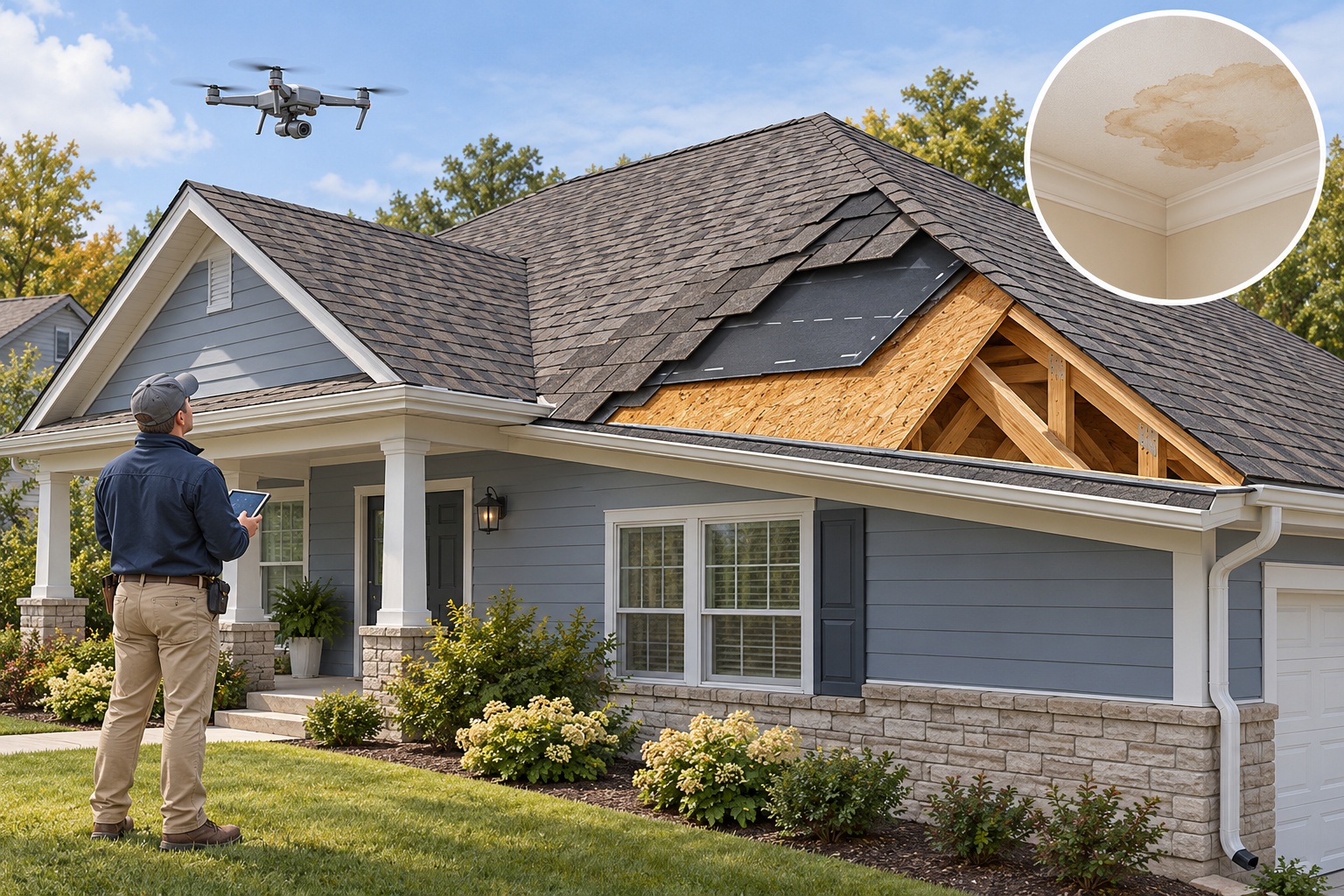
The important question is not only what the visit costs. It is whether you are buying the type of inspection that can answer your actual question.
Published method and add-on estimates
Angi’s guide separates several methods and optional services. Its labels and scopes are not standardized across providers, so use the figures as prompts for a written quote rather than assuming two similarly named inspections are equivalent.
| Service in Angi’s guide | Reported estimate (USD) | Scope question to resolve |
|---|---|---|
| Physical inspection | $75–$200 | Is roof access safe and included, or is the review limited to visible areas? |
| Drone inspection | $150–$400 | Does the deliverable include mapped photographs and close views of details? |
| Infrared inspection | $400–$600 | What conditions are suitable for scanning, and who interprets the images? |
| Attic inspection add-on | $200–$500 | Which attic areas are accessible, and is moisture testing included? |
The same guide reports an overall $75–$1,150 range and a $252 average. The method figures may overlap with, rather than add mechanically to, the headline total. Request an itemized scope and confirm currency, travel, report, and tax before comparing bids. These are US estimates; obtain local CAD quotes in Canada.
Four services are often called a roof inspection
| Service | Best for | Typical limitation |
|---|---|---|
| General visual inspection | Understanding visible condition before maintenance, purchase, or budgeting | Does not open the assembly or prove that hidden layers are dry |
| Leak investigation | Tracing an active or intermittent water-entry problem | May require repeat observation, testing, or opening materials |
| Storm assessment | Documenting visible wind, hail, impact, or edge damage | Does not determine insurance coverage or every concealed failure |
| Specialized evaluation | Moisture scanning, structural review, engineering, or detailed insurance documentation | Usually a separate scope and fee |
A free replacement estimate is different. A contractor may inspect enough to price the work they propose, but the deliverable may not be an independent condition report or a diagnosis of competing repair paths. Ask whether the visit produces findings you can keep, photographs, an identified repair area, remaining unknowns, and a repair-versus-replacement opinion.
What a standard visual inspection should address
A useful condition inspection normally considers the visible covering, flashings, valleys, walls and penetrations, roof edges, gutters or roof drains, and signs of deterioration. From safe accessible locations, the inspector may also look for missing, cracked, curled, split, loose, or displaced components. Interior ceiling stains and accessible attic observations can add context, but an attic check is not automatically included.
NRCA maintenance guidance notes that some steep-slope inspections can be performed from the ground or a ladder at the edge. That is a practical safety boundary, but it also limits what can be seen. A report based on binoculars, a camera pole, or a drone can document surface conditions without a full roof traverse; it cannot promise that concealed decking, underlayment, or insulation is sound.
What moves the fee
Expect the price to rise with:
- multiple stories, steep slopes, fragile coverings, or difficult ladder access;
- many roof planes, dormers, valleys, skylights, chimneys, and transitions;
- a large low-slope roof with drains, parapets, or mechanical penetrations;
- snow, ice, wet surfaces, or storm debris that restrict safe access;
- an attic or interior component;
- a written narrative, photographs, measurements, or repair-priority schedule;
- moisture scanning, controlled water testing, or other specialized methods;
- travel, emergency scheduling, or insurer-specific documentation.
For a simple, one-story visual check, a few hundred dollars may buy the information needed. A difficult leak or specialist assessment can cost more than the headline inspection range because it is no longer a routine condition survey.
Inspection versus leak diagnosis
A visual inspection answers, “What visible conditions deserve attention?” Leak diagnosis asks, “How is water entering, and what scope is likely to stop it?” Those are not always the same.
Water can travel along decking, framing, underlayment, or a penetration before it appears indoors. The stain below a skylight or chimney does not prove that the skylight unit or chimney flashing failed. Wind-driven rain may appear only under particular weather conditions. Low-slope roofs can hold water far from the interior symptom.
If leakage is the reason for the visit, request a diagnostic scope and ask what happens if the first visual review is inconclusive. A service call that includes a small repair may be economical; a low inspection price followed by an unpriced open-ended investigation may not be.
What the inspection cannot establish
Without opening the roof, a visual inspection normally cannot determine every area of wet underlayment, the full quantity of rotten decking, the condition of concealed fasteners, or the exact remaining service life. It also cannot certify structural capacity for tile, solar panels, or unusual snow loading unless a qualified structural professional performs that work.
Treat statements such as “five years left” as an informed estimate tied to present condition, not a warranty. Ask which observations support it and what uncertainty remains.
Three economic scenarios
Routine planning: An accessible roof has no active leak. A visual inspection identifies small maintenance items and provides a baseline. Paying a modest fee can prevent a sales-driven replacement conversation from becoming the only source of information.
Targeted problem: A ceiling stain appears during wind-driven rain. The homeowner pays more for leak tracing, photographs of interfaces, and a defined flashing repair. The value comes from narrowing the intervention, not from the inspection alone.
Complex follow-up: The inspector finds broad deck deflection, multiple wet areas, or a heavy covering whose support is uncertain. Roofing prices are premature until structural or building-envelope questions are separated. The inspection has not “failed”; it has identified the next decision.
How to use the report
Separate findings into immediate water-entry or safety concerns, focused repairs, maintenance, and capital planning. For each recommended action, ask:
- What condition was observed?
- Is the proposed work correcting a symptom, the entry point, or a wider assembly problem?
- What remains concealed?
- Can this be repaired without compromising surrounding material?
- Would opening the area create information that changes the price?
A good report gives you a basis for comparable quotes. It does not eliminate every unknown, but it should make the unknowns visible before you approve work.
Choosing the inspector and deliverable
The right provider depends on the decision. A roofing contractor can be well placed to diagnose an installed system and price repair, but may naturally frame findings around services they sell. A consultant or inspection-only provider may offer greater independence but no immediate repair. A home inspector can identify visible concerns in a broader property context without necessarily providing roof-system specialization. A structural engineer answers load, framing, or movement questions rather than routine covering condition.
Ask about experience with the installed material, whether roof access is expected or conditional, and how limitations appear in the report. A useful engagement states whether the inspection is visual only, whether the attic is included, whether weather testing is contemplated, and whether the fee is credited toward later work. A credit is not inherently bad, but it changes the economic relationship.
Related costs after the report
Budget for the possibility that inspection is the first of several bounded services:
- leak tracing or moisture investigation when the visual path is inconclusive;
- structural evaluation for sagging, framing damage, heavy replacement materials, or solar loads;
- chimney, skylight, HVAC, or plumbing evaluation when the leak crosses an interface;
- laboratory or hazardous-material work only when a specific condition warrants it;
- repair design or permit documentation where local scope requires it.
The report should route these needs rather than bundle speculative allowances. Paying another qualified party is economical when it resolves a question that would otherwise distort a five-figure replacement decision.
Comparing inspection proposals
Normalize the property areas, access assumptions, interior/attic scope, photographs, written deliverable, storm or insurance documentation, testing, travel, and follow-up conversation. A $100 visual visit and a $500 documented condition assessment are not competing products if only the latter answers the question you need resolved.
Before the visit, provide leak timing, past repairs, roof age if known, product records, solar or equipment plans, and safe interior access. Those details can focus paid time without prejudging the result.
Turn findings into a priced decision
An inspection earns its fee only when the next action becomes clearer. Sort findings into four buckets: immediate water-control or safety work; near-term repairs that prevent a larger opening; maintenance that can be scheduled; and observations that need no work now. Ask the inspector to distinguish observed damage from a risk factor and a risk factor from a predicted failure. Those labels should not be priced as if they mean the same thing.
For each recommended repair, identify the affected location, likely mechanism, consequence of waiting, and the additional investigation needed before a fixed price is possible. A report that says only “repair flashing” transfers the diagnostic cost to the bidding stage. A report that maps the interface and explains the observed pathway lets contractors quote a more comparable scope.
Use the report to build three budgets rather than one total. The minimum budget addresses confirmed active problems. The planned budget adds deteriorated components whose access can be combined efficiently. The capital budget covers replacement or redesign that should be evaluated separately. Keeping those totals apart prevents every defect from being used to justify an immediate reroof, while also preventing a cosmetic maintenance budget from hiding active leakage.
When a second opinion changes the economics
A second inspection is rarely needed for an ordinary, well-documented maintenance finding. It becomes more valuable when the recommended project is large relative to the inspection fee, the first provider could not access the relevant area, the proposed repair mechanism does not match the observed symptoms, or competing contractors disagree about whether the system is repairable.
The second opinion should resolve a named uncertainty. Examples include whether moisture is isolated or distributed, whether deck movement is structural, whether an interface can be opened without destroying surrounding material, and whether a roof has enough remaining serviceability to coordinate with solar work. Do not order duplicate generic inspections and expect certainty to emerge from volume.
When destructive testing is proposed, agree on the opening location, restoration method, decision points, and who owns resulting weather protection. The useful comparison is the testing cost versus the cost of making a large decision from an unverified assumption.
A homeowner’s inspection brief
Before accepting a proposal, write down the decision the inspection must support: locate one leak, establish a maintenance baseline, assess storm effects, prepare for purchase, or decide between repair and replacement. Then require a deliverable proportional to that decision. For a purchase or major capital decision, photographs, limitations, remaining uncertainties, and repair priorities matter more than a verbal “looks fine.” For a bounded leak, diagnostic reasoning and a defined repair path matter more than a long inventory of unrelated cosmetic conditions.
This brief also exposes exclusions early. If the attic, detached garage, low-slope addition, chimney, or solar-covered areas matter to the decision, confirm whether they are included and accessible. A lower fee is not a saving if the excluded area contains the question that prompted the inspection.