
Asphalt is the baseline steep-slope reroof system in much of the US and Canada, but installed prices still vary widely. One current US specialist model estimates about $5 per square foot for a simple builder-grade asphalt roof and a much broader $6,900–$24,000 range for a 2,000-square-foot project once location and complexity are included. Use the lower unit figure as a narrow modeled case—not a universal contractor price.
The system is more than field shingles
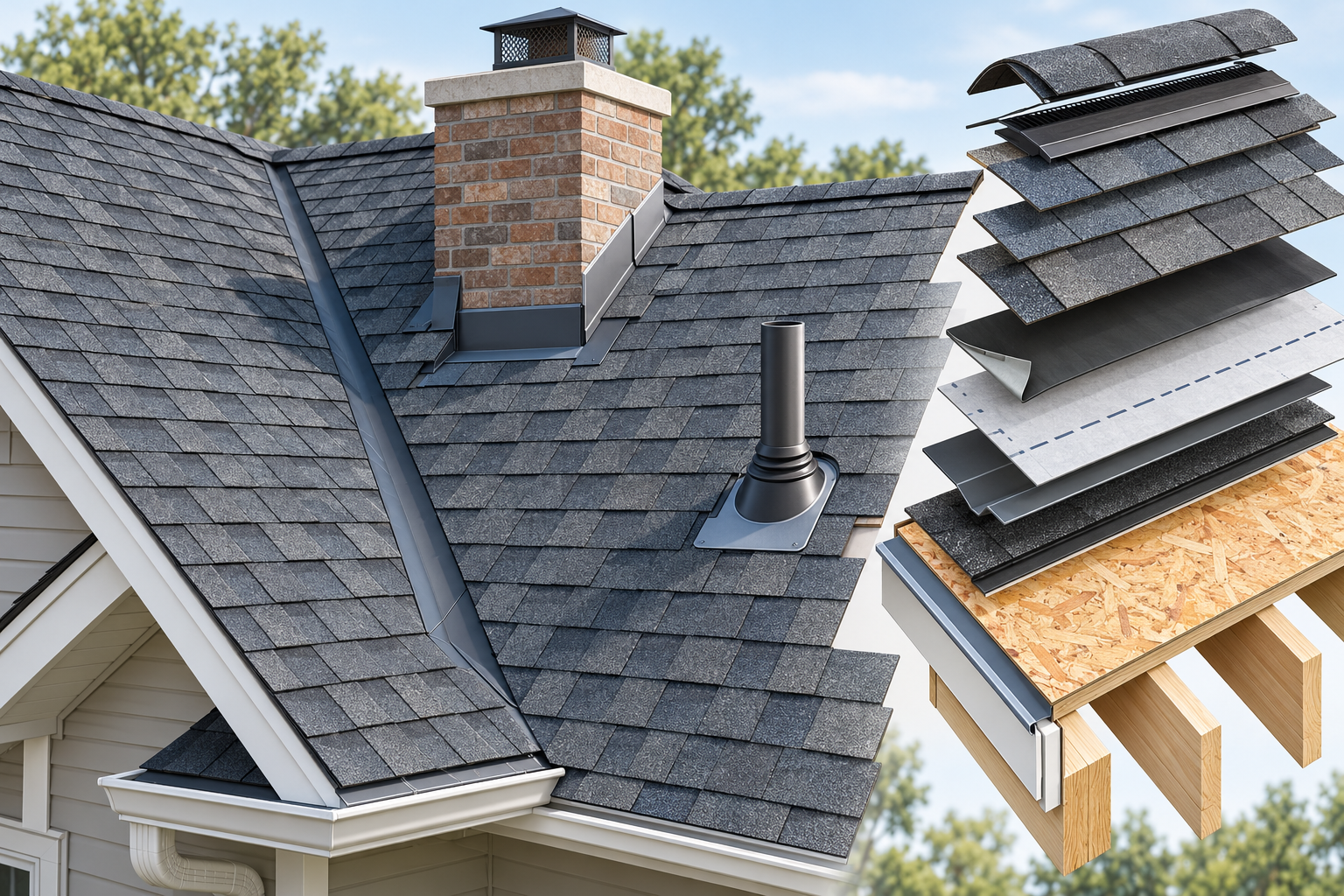
A complete asphalt reroof can include tear-off, deck repairs, underlayment, self-adhered membrane, drip edge, starter course, field shingles, ridge and hip caps, valleys, wall flashing, pipe boots, vents, fasteners, disposal, and site protection. Product lines often package compatible components for warranty or performance purposes, but the exact requirements are manufacturer-specific.
When a quote names only the shingle, ask what completes the system.
Product tier and installed price
Basic three-tab or standard products generally have the lowest material cost. Laminated or “architectural” shingles add thickness, profile, and product options. Premium or designer products may add weight, appearance, specialized accessories, and more expensive waste.
Labor and assembly costs remain substantial at every tier. Upgrading the field shingle does not double every line item; conversely, selecting the cheapest shingle does not make tear-off, flashing, access, or decking disappear. Evaluate the incremental installed price, not package marketing.
Geometry and labor
A large simple gable can install efficiently. Hips, valleys, dormers, walls, turrets, skylights, and short planes increase cuts, waste, staging, and flashing work. Steep or multi-story access slows production and raises safety and handling cost. These factors can outweigh the difference between neighboring shingle grades.
Ask for measured roof area, waste factor, and whether ridge/hip products are counted separately.
Tear-off and decking
Removing old covering lets the crew inspect the deck and install the new system on a known substrate. Multiple layers, heavy debris, tight access, and high disposal fees raise cost. Roofing over an existing layer may reduce initial labor where allowed and technically suitable, but limits deck inspection and can shift expense to the next replacement.
Deck quantity often remains uncertain until opening. Use an included allowance plus unit price and documentation process.
Underlayment, flashing, and vents
Underlayment and self-adhered membrane choices depend on product, climate, geometry, and local rules. Membrane can reduce leakage risk in vulnerable locations, but it does not correct the heat-loss and air-leakage conditions that cause ice dams.
Reroofing is a logical time to renew aged pipe boots and integrate wall, chimney, valley, and skylight flashings. Ventilation changes should be based on the actual attic/roof assembly; adding exhaust vents alone is not a universal solution to moisture.
Wind and hail options
Product ratings and roof-assembly measures can matter in hazard-prone locations. IBHS describes temperature-activated shingle sealing and weathering effects; a material label alone does not prove storm resistance. High-wind performance can involve cover attachment, deck attachment, sealed-deck measures, and roof edges.
Verify the selected product, attachment, local design conditions, installer requirements, and any program or insurance claim. “Impact resistant” does not mean hail-proof, and a warranty term does not prove service life.
Three budget scenarios
Simple value reroof: Accessible gable, one tear-off layer, sound deck, standard laminated shingles, ordinary flashings. This is closest to published unit-cost models.
Typical detailed roof: Several valleys and penetrations, new flashing and vents, modest deck replacement, upgraded underlayment. Labor and accessories move the total above a material-based estimate.
Complex hazard upgrade: Steep multi-level roof, extensive opening, sealed-deck or wind-edge work, impact-rated product, difficult disposal. The project can reach or exceed the top of broad asphalt ranges.
How to compare shingle quotes
Normalize manufacturer and exact product, accessory components, roof area, tear-off, deck allowance, underlayment, flashing, ventilation, waste, disposal, permit, workmanship coverage, and exclusions. Ask what happens if weather interrupts the open-roof phase and how temporary dry-in is handled.
An asphalt reroof is economical because the system is widely available and can be efficient to install—not because every asphalt project is simple. Scope clarity is the best defense against a low bid becoming a high final invoice.
Material allowance versus final selection
Some proposals include a shingle allowance and let the owner choose later. Confirm whether upgraded colors, accessories, freight, ridge caps, starter, and waste change the contract. Product substitutions should require approval and updated technical/warranty documents.
Availability matters to schedule and future repair. A mainstream locally stocked line can offer more practical value than a specialty product whose replacement pieces require long lead times.
Overlay as an alternative
Where locally allowed and supported by the product and substrate, an asphalt overlay can reduce removal and disposal. It limits deck visibility, retains old weight and irregularities, complicates some details, and shifts tear-off to the future. Compare actual savings against these tradeoffs rather than assuming roof-over is automatically cheap or unacceptable.
Expected adders
Decking, long custom wall or chimney flashings, multiple skylights, extensive ridge ventilation, ice-barrier or sealed-deck coverage, gutters disturbed by edges, and solar removal can each alter the base. Ask bidders to price options consistently. A material upgrade and a hazard-system upgrade are different decisions even when sold together.
Ownership and maintenance
Retain the exact product, color, accessory system, installer, photographs, warranty, and repair stock if available. Inspect after material storm events and address displaced components and drainage. Do not infer a maintenance-free period from the warranty label.
At future repair, condition and compatibility matter more than marketing age. A documented, coherent asphalt system is usually easier to evaluate than one built from unidentified substitutions.
Canadian context
Canadian roofs share many assembly decisions but labor, product mix, winter conditions, permit practices, disposal, and local market pricing differ. Obtain CAD bids and verify local ice-barrier and ventilation requirements. US dollar ranges are context for scope variability, not a converted Canadian budget.
One Canadian reference point from Roof Manager is CAD $11,400 for a normalized 2,000 sq ft, single-family, 6/12 simple-gable roof with architectural asphalt shingles, one layer removed, and standard underlayment. The provider describes a platform dataset of more than 4,200 measurements/proposals, supplemented by invoice and association reporting over January 2025–April 2026. This is one source’s modeled reference case, not a representative national accepted-bid survey; tax treatment is not stated. A different geometry, layer count, deck condition, or scope can change the price substantially.
Normalize the installed assembly
Create a line-by-line comparison for measurement, waste, tear-off layers, disposal, deck allowance and unit price, eave and valley membrane, field underlayment, drip edge, starter, field shingles, ridge/hip caps, ventilation, pipe and wall flashing, chimney or skylight work, temporary protection, and cleanup. Record exact product names rather than accepting “architectural shingle” as a complete specification.
Check quantities as well as unit quality. One contractor may measure more roof area, carry more waste for complex geometry, or include detached structures. Another may exclude a low-slope section that needs a different system. Reconcile those boundaries before treating the total as a market difference.
For decking and concealed details, use the same allowance or unit basis in every bid scenario. A low base with an undefined change-order process can become more expensive than a higher bid that carries a realistic assumption.
How conditions move a replacement budget
In a low-complexity case, the roof is simple and accessible, one covering layer is removed, the deck is largely sound, and penetrations are limited. Shared fixed costs are spread across straightforward production.
In a typical case, valleys, dormers, chimney or wall interfaces, several vents, localized deck repair, and stronger site protection add labor and materials. The selected shingle grade may be less influential than detailing and geometry.
In a complex case, steep or high access, multiple existing layers, fragile landscaping, distributed deck problems, solar removal, low-slope transitions, extensive custom flashing, or restricted staging interact. These drivers can multiply rather than merely add: difficult access slows each unit of tear-off, deck work, and detailing.
Ask bidders which case their fixed price assumes and what evidence could move the project into another. That discussion is more useful than demanding one generic cost per square.
Spend upgrades in the right order
First fund a suitable complete assembly, sound substrate, necessary water-control details, safe access, and qualified installation. Then compare product appearance or performance options. A premium field shingle does not compensate for omitted flashing or an incompatible low-slope application.
For each upgrade, ask for the installed incremental price and what physically changes. Some upgrades affect only field material; others require matching accessories or a specific installation pattern. Evaluate wind, impact, cool-roof, warranty, and aesthetic claims from exact product documents and local exposure rather than from tier labels.
If ownership may be short, choose required performance and acceptable appearance without assuming resale repays the upgrade. For long ownership, consider repair stock, local product availability, accessory coherence, and how future solar or equipment work will integrate. These factors shape lifecycle value without requiring an invented lifespan forecast.
Read allowances and alternates
A material allowance should state quantity basis and what happens when the final product costs more or less. Decking should have an included assumption and auditable unit. Flashing labeled “as needed” should name the visible interfaces and the conditions requiring replacement. Ventilation and ice/wind upgrades should appear as controlled alternates unless required for the selected assembly.
Ask for the base and alternate totals after all associated accessories and labor are included. A small field-shingle price increase may become a different installed increment once ridge, starter, waste, or installation conditions change. Conversely, a salesperson should not attribute unrelated deck and flashing corrections to the premium shingle.
The purchase is ready when bids describe the same complete water-control assembly, difficult-case costs are controlled, and discretionary upgrades remain visible. A lower headline price that cannot pass this normalization is still an incomplete budget.
Repair and future-service boundary
Ask how a damaged field shingle, ridge, valley, or wall interface will be repaired and whether matching stock is retained. Avoid rooftop equipment or solar layouts that make ordinary service unnecessarily broad. A replacement is a capital reset of the specified roof assembly, not a promise that branches, hail, wind, masonry, gutters, or equipment will never create another repair.
Final decision threshold
Proceed when the roof boundary, complete assembly, exact products, concealed-condition controls, access, adjacent trades, and ownership priorities align. If competing totals still differ materially, trace the difference to quantities, details, risk allocation, or contractor capability before treating it as negotiation room. The lowest bid becomes meaningful only after it purchases the same roof.
Closeout that protects future value
Keep measurements, exact field and accessory products, deck repairs, underlayment and flashing photographs, ventilation changes, installer and warranty records, color/lot information, and spare material where practical. This package does not extend service by itself, but it lowers future diagnosis and matching cost and shows whether a later defect is local or assembly-wide.
Final budget range
Carry a low total with simple access and sound deck, an expected total with ordinary geometry, interfaces, and localized deck work, and a difficult total with steep/high access, layers, distributed substrate work, solar, or complex flashing. Hold the exact shingle system constant. The range then describes property uncertainty rather than mixing a premium product into the high case.
Uncertainty boundary
Deck quantity, custom flashing, and weather can change final cost even under a strong contract. Shared units, authorization thresholds, dry-in, substitutions, and comparable budget cases make that uncertainty manageable. They are not reasons to accept an incomplete base assembly or a generic price per square.