
Localized wood-shake or shingle repair may cost hundreds to low thousands, depending on access, matching, and scattered deterioration. Complete replacement is premium labor: one US specialist model estimates builder-grade wood shake around $12.70 per square foot on a simple roof, but species, grade, assembly, fire treatment, geometry, and region can move actual work substantially.
Diagnose the condition, not the color
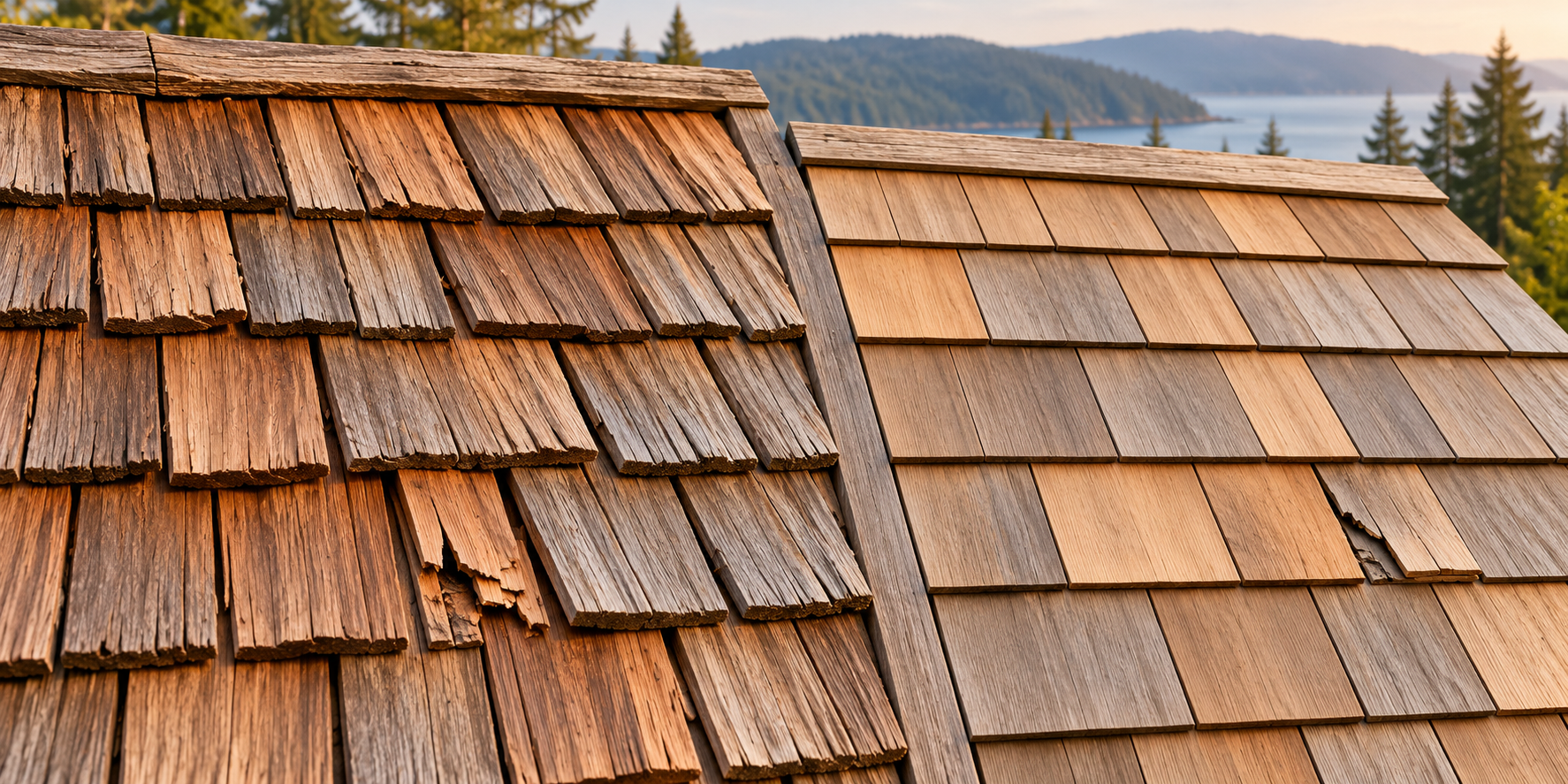
Wood naturally weathers. Gray appearance does not by itself prove failure. More important conditions include split, missing, badly curled, eroded, loose, or decayed units; failed flashings; blocked drainage; and whether the surrounding material can accept repair.
Moss, lichen, and debris may hold moisture or obscure defects. Cleaning compatibility is material- and treatment-specific. Aggressive washing can damage wood fibers or drive water into the assembly.
Repair scope
Individual units can sometimes be replaced while preserving the field. Scattered repair becomes expensive when each defect requires separate access or neighboring units split during opening. Matching size, exposure, grain, thickness, species, and weathered appearance can also be difficult.
A focused repair should inspect underlayment, deck, and flashing in the opening. Surface replacement will not correct a failed valley or wall interface.
Treatment and maintenance
Products marketed for cleaning, preservatives, moss control, or fire performance must be evaluated for the exact roof and local requirements. Do not assume one treatment reverses deterioration or creates a guaranteed service interval. Ask what condition it addresses, product listing, application prerequisites, runoff controls, and effect on warranty or future coating.
The economics may favor debris control and selective repair over broad cosmetic treatment. If treatment requires frequent specialist access, include that recurring cost in material comparisons.
Full replacement
Replacement cost includes tear-off, disposal, deck suitability, underlayment, ventilation/assembly details, flashings, fasteners, ridge and hip work, and new shakes or shingles. Premium grade, complex roof planes, custom exposure, and limited local installer supply increase price.
Switching to asphalt, metal, synthetic/composite, or another material may reduce maintenance or meet local constraints, but it changes appearance, substrate/detailing, and ownership economics. Compare complete installed systems.
Fire and regulatory context
Wildfire exposure, product classification, treatment, homeowner-association rules, and local code can materially constrain wood roofing. These are high-consequence location-specific questions. Do not rely on a general statement that cedar is permitted, prohibited, or “fireproof.” Verify the product and jurisdiction before budgeting around it.
Scenarios
Isolated storm damage: Matching material exists and the field is serviceable. Repair is economical.
Moss plus scattered splits: Inspection and material-safe cleaning may reveal a repairable system, but broad deterioration can turn treatment into wasted spending.
Failed flashing under serviceable wood: Open and rebuild the interface, accepting specialist labor and replacement-stock needs rather than discarding the whole roof.
Local restrictions or unavailable material: Replacement comparison should include compliant alternatives, appearance, deck preparation, and future repair supply.
Quote checklist
Specify shake versus shingle, species/grade/product where known, repair quantity, matching plan, treatment method, tear-off, deck and underlayment, flashing, ventilation, fire classification claims, disposal, workmanship, and recurring maintenance assumptions.
Wood roofing can be repaired or preserved when the field remains coherent. The decision becomes replacement when deterioration is distributed, compatible material is unavailable, or local performance requirements make the existing approach impractical.
Distinguish shakes and shingles
Wood shakes and shingles can differ in manufacturing, texture, thickness, exposure, and assembly details. Species, grade, treatment, and product certification matter. Quotes should identify the actual product rather than using “cedar” as a complete specification.
Cost of specialist access
Walking or staging on weathered wood can damage units. Steepness, height, valleys, dormers, and chimney interfaces raise labor. A low repair unit price that excludes collateral breakage may not remain low. Agree on a mapped scope and added-unit price.
Moisture and assembly context
Debris, shade, ventilation, underlayment, and roof design affect drying, but no single cleaning or ventilation intervention guarantees wood-roof life. Diagnose leaks at flashing and lower layers rather than attributing all moisture to surface age.
Replacement comparison
For wood replacement, price exact grade/product, exposure, fastening, underlayment, fire classification or treatment where applicable, flashings, deck work, waste, and future maintenance. Compare a compliant wood system with material-switch alternatives using the same tear-off and deck assumptions.
Ownership horizon
Preserving a distinctive wood roof can support architectural preference and avoid premature disposal. Switching may reduce future specialist needs. Evaluate likely maintenance and repair access without assuming any material is maintenance-free. Keep spare product and treatment records where possible.
Normalize wood-roof quotes
State whether the work is cleaning/treatment, isolated unit repair, a bounded flashing or lower-layer opening, or replacement. For repair, compare mapped units, access, collateral breakage, exact replacement material, fastening, underlayment involvement, cleanup, and treatment boundaries. For replacement, compare exact wood product and grade, exposure, quantity and waste, attachment, lower assembly, flashings, ventilation or spacing approach, deck allowance, fire-related product requirements where applicable, and disposal.
Do not compare an appearance treatment with a repair or a repair with replacement. A treatment may change surface condition without correcting split units, failed flashing, or wet substrate. A full replacement quote may include code- or product-driven assembly work that a patch does not address. Put exclusions beside totals.
Low, typical, and complex cases
A low-complexity repair addresses a small accessible group of damaged units or one defined interface while surrounding wood remains workable. Specialist setup and matching can dominate the invoice.
A typical ownership project combines selective repairs, debris management, compatible maintenance, and monitoring of shaded or slow-drying areas. The economic question is the interval and cumulative access cost, not whether one cleaning visit makes the roof new.
A complex case includes widespread splitting or erosion, multiple leak paths, brittle material, lower-layer problems, difficult fire/regulatory constraints, or scarce matching stock. Compare broad preservation, complete wood replacement, and a material switch with the same deck and interface assumptions.
Repeat-work and material-switch economics
Map repairs by slope and cause. A few isolated storm or branch events can remain good repair candidates. Repeated work in shaded fields, several failing interfaces, and damage caused by access can show that the maintenance path is consuming material and mobilization without restoring a coherent system.
Switching to asphalt, metal, tile-look synthetic, or another eligible system may reduce specialist dependence or change capital needs, but it can also change weight, ventilation details, appearance, fire/wind performance, roof thickness, and future repair methods. Compare exact assemblies and local acceptance rather than claiming one substitute is universally cheaper over life.
For short ownership, required safety and water control come first; premium wood replacement should not rely on assumed resale recovery. For long ownership, include realistic cleaning, treatment where supported, repair access, spare material, and specialist availability. Use a range of intervention scenarios rather than a promised maintenance interval.
Decision thresholds
Continue repair when causes are local, retained units remain workable, and the lower assembly is sound. Seek a broader preservation scope when several repairs can share staging and natural boundaries. Move to replacement or material-switch comparison when damage is distributed, access repeatedly breaks surrounding units, concealed layers require broad opening, or the desired compliant wood system cannot be sourced and serviced reliably.
A useful contract defines the initial quantity, added-unit prices, stop point, treatment limitations, weather protection, and evidence required for a larger scope. That keeps the inherent variability of natural weathered material from becoming an undefined invoice.
Read wood-roof quote lines
“Replace damaged shakes” needs product type/grade where applicable, exposure and installation compatibility, mapped quantity, surrounding breakage, and added-unit terms. “Clean and treat” needs method, product compatibility, target condition, landscaping protection, and a statement of what it will not repair. “Replace roof” needs the complete lower assembly and fire/regulatory basis, not only a wood material allowance.
Compare samples and intended appearance. New natural wood beside weathered material will not match immediately, and treatment can change appearance without proving improved water control. Aesthetic expectations belong in the contract so they do not become proxy arguments about functional failure.
Example ownership budgets
A repair-led budget carries specialist inspections or condition-based visits, mapped unit/interface work, debris/treatment only where compatible, and a separate replacement reserve. A preservation phase groups a high-risk slope or flashing zone under one staging event. A replacement budget adds complete assembly, structural/regulatory questions, and future maintenance.
Test each path under a mild and difficult recurrence case. If a preservation conclusion depends on every remaining unit surviving access, it is fragile. If replacement wins only after assigning old wood zero value and the new material an unsupported life, it is also fragile. Use observed workability and repeat history to choose.
Closeout and future service
Keep product identification, batch or source where available, installation exposure, treatment, fastening, flashing photographs, repair map, and spare units. Specify safe access practices for solar, chimney, and other trades. Avoiding uninformed foot traffic can be as economically important as selecting the next maintenance product.
Normalize material-switch bids
Use the same tear-off, deck and structural assumptions, underlayment functions, flashing, ventilation/assembly boundaries, access, disposal, and adjacent work for wood, asphalt, metal, or synthetic alternatives. Then identify what changes in weight, product, attachment, details, fire/wind basis, appearance, maintenance, and local service.
A lower-price substitute is not cheaper if it omits deck or interface work required by the switch. A new wood quote is not comparable if it includes premium grade or fire-related product features absent from the retained/repair path. Controlled alternates keep preference separate from necessary reconstruction.
Final decision example
If a roof has scattered repairable units and sound lower layers, a mapped specialist repair plus exposure-driven maintenance can preserve distinctive material at lower cost. If repeated access breaks neighboring units and several flashings/lower layers require opening, a broad preservation or replacement scope can reduce mobilization. If local wood-system service or compliant product is unavailable, a material switch may be the only supportable long-term path.
The decision should name which of those conditions exists, the expected next intervention, and the difficult-case budget. Color alone, roof age alone, and a universal maintenance schedule cannot do that work.
Budget the uncertainty, not a generic wood premium
For repair, carry a mapped base quantity plus adjacent-breakage and interface units. For preservation, carry staging, cleaning/treatment only where suitable, lower-layer work, and a stop threshold for unworkable material. For replacement, carry exact wood grade/system, full accessories, fire/regulatory verification, deck and structural contingencies, and future maintenance.
Compare material-switch alternates with the same difficult deck and access case. This reveals whether the premium comes from wood itself, specialist handling, compliance, geometry, or unrelated concealed work.
Uncertainty boundary
Natural weathering and collateral breakage make exact repair quantities difficult. A condition map, sample or source information, base quantity, added-unit rate, and stop threshold create a usable range. Evidence limits a precise count; it does not limit comparison of repair, preservation, replacement, and material-switch economics.