
Synthetic and composite roofing commonly costs more than mainstream asphalt and may cost less than new natural slate, clay tile, or premium wood—yet no single range describes the category well. Products can use polymers, rubber, mineral fillers, recycled content, laminated constructions, or proprietary combinations. Installation, accessory, and waste requirements vary as much as material composition.
Compare exact products, not the words “synthetic” or “composite.”
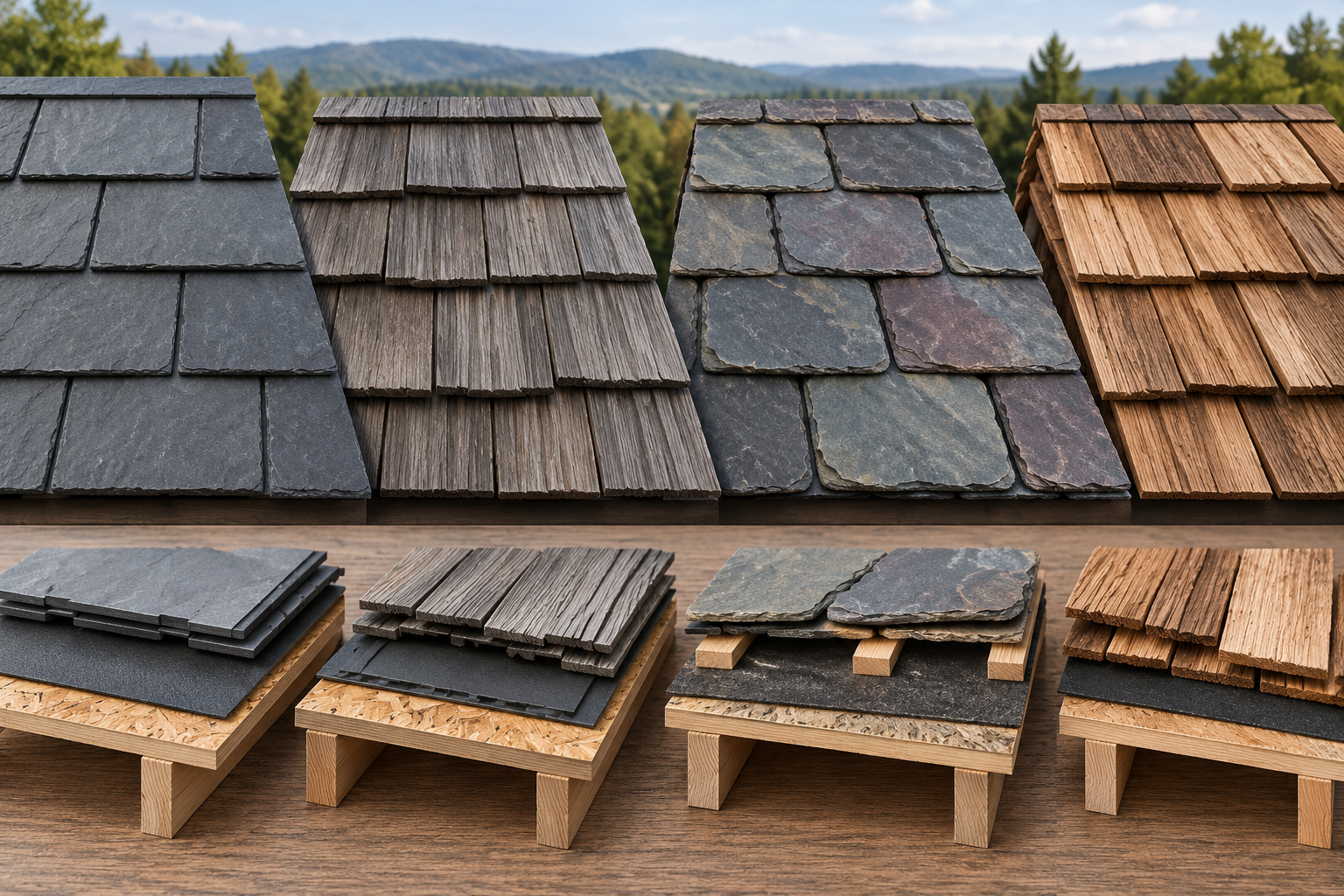
What problem is the product solving?
Many products imitate slate, shake, or tile while seeking lower weight, more regular dimensions, different impact behavior, easier cutting, or less maintenance. Others are premium shingles with proprietary constructions. The economic benchmark should be the material being substituted and the attribute you value.
If the goal is appearance at lower structural load, compare with natural slate or tile plus any structural work. If the goal is impact performance, compare tested exact products. If the goal is lower maintenance than wood, include realistic future cleaning and repair assumptions.
Installed-cost drivers
- exact product and accessory system;
- local distributor availability and freight;
- trained installer availability;
- roof geometry, layout, and waste;
- deck and underlayment requirements;
- starter, ridge, hip, valley, and flashing details;
- fastening and local wind conditions;
- removal of existing covering;
- retained stock for future matching.
A material that cuts quickly can reduce labor on some roofs. A proprietary system with unfamiliar details can increase it. Obtain a project-specific comparison.
Verify performance claims
Impact, wind, fire, UV, temperature, and walkability claims should attach to a named product and recognized test or listing. A class or rating still has scope and does not guarantee zero storm damage. Material name does not establish performance of the complete roof assembly.
Ask for current technical data, installation instructions, evaluation reports where relevant, and local acceptance. Marketing comparisons with natural materials are not substitutes for those documents.
Warranty and manufacturer longevity
Long warranty terms can be appealing in a newer product category, but the issuing manufacturer, exclusions, prorating, transfer, required accessories, installer conditions, and remedy matter. Product-line continuity also affects future matching.
Model the possibility that an exact profile or color is unavailable for a later repair. Keeping spare units helps but does not eliminate installation or warranty questions.
Repairability
Unitized products may allow localized replacement, but interlocks, clips, brittleness, thermal behavior, or proprietary dimensions can complicate access. Ask the installer to demonstrate how one damaged unit would be replaced and whether ordinary local contractors service the system.
The best lifecycle claim is less useful if every small repair requires long-distance specialist mobilization.
Scenarios
Slate-look without structural premium: A lighter product may avoid some support work while delivering desired appearance. Compare installed synthetic scope with natural slate and a mainstream alternative.
Hail-focused purchase: Verify exact impact classification, attachment, local insurer treatment, and replacement availability. Do not equate rating with hail-proof.
Remote market: Freight and installer scarcity may erase a material-price advantage and create future repair risk.
Historic appearance: Synthetic material may or may not satisfy preservation or local approval requirements. Separate aesthetic preference from formal compliance.
Decision framework
Choose a synthetic or composite system when a specific verified attribute solves a property problem and the supply, installer, warranty, and repair ecosystem are credible. Defer when the case rests mainly on broad lifespan promises or when future matching and service are uncertain.
The premium makes sense only relative to a clear alternative. Compare complete installed cost, structural implications, maintenance, repair path, and conservative replacement horizon—not just a brochure’s material checklist.
Build a product dossier before signing
Retain current technical sheet, installation instructions, evaluation/listing information where relevant, warranty, distributor contact, exact color/profile, and installer certification if required. This documentation helps reviewers verify claims and future contractors source repairs.
If the sales case relies on recycled content, sustainability, recyclability, or reduced waste, request product-specific evidence and local end-of-life options. These claims can be meaningful but do not determine roof performance.
Price the comparison fairly
Compare the synthetic product with the actual natural or mainstream alternative on the same roof. Include tear-off, deck, underlayment, flashing, ridge/hip accessories, waste, freight, installer travel, and structural work. A material-only price can understate proprietary accessories and overstate avoided structural cost.
Market and manufacturer risk
A younger manufacturer or product line can create warranty and matching uncertainty. That does not prove poor performance, but it belongs in the decision. Consider distributor depth, installed local base, availability of replacement units, and whether another contractor can service the system.
Scenarios beyond first cost
For a long-term owner seeking slate appearance without the same weight, exact product evidence may justify premium. For a short ownership horizon, the upgrade may mainly deliver appearance with uncertain resale recovery. In a hail-prone area, verified rating and insurer treatment matter; in a remote market, repair logistics may overwhelm theoretical durability.
When to defer
Defer selection when the contractor cannot produce product documents, local acceptance is unclear, installer experience is thin, or the warranty remedy depends on unavailable proprietary parts. Resolve those risks before removing the existing roof.
Normalize installed cost against the real alternatives
Price the exact synthetic product, a mainstream suitable covering, and—if appearance motivates the project—the natural material it imitates. Use the same roof measurement, tear-off, deck assumptions, underlayment functions, flashings, ventilation, edges, access, and disposal. Then separate changes in field material, accessories, structural work, labor, freight, waste, and installer travel.
A synthetic system may avoid some structural or handling costs associated with natural slate or tile, but those savings should appear as actual omitted work, not marketing percentages. It may also add proprietary ridge, hip, starter, fastener, or flashing components. Request exact quantities and product names so the premium can be traced.
If one installer quotes synthetic and another quotes asphalt, contractor scope and quality can overwhelm material differences. Ask for controlled alternates where possible or reconcile every non-product line before calculating the upgrade.
Three decision-support scenarios
In an appearance-led residence with a long ownership plan, a documented product can deliver a desired slate or shake look at a different weight and installation profile. The owner should test samples on the roof, verify local installer depth, and value aesthetics without assuming guaranteed resale.
In a resilience-led project, use exact test classifications, installation conditions, accessory requirements, and local insurer or authority treatment. A rating can be relevant without guaranteeing survival or economic payback from any storm.
In a remote or short-horizon project, freight, replacement stock, proprietary tools, thin local service, and uncertain buyer recognition may weaken the premium case. A common repairable material can be economically stronger even if its headline attributes are less distinctive.
Ownership-horizon and product-line risk
Model at least three outcomes: the product remains supported and requires ordinary repairs; matching units become difficult but compatible repair remains possible; or manufacturer/distributor support changes and a damaged section requires an improvised or broader solution. Do not assign probabilities without evidence, but recognize that these outcomes make retained stock, documentation, and multi-contractor serviceability valuable.
For long ownership, ask who can repair one unit, a valley, or future solar penetration and how interlocking areas are opened. For short ownership, do not presume the market reimburses an unfamiliar premium. Provide the next owner with product approvals, invoices, warranty terms, installation photos, and spare units.
Decision thresholds and alternatives
Proceed when the exact product solves a named weight, appearance, or verified performance need; is accepted for the assembly; has credible distribution and qualified installation; and the installed premium fits the owner’s horizon. Defer or select a mainstream alternative when documentation, accessories, acceptance, warranty remedy, or service path remains unresolved.
Natural slate, tile, or wood may offer authenticity and a mature specialist ecosystem at different weight and cost. Asphalt or metal may offer broader local service and lower or different capital needs. Compare complete systems that meet the same must-have constraints, then treat aesthetics as an explicit preference rather than disguising it as certain lifetime savings.
Read product and warranty language
“Slate-like” or “shake-like” describes appearance, not material identity or verified performance. Request exact composition description, product report/approval applicable to the project, tested classifications, installation instructions, accessory list, and warranty remedy. Confirm that the quoted assembly—not merely a sample field unit—meets the stated condition.
A long warranty can be weak if it is prorated, material-only, difficult to transfer, dependent on proprietary parts, or excludes labor and consequential work. Compare the responsible entity and remedy, not headline duration. Installer workmanship and manufacturer product coverage remain separate.
Example: premium appearance on a cut-up roof
On a simple roof, field-material premium may be visible and controlled. On a cut-up roof, hips, valleys, starters, ridges, waste, and installer labor can dominate; proprietary accessories and freight can expand the synthetic premium. A natural product might add weight and specialist labor, while mainstream asphalt might sacrifice the desired profile.
Ask for all three installed totals with identical deck and flashing assumptions. The result may show that the synthetic product solves a real middle-position need, or that its theoretical material advantage disappears in project geometry. Either is a useful finding.
Closeout as risk reduction
Retain approvals, exact product/color/profile, quantities, installation photos, warranty registration, distributor and installer contacts, and spare units. This documentation does not guarantee product continuity, but it lowers future identification and repair friction—the very risk that often matters most in a newer proprietary system.
Final purchase test
Proceed only if the product dossier answers suitability, exact installed assembly, local acceptance, qualified installer, distributor depth, one-unit and detail repair, warranty remedy, and installed premium against real alternatives. State which need the premium solves and test the decision without guaranteed resale or lifespan. If the product still wins, its value case is specific and defensible rather than speculative.
Budget uncertainty explicitly
Use low, expected, and difficult cases for freight, waste, proprietary accessories, installer travel, deck/structural work, and future matching. Keep conditions common to all roof options constant. This reveals whether the synthetic premium is stable or depends on every proprietary component remaining easy to obtain. Uncertainty should adjust the decision range, not be converted into a claim that a newer product must be avoided.
Low, expected, and difficult installed totals
The low case has simple geometry, local qualified labor, routine freight, and a complete documented accessory package. The expected case adds cut-up geometry, proprietary hips/ridges/starters, waste, installer travel, and ordinary deck work. The difficult case adds structural change, scarce accessories, remote service, or complex natural-material-like detailing. Price mainstream and natural alternatives under the same three project cases.
Uncertainty boundary
Manufacturer and distributor continuity cannot be predicted. Treat repair stock, documentation, installer depth, and alternative service as risk controls, and test the premium without guaranteed longevity. Uncertainty should be visible in the difficult case rather than used to dismiss or endorse the product categorically.