
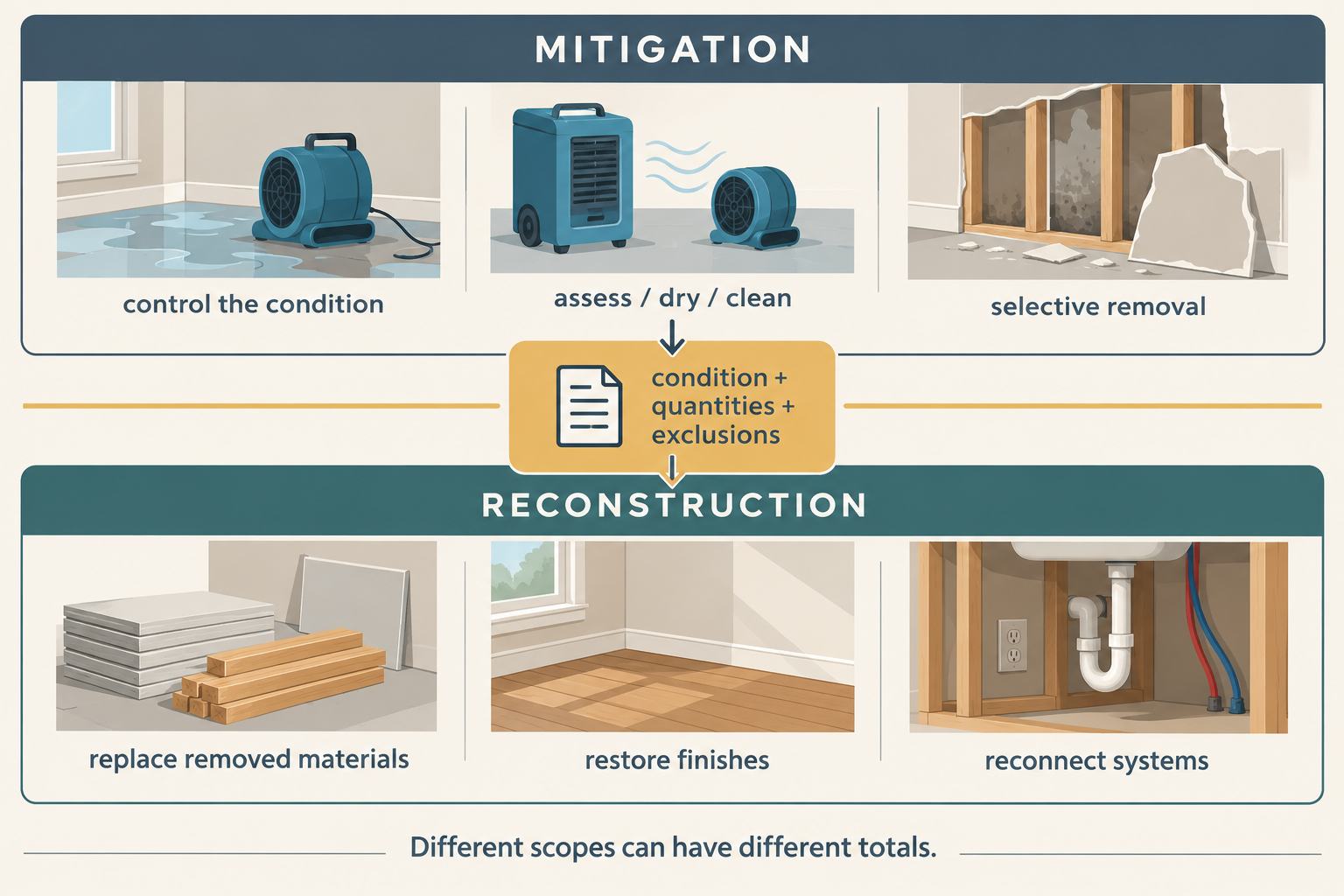
Mitigation and reconstruction answer different questions. Mitigation addresses continuing damage and the condition created by the loss. Reconstruction restores the building after the affected scope is understood. The two estimates may overlap at controlled demolition or cleaning, but they are not interchangeable.
What mitigation usually addresses
Mitigation may include emergency response, source-control coordination, extraction, moisture assessment, drying, cleaning, containment, monitoring, and selective removal. The goal is to stop the condition from worsening and make the remaining scope understandable.
It may also include demolition when removing a wet or contaminated material is necessary to reach, clean, or dry an assembly. That does not mean the mitigation contractor is rebuilding the removed wall, floor, ceiling, or cabinet.
What reconstruction usually addresses
Reconstruction may include framing, insulation, drywall, trim, flooring, cabinetry, paint, fixtures, and reconnection of plumbing, electrical, or HVAC systems. It may include permits and inspections where required. Finish quality, hidden damage, specialty materials, access, and current-code work can make the rebuild much larger than the cleanup.
The boundary is practical, not universal. A company may offer both services, while another may provide only emergency mitigation or only rebuilding. A task can be allocated differently between estimates without changing the underlying work.
Why totals are easy to misread
Two documents may cover different rooms, phases, quantities, equipment duration, demolition assumptions, contents, taxes, overhead, permits, or exclusions. A contractor’s estimate also does not decide whether an insurer owes for that work. An adjuster’s scope does not prove that the building is technically dry or that the proposed reconstruction is complete.
Compare estimates by phase and unit of work. Ask what has been observed, what is assumed, what is excluded, and what would create a supplement or change order. Look for missing removal, drying, disposal, contents, permits, finish restoration, or system reconnection rather than choosing the shorter document automatically.
Three ways two estimates can both be reasonable
An extraction-and-drying estimate may stop when moisture is controlled, while a reconstruction estimate begins with damaged drywall and flooring already removed. A mitigation estimate may include controlled demolition and disposal, while a rebuild estimate includes replacement of the same areas. A contractor may bundle cleaning and minor repairs while another separates them. The difference is not automatically overcharging or underpricing; the locations, quantities, end conditions, and contract terms have to be compared.
If the documents cover different rooms, list that first. If they cover the same room, mark every shared line and ask each provider to explain the division. A written phase map often resolves a disagreement faster than comparing totals.
Common questions before the phase changes
Ask whether the source is repaired, whether drying records are complete, whether affected contents have been removed, whether contamination has been addressed, and whether the authority requires a permit or inspection. Ask what happens if a later inspection finds wet insulation, damaged framing, mould, or an affected HVAC system. Those conditions may change both scope and responsibility.
Do not let the desire for a finished room cause permanent work to start before the underlying condition is understood. At the same time, do not delay necessary emergency mitigation while waiting for a perfect reconstruction estimate.
The homeowner’s decision record
Keep the two estimates, photographs, records, authorizations, supplements, and change orders together. Note the date and condition when the phase boundary changed. Record which items are physical necessities, policy questions, voluntary improvements, or still unknown. This record helps the homeowner decide whether to proceed, seek another estimate, ask the insurer for review, or obtain a specialist assessment.
Ask: “When does your scope end, what condition will the property be in then, and which scope restores the removed or affected materials?” The answer should identify the transition from emergency work to a permanent repair. Keep the original source repair separate, too; a plumber repairing a pipe and a restoration company drying the house may both be necessary.
A phase comparison that works in practice
Mitigation is usually about controlling an active or consequential condition: protecting the property, extracting water, drying assemblies, containing contamination, cleaning, monitoring, or removing material that cannot responsibly remain. Reconstruction is usually about returning defined building assemblies to a usable finished condition: replacing drywall, insulation, flooring, trim, cabinets, fixtures, paint, or system connections.
The boundary is not identical in every company. Controlled demolition may appear in mitigation because opening an assembly is necessary to dry it. The replacement of that assembly may appear in reconstruction. Cleaning may belong to either phase depending on the loss and the contract. The names matter less than the start condition, end condition, quantities, and handoff record.
Why a lower mitigation estimate can precede a larger rebuild
Mitigation can make a property safer and drier without replacing every removed finish. A room may be left with open walls, removed flooring, stored contents, temporary protection, and unresolved system work. The reconstruction estimate then includes labor and materials that were never part of the first invoice.
Hidden conditions can also become visible only after removal or drying. A damaged subfloor, corroded connection, affected insulation, or code-related requirement may change the later scope. That change should be explained by the observed condition and not presented as an automatic consequence of every water loss.
How to compare two estimates
Make a side-by-side list of:
- rooms and assemblies included;
- phase and starting condition;
- measurements, quantities, and equipment duration;
- demolition and disposal;
- cleaning, contents, and storage;
- materials, finish level, and system reconnection;
- permits, inspections, supervision, tax, and overhead;
- exclusions, allowances, and supplement rules; and
- the condition expected when the work is complete.
If one estimate does not mention a category, do not assume it is included or unnecessary. Ask. An omission may be intentional, unknown, assigned to another contractor, or simply overlooked.
What insurance changes—and what it does not
An insurer or adjuster may organize a claim into mitigation, structure, contents, additional living expenses, or later payments. That organization can differ from how a contractor divides its work. Policy terms, deductible, limits, exclusions, endorsements, and valuation affect payment questions. They do not change the physical fact that wet drywall needs a defined treatment or that a source leak must be repaired.
Keep the contractor’s physical scope, the adjuster’s scope, and the policy question separate. If the disagreement is about whether a wall is wet or whether a floor must be removed, ask the relevant technical professional for the condition record. If it is about a deductible, limit, endorsement, or valuation, ask the insurer or claim representative. A second estimate is most useful when it answers a specific unresolved question rather than merely producing another unexplained total.
The decision at the phase boundary
Before mitigation closes, ask for the final moisture or condition record, photographs, removed-material list, contents status, unresolved hazards, and reconstruction handoff. Before reconstruction starts, confirm the source is controlled, the property is ready for the proposed work, and the rebuild scope states what it restores.
This phase discipline helps the homeowner authorize urgent work without accidentally approving a full rebuild, while also preventing the common mistake of treating a mitigation invoice as proof that the property is finished.
The handoff should have a stopping rule
Mitigation should end when the immediate loss is controlled and the agreed condition for that phase has been documented. That may include source repair, completed extraction, monitored drying, cleaning, controlled removal, and a record of what remains. It does not necessarily mean that finishes, cabinets, flooring, insulation, paint, or other building elements have been restored.
Before the next contractor starts, ask who owns each unresolved item. A wet subfloor may require reconstruction after drying; damaged wiring may require an electrician; a contents item may need separate treatment; a permit question may belong to the authority or designer. If a task moves between scopes, record the transfer rather than assuming the next invoice includes it.
This stopping rule protects both speed and comparability. Emergency work can begin with limited information, while the reconstruction scope can be priced after the building condition is known. The homeowner gets a usable decision record instead of a single contract whose boundaries are difficult to identify later.