
Extraction and structural drying are related but different services. Extraction removes standing or free water. Structural drying reduces moisture in floors, walls, ceilings, insulation, furnishings, and other assemblies after the visible water is gone.
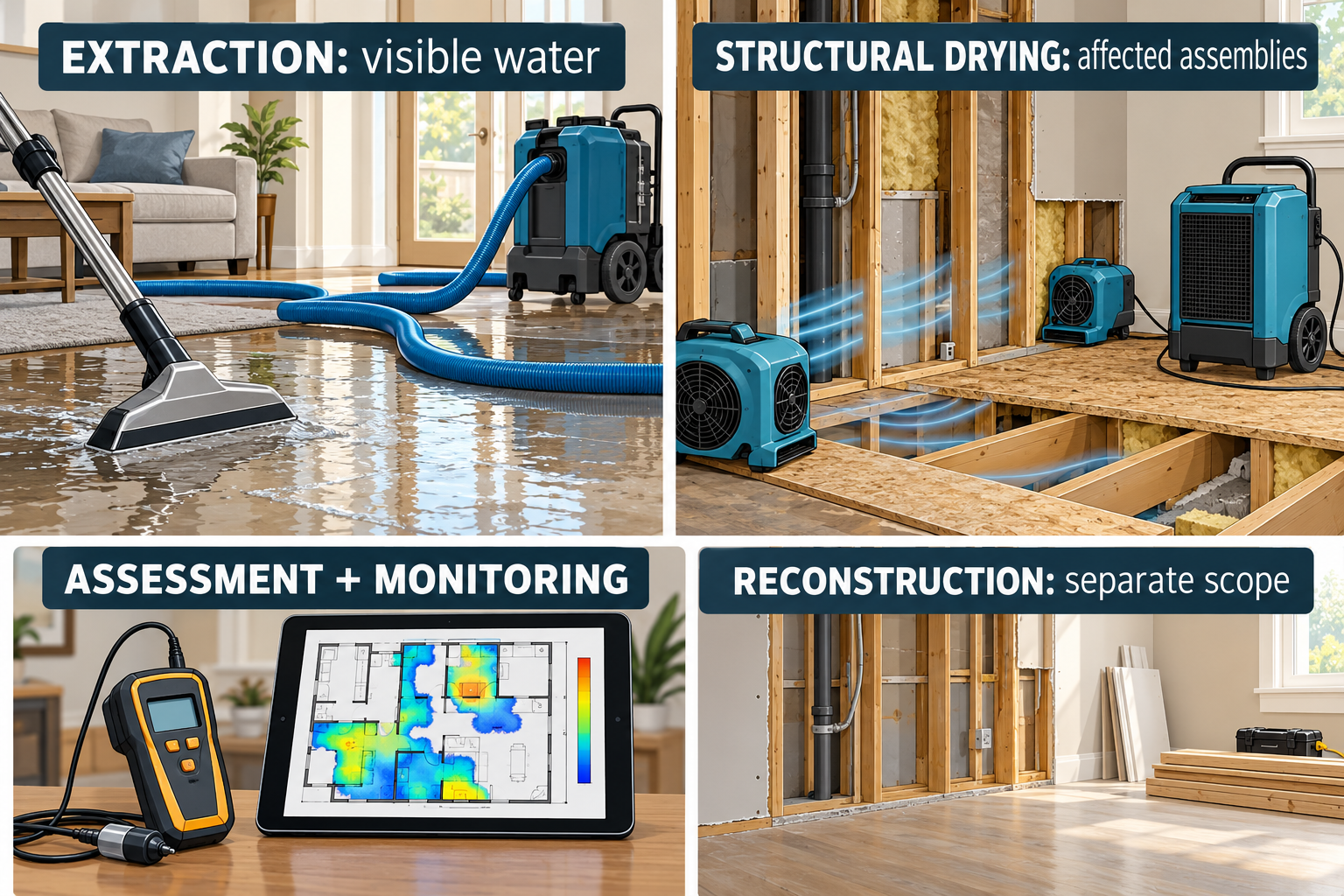
What the drying scope involves
A professional scope may begin with inspection and moisture mapping. It can then use air movement, dehumidification, controlled ventilation, monitoring visits, and targeted removal where materials cannot be dried or safely salvaged. The equipment count and duration depend on the affected volume, material, temperature, humidity, water source, access, and concealed moisture.
There is no responsible universal number of air movers, a fixed number of drying days, or a single installed price for every house. Equipment may be billed by time, by job, or within a broader mitigation estimate. Ask which method is being used and what evidence will show that drying is progressing.
What changes the cost
Cost tends to increase when water has moved into multiple rooms or floors, entered wall and ceiling cavities, saturated insulation or subfloors, or remained undiscovered. Access, furniture, contents, emergency response, winter conditions, power requirements, monitoring visits, and disposal can add work.
Contamination changes the decision. Sewage and floodwater can require isolation, professional cleanup, disposal, and replacement rather than ordinary drying. A flooded or suspected contaminated HVAC system should be assessed before operation.
When drying in place may not be enough
Some materials can be cleaned and dried; others hold contamination or cannot be dried reliably in place. Removal should be tied to the affected material, the water source, the moisture condition, and the planned reconstruction—not simply to the presence of equipment.
Do not turn this cost guide into a do-it-yourself drying procedure. Standing water, electrical hazards, sewage, hidden mould, combustion equipment, and structural damage can make an apparently simple job unsafe.
Three mitigation-only examples
A small, accessible clean-water release may involve limited extraction, a moisture check, a few pieces of equipment, and follow-up monitoring. Water in a wall, ceiling, or insulated floor assembly may require targeted openings, longer equipment time, and a reconstruction handoff. Floodwater, sewage, smoke-affected water, or a contaminated HVAC system may require containment and removal decisions before ordinary drying is considered.
These examples are not price tiers. They show why a contractor needs to describe the water source, materials, affected volume, access, and condition before offering a meaningful number. A quote based only on room size may miss concealed moisture or overstate work that does not apply.
What a moisture record can and cannot show
Moisture readings and maps help document where an assessment was made and whether conditions are changing. They do not by themselves establish that every cavity was inspected, that all contamination is absent, or that the home is safe to reoccupy. Ask which materials were measured, which areas could not be accessed, and how the contractor interprets the results.
If a drying target is described, ask what standard or project condition it represents and who decides that it has been reached. Avoid a contract that treats a fixed equipment period as the same thing as a dry building.
The drying-to-rebuild handoff
Before mitigation ends, confirm who will repair openings, replace removed materials, clean remaining surfaces, reconnect systems, and obtain any required permits or inspections. If the same company provides reconstruction, ask for the phase boundary and pricing. If another contractor takes over, make sure moisture records, photographs, demolition notes, and contents records are transferred.
The cost of drying should be judged by the condition it manages and the documentation it produces. It should not be judged by whether the equipment ran for a predetermined number of days.
Ask for the affected areas, inspection method, equipment types and quantities, expected monitoring, power or access assumptions, removal and disposal, cleaning, contents handling, and the event that ends the mitigation scope. Confirm whether reconstruction is excluded.
Rapid drying is worthwhile, but it is not a promise that mould will not occur. Health Canada describes drying within about 48 hours as making mould less likely, not as a universal completion standard. The price should therefore be compared with the condition being managed, not with an arbitrary day count.
Common ways drying is priced
Providers may price a drying project as a job total, by affected area, by equipment type and duration, by visit, or through a combination of those methods. None of those formats is automatically better. The useful question is whether the charging method is tied to the affected assemblies and the monitoring needed to decide when the mitigation scope can end.
Equipment can include air movers, dehumidification, extraction equipment, power management, containment, and monitoring tools. Equipment count and duration are condition-dependent. A quote should not imply that a certain number of machines or a fixed number of days is appropriate for every room, floor, material, or climate. It should identify the basis for the estimate and how changes are handled.
Why assemblies matter more than the visible puddle
Water can remain below flooring, behind baseboards, inside wall cavities, beneath cabinets, or in insulation. A concrete slab, wood subfloor, finished floor, drywall assembly, and insulated exterior wall do not dry in the same way. Access, ventilation, temperature, humidity, contents, and whether the source is still active all affect the work.
That does not mean every wall or floor must be opened. It means the estimate should identify what was inspected, what could not be inspected, what evidence supports drying in place, and what condition would lead to controlled removal. A professional moisture map or report can be more valuable than a promise that equipment will simply run for a set period.
When extraction and drying are not the whole scope
Drying may be inappropriate as a standalone response when water is contaminated, when materials cannot be cleaned safely, when sewage or floodwater is involved, when a cavity cannot be responsibly evaluated, or when the source continues to release water. A flooded or contaminated HVAC system also needs the appropriate professional assessment before use.
Removal may be needed to expose wet assemblies, eliminate material that cannot be dried, or control contamination. Removal creates a later reconstruction question. Ask who will replace the drywall, insulation, flooring, trim, cabinets, or other materials and whether that work is excluded from the drying invoice.
A simple comparison example
Two companies may quote different totals for the same reported leak. Company A may include one extraction visit and a fixed equipment allowance. Company B may include repeated monitoring, moisture documentation, controlled access, and a clearer release condition. Company B is not necessarily overcharging, and Company A is not necessarily under-scoping; the documents may describe different services.
Compare the affected area, inspection method, equipment, visit schedule, monitoring record, electricity or access assumptions, removal and disposal, cleaning, contents handling, and end condition. If one estimate includes reconstruction or painting, separate those lines before judging the drying price.
Questions before the equipment arrives
Ask:
- What areas and assemblies are included?
- What source-control work must be complete first?
- What equipment and monitoring are included, and on what charging basis?
- What condition ends the drying phase?
- What happens if the readings or condition do not improve as expected?
- Is demolition, disposal, cleaning, contents, HVAC, or reconstruction excluded?
- What report or handoff record will I receive?
Rapid response can reduce the chance of additional damage, but it does not guarantee a short project or a mould-free result. The responsible comparison is between the price and the documented mitigation service, not between one equipment count and another.
Monitoring closes the loop
Equipment is only one part of drying. Ask how readings are taken, where they are recorded, which materials are being compared, and how the provider decides that the trend is adequate. A room can feel dry while a wall cavity, subfloor, insulation layer, or cabinet toe-kick remains affected. The record should identify inaccessible areas and any assumption that a later opening will be needed.
If equipment is removed before the building is ready, ask why. If it remains longer, ask what changed and whether the added days reflect readings, access, weather, power, source control, or a new area of damage. This turns a variable equipment charge into a decision that can be reviewed.
Ask for the handoff that follows drying: areas released, materials removed, remaining moisture or condition questions, photographs, readings where appropriate, and the reconstruction or specialist owner. A monitoring record cannot answer every health or building question, but it can show what the mitigation phase actually accomplished.