
External flooding is not simply a larger version of an indoor pipe leak. Floodwater can carry sewage, chemicals, mud, and other contaminants. Re-entry, electrical systems, private wells, contents, material removal, drying, insurance, and floodplain requirements can all change the recovery scope.
When the property is rented, keep the building-recovery scope separate from the renter’s contents and displacement questions. The flooded rental-home guide maps those budgets and handoffs; it does not assign a universal lease duty or insurance result.
The waterline is only one measurement
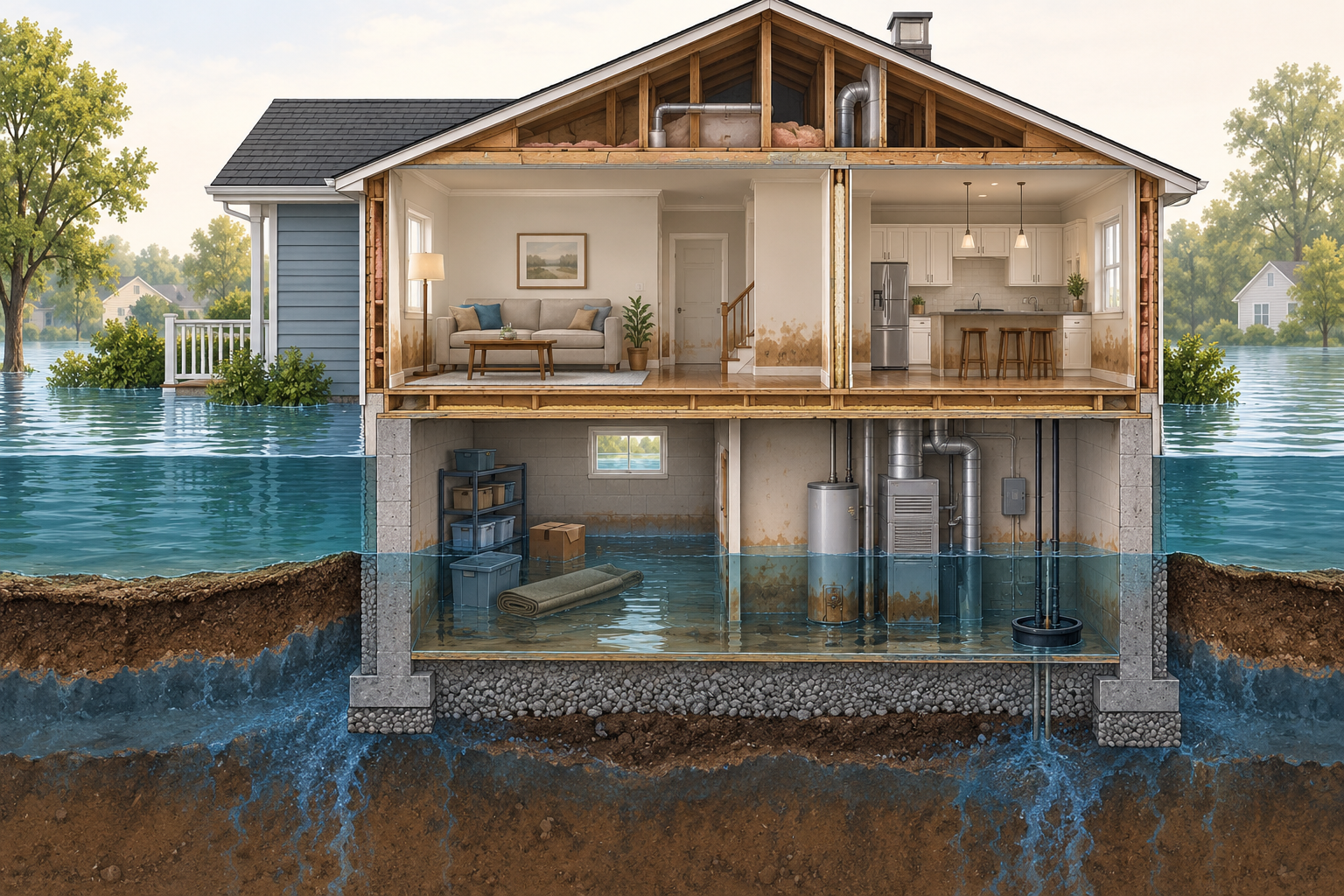
Floodwater can move behind walls, below flooring, through insulation, into cabinets, and across several rooms. Mud and debris can hide damaged materials, while the building’s utilities may be unsafe to use. Ask for an assessment of the affected assemblies and systems, not only a measurement of where water was visible.
If the flood came from outside, the event may also affect a private well, septic system, foundation, drainage, or access route. Those source and property decisions may belong to other specialists, but their cost and timing can affect restoration. Keep them visible as dependencies rather than folding them into an unexplained cleanup allowance.
Do not confuse drying with clearance
Rapid drying can reduce mould risk, but it does not establish that the building is structurally safe, electrically safe, free of contamination, or ready for normal occupancy. Ask which professional or authority evaluates each condition and what records the restoration company will provide. A finished extraction invoice answers only one part of the recovery question.
Do not return until local authorities indicate that it is safe. A flooded building may have structural, electrical, gas, sewage, mould, or carbon-monoxide hazards. In Canada, current public-safety guidance also calls for qualified electrical inspection where relevant, professional inspection of flooded appliances, and qualified well-system attention before well water is used. U.S. CDC guidance similarly advises caution and professional assessment of electrical and HVAC conditions.
Safety work is not a cost shortcut. If power can be isolated only by entering standing water, call a qualified electrician. Do not operate generators, grills, or fuel-powered equipment indoors or near openings.
What cleanup may include
Flood restoration may involve documentation, pumping or extraction, mud and debris removal, containment, cleaning, disposal, moisture assessment, drying, contents handling, controlled demolition, and reconstruction. Materials that cannot be cleaned or dried may need to be discarded, but the decision is material- and contamination-specific.
The timing of drying matters. Health Canada describes drying within about 48 hours as making mould less likely, not as a guarantee or a universal clearance rule. Hidden cavities, insulation, subfloors, HVAC, and contents can retain moisture after standing water is gone.
Cost drivers
The total depends on water depth and composition, affected area, duration, building materials, access, electrical and well conditions, contents, demolition, disposal, drying duration, finish level, code requirements, and temporary housing. A cleanup-only estimate should not be compared with a full rebuild estimate as if they were competing prices.
For a Canadian address, Public Safety Canada’s Community Risk Index can provide broad community awareness, but its census-area rating is not an assessment of this parcel, the cause or depth of damage, insurance coverage, or a restoration price. Local or site-specific information is needed for those decisions.
Insurance and future code work
Flood insurance and other recovery programs differ between the United States and Canada and by policy and jurisdiction. Canadian flood or sewer-backup coverage may be optional or endorsement-dependent. A U.S. NFIP policy can have specific flood-related mechanisms, but ordinary homeowner coverage and NFIP coverage are not interchangeable.
Ask the building official which compliance work is required, the insurer which coverage and limits apply, and the contractor which phase each estimate covers. Future flood mitigation belongs in the recovery conversation, but it should not be silently added to the basic cleanup price.
For an NFIP-participating community in a Special Flood Hazard Area, FEMA describes a substantial-damage baseline when repair cost reaches 50% of the pre-damage value of the structure; local officials determine the applicable result, and a stricter or cumulative local rule may apply. That floodplain-compliance decision does not by itself determine an insurer’s total-loss treatment or payment. See the code-upgrade guide for the separate NFIP and local-authority questions.
Build the flood-loss scope in stages
After safe re-entry, the first assessment should identify standing water, mud, debris, damaged utilities, contaminated contents, building movement, and water that has entered cavities or assemblies. Extraction is only one stage. The project may then require cleaning, removal of material that cannot be dried, structural drying, contents handling, disposal, reconstruction, and code or floodplain review.
Do not turn the list into an automatic package. A shallow event with limited cleanable materials can have a different scope from deep flooding that saturates insulation, drywall, flooring, mechanical equipment, and a private well. The source and duration also matter. A building that was closed for days may have more hidden moisture and mould concern than one addressed promptly, but no elapsed-time formula predicts the final result.
Re-entry is a separate decision from cleanup
Public-safety guidance matters before a homeowner compares restoration prices. Do not return until the relevant authorities indicate that it is safe. A flooded building may have structural movement, electrical, gas, sewage, mould, or carbon-monoxide hazards. If power can be isolated only by entering standing water, use a qualified electrician. Do not turn on flooded appliances or use a private well until the appropriate professional or local-health guidance says the system can be used.
This boundary affects cost because a restoration crew may be unable to begin normal work until utilities, access, or structural concerns are addressed. It also affects the meaning of an estimate. A pumping price is not a safety clearance, and a drying invoice is not proof that a building is ready for occupation.
Cost scenarios after external flooding
A shallow, promptly addressed event may involve safe access, documentation, extraction, cleaning, drying, limited contents handling, and removal of materials that cannot be cleaned or dried. The affected building systems may remain usable after appropriate assessment.
A deeper flood can add mud and debris, contaminated porous materials, damaged appliances, electrical or HVAC evaluation, wall and floor removal, contents loss, disposal, repeated drying, reconstruction, and temporary living. A private well or septic system can add another specialist handoff. The source may also damage the access route, drainage, foundation, or below-grade assemblies.
An event in a floodplain may create a later code or substantial-damage question. That question can change the reconstruction scope, but it is not determined by the restoration contractor’s total or by a universal percentage rule.
Compare cleanup and rebuilding separately
Ask the contractor to distinguish:
- safe access and temporary protection;
- documentation and condition assessment;
- pumping, extraction, mud, and debris removal;
- cleaning, containment, drying, and monitoring;
- contents inventory, treatment, storage, or disposal;
- controlled demolition and disposal;
- reconstruction and system reconnection; and
- permits, inspections, code work, and exclusions.
Materials that cannot be cleaned or dried may need disposal, but the decision remains material- and contamination-specific. The quote should identify why removal is proposed and which later scope restores the opening. Do not compare a cleanup-only estimate with a finished-rebuild estimate as if they were competing prices.
Flood insurance and recovery programs
Coverage differs between the United States and Canada and among policies, endorsements, causes, and jurisdictions. Canadian overland-flood or sewer-backup coverage may be optional or endorsement-dependent. A U.S. NFIP policy can include specific flood-related mechanisms, such as an eligibility-dependent Increased Cost of Compliance process, but that does not make ordinary homeowner coverage and NFIP coverage interchangeable.
Ask the insurer or claim representative which policy and limits apply, the building official which compliance work is required, and the contractor which phase each estimate covers. Keep future resilience or mitigation visible as a separate decision. A flood-resistant improvement may be worthwhile without being part of the basic cleanup or automatically covered.
Questions for the first complete scope
Ask what was observed, what remains inaccessible, which utilities and systems were assessed, what contents were recorded, and what condition the property should reach before reconstruction. Ask how new damage will be documented if mud, demolition, or drying reveals it later. Keep photographs, receipts, inventories, and professional reports together where safe.
The most useful flood budget is a staged one. It recognizes the urgency of safe stabilization while preserving the distinction between cleanup, material removal, drying, contents, reconstruction, code work, and future resilience. That structure is more reliable than a single flood-restoration average.
Conditions that widen the flood scope
The initial visible waterline may not describe the complete project. Scope can widen when water entered cavities, affected insulation or subfloor, carried mud or sewage, damaged electrical or HVAC systems, contaminated contents, undermined exterior areas, or made the building inaccessible. Ask which of those conditions was observed and which remains unverified.
Flood cleanup also has a sequence risk. Moving contents before documenting them can lose evidence; removing finishes before identifying utilities can create a safety issue; drying before the source and contamination are understood can produce the wrong plan. The provider should explain the order of work and the control that allows the next phase to start.
When comparing proposals, keep emergency stabilization, cleaning, disposal, rebuilding, and resilience changes in separate subtotals. A homeowner may approve urgent access or debris work while waiting for a fuller reconstruction decision. That is not indecision; it is a way to protect the property while the condition and coverage questions are still being documented.