
Mold concerns change a water-loss project when growth is visible, moisture remains, a cavity is affected, contamination is involved, or the problem keeps returning. Drying the building is important, but drying is not the same as proving that mold is absent or that reoccupation is safe.
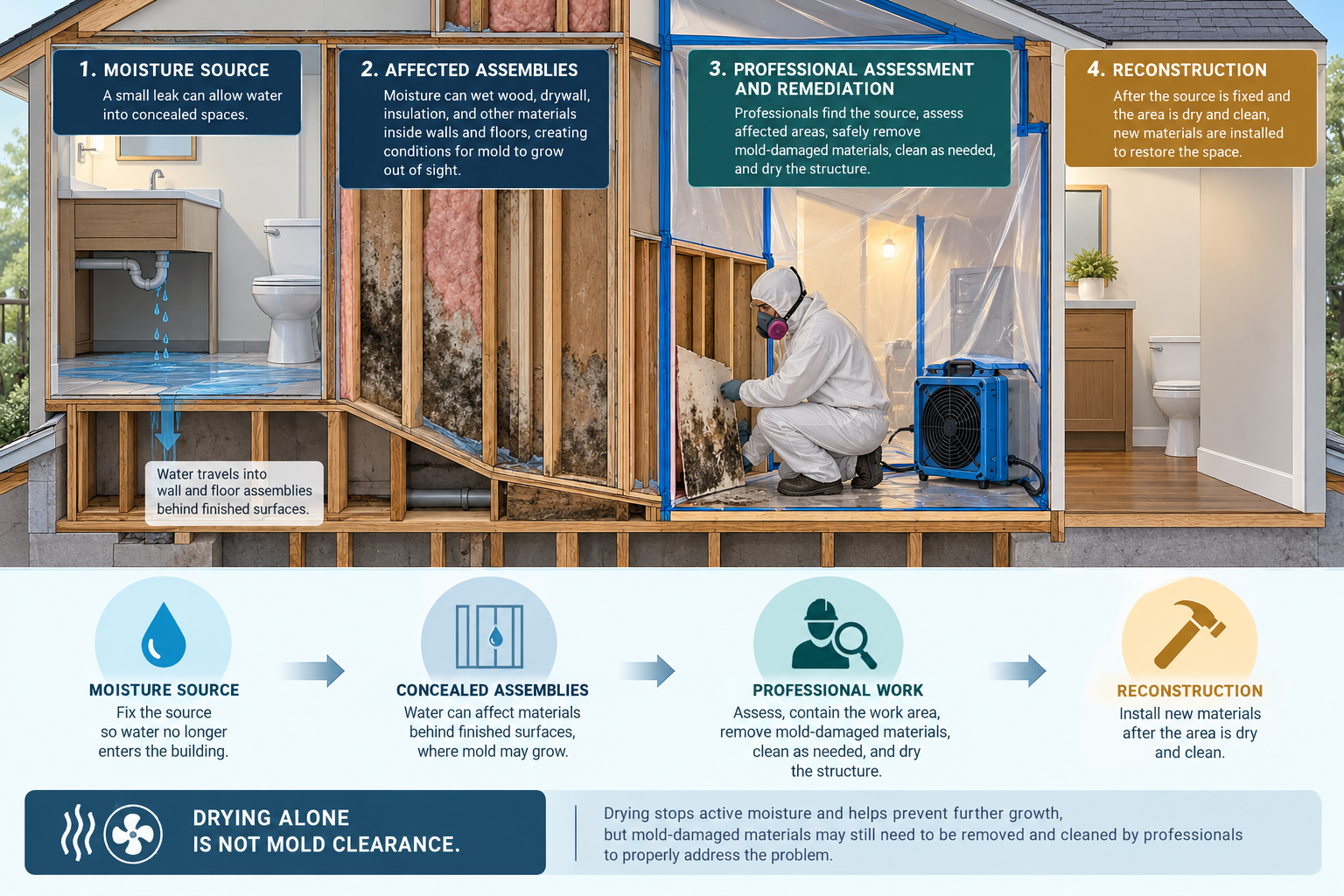
Describe the moisture pathway
The important question is not only where mould is visible. Ask whether the moisture came from a burst pipe, roof or window intrusion, flood, condensation, HVAC, plumbing leak, or another source, and whether that source has been corrected. A remediation scope that leaves the pathway active can produce recurring work and cost.
Keep source repair, moisture control, mould work, and reconstruction as separate lines. That makes it easier to see whether a quote addresses the cause or only the visible result.
EPA and Health Canada both emphasize correcting the water or moisture source. Cleaning visible growth without correcting the cause can allow the problem to return. Do not paint or caulk over moldy material as a substitute for cleaning, removal, and drying.
The underlying source may be a pipe, roof, window, foundation, HVAC condition, flood, or condensation problem. That diagnosis and the mold response may involve different specialists.
When professional help becomes more important
EPA’s residential guide uses an approximately 10-square-foot example for situations where a homeowner may be able to follow its guidance, while larger areas, substantial water damage, contaminated water, hidden mold, or suspected HVAC contamination change the decision. Health Canada identifies large, recurring, hidden, cavity, and contaminated conditions as reasons to seek qualified professional help.
Those examples are source-specific guidance, not a legal North American threshold. Health concerns, occupants, material, access, contamination, and building conditions can make professional assessment appropriate at a smaller size.
How the scope and cost change
The project may add assessment, containment, controlled removal, disposal, cleaning, drying, air or HVAC evaluation, contents handling, and reconstruction. Porous materials can be difficult or impossible to clean completely. A quote should identify affected areas, moisture-source correction, removal assumptions, cleaning method, containment, disposal, reconstruction, and exclusions.
Do not run an HVAC system known or suspected to be contaminated until it is assessed. Do not treat a consumer cleaning checklist as permission to disturb sewage, hidden mold, or hazardous materials.
What completion means
EPA describes cleanup completion as a judgment involving correction of the moisture problem, attention to visible mold and odors, no recurring water or mold on revisit, and the ability to reoccupy without health complaints or symptoms. That is not a universal clearance test. Local health, building, HVAC, and professional requirements may still apply.
Standalone mold testing and general mold-remediation decisions belong in the broader environmental-hazard category. This article stays focused on the post-loss transition from water restoration to remediation and reconstruction.
Drying, mould, and remediation are different checkpoints
Water restoration asks whether the source is controlled and affected materials and assemblies can be safely cleaned or dried. Mould remediation asks how growth is removed, how the moisture cause is corrected, and how the affected area is managed. Reoccupation asks a still different question about the condition of this property and its occupants. A drying invoice does not answer the last two questions automatically.
The timeline matters because prompt drying can reduce risk, but public guidance does not establish a precise biological deadline for every material or building. A wall cavity, insulation, subfloor, contents, or HVAC system may retain moisture after the room surface appears dry. Ask for the areas inspected, monitoring records, inaccessible spaces, and the reason for opening or removing an assembly.
How to compare a remediation scope
Ask the professional to identify the moisture source, affected boundary, containment or isolation approach, removal and disposal assumptions, cleaning method, drying, HVAC or air-system assessment, contents, reconstruction, and exclusions. Ask what condition will be documented at completion and what follow-up is recommended.
A proposal that only applies a coating or paint may not address mould beneath a surface or the moisture source. A proposal for broad demolition should explain the observed condition and why cleaning or drying is not a responsible option. The most expensive scope is not automatically the most protective, and the smallest scope is not automatically adequate.
Why a water-loss project changes when mould is found
The original restoration question may have been extraction and drying. Once visible mould, recurring moisture, a wet cavity, contaminated water, or suspected hidden growth is present, the work may need a separate assessment and containment decision. The source of moisture still has to be corrected. Cleaning or removing visible material without addressing the water problem does not resolve the recovery scope.
The transition does not happen at one universal elapsed time or area threshold. Health Canada and EPA provide conditional guidance examples, including larger areas, contaminated water, hidden mould, substantial water damage, and HVAC concerns. Their examples are not legal, insurance, or universal clearance rules. Site condition, occupants, materials, and professional judgment matter.
What can add cost
The additional scope may include assessment, access to concealed cavities, containment or isolation, protective work practices, controlled demolition, bagging and disposal, cleaning, drying, HVAC assessment, contents handling, monitoring, reconstruction, and temporary living. The cost depends on the boundary, material, moisture source, access, contamination, and how much of the building must be opened.
Do not price mould as a simple per-square-foot problem. A small visible area in a wet wall can have a different decision from a larger area on a cleanable surface. A sewage or contaminated-water loss may require a more conservative professional response. The estimate should explain the affected boundary and the reason for the proposed remedy.
Restoration contractor versus specialist
Some restoration companies handle moisture and post-loss cleaning; an environmental or mould specialist may be appropriate for assessment or a defined remediation scope. An HVAC professional may need to assess an affected air system. A structural or building professional may be needed where assemblies, movement, or code are involved.
Ask who is responsible for identifying the source, setting the work boundary, deciding removal, documenting completion, assessing HVAC, and rebuilding the opened assembly. No single contractor title answers every question. The handoff should identify what each professional observed and what decision remains.
Reoccupation and completion
Dry surfaces, a completed invoice, or a lack of visible mould does not automatically establish that a home is ready for normal occupancy. EPA describes completion as a judgment involving correction of the moisture problem, addressing visible mould and odors, checking for recurrence, and considering occupants’ experience; it does not establish a universal clearance test. Local authorities, health professionals, building professionals, and the actual site may require different decisions.
Ask what conditions were inspected, what remains inaccessible, what records support the completion judgment, and what follow-up is recommended. Do not run a suspected contaminated HVAC system until it has been appropriately assessed.
Insurance and category boundary
Coverage for mould, resulting water damage, testing, remediation, contents, temporary living, deductibles, and exclusions is policy- and jurisdiction-specific. Notify the insurer according to the policy and document conditions when safe. General mould testing and standalone environmental-hazard work belongs in the related environmental-hazard category; this article stays focused on the transition within a post-loss restoration project.
The useful decision is not “mould means total replacement” or “mould is only a cleaning line.” It is a documented chain: correct the source, assess the affected boundary, choose a responsible remediation scope, restore opened materials, and make the reoccupation decision with the appropriate evidence and professionals.
Do not use mould as a substitute diagnosis
An odour, stain, or visible growth may show that a building condition needs attention, but it does not by itself identify the source, the extent, the material response, or the correct remedy. Ask what evidence connects the proposed work to moisture, contamination, or a specific affected assembly. Broad demolition or broad testing should have a defined question and a reasoned boundary.
The same caution applies after cleaning. A new surface can conceal an unresolved leak, and a negative or limited test does not repair wet material or establish every occupant’s health response. The completion record should identify the source correction, the areas addressed, materials removed or retained, inaccessible areas, HVAC decisions, and any follow-up condition to watch.
If the project involves a tenant, vulnerable occupant, shared building, or disputed responsibility, keep the physical assessment separate from the legal or medical question. The restoration scope can document what was found and done; the appropriate authority or professional must answer questions beyond that scope.