
Contents restoration is the economic decision about belongings affected by water, smoke, fire, sewage, floodwater, or mould. The cheapest immediate replacement is not always the best choice, especially for valuable, irreplaceable, or sentimental items.
Contents are a separate scope from building reconstruction. Drywall, flooring, cabinets, wiring, and other building assemblies may be removed or rebuilt while furniture, clothing, electronics, documents, and personal possessions follow a different clean, restore, discard, storage, or replacement decision. A building estimate does not answer which belongings can be salvaged, and a contents inventory does not establish what the building needs.
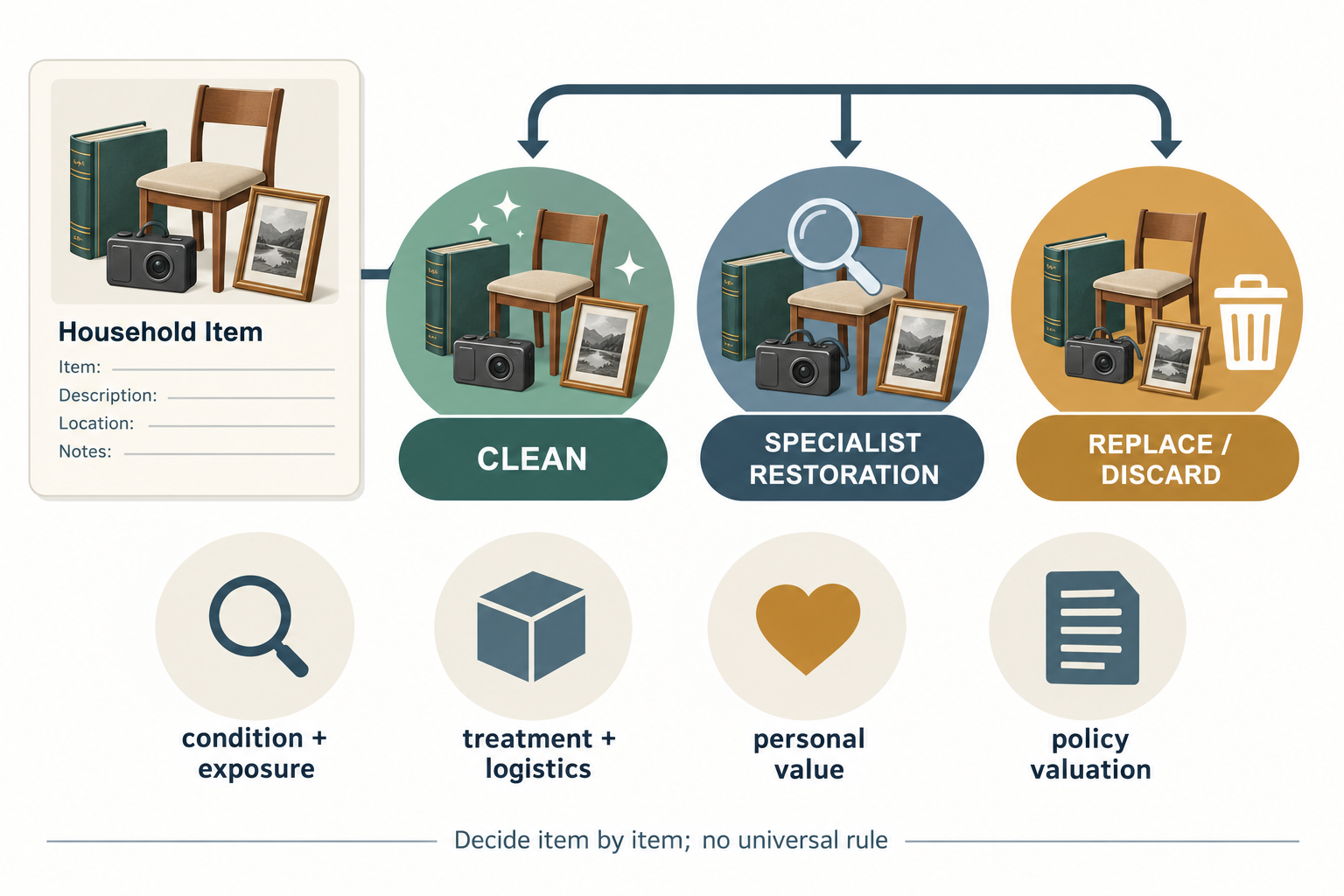
Preserve the decision before moving the item
When safe, photograph the item in place, note the event and exposure, and record whether it is wet, soiled, smoky, odorous, broken, or otherwise affected. Do not use a damaged appliance or electronic item just to see whether it works. If the item is unsafe or contaminated, ask how its condition can be documented without keeping it in the occupied home.
This record helps the homeowner compare restoration and replacement without asking a contents specialist to remember a changing inventory.
Separate personal value from policy value
A family photograph, antique, instrument, or inherited item can justify specialist treatment even when a like-kind replacement is inexpensive or impossible. An ordinary item may be more economical to replace after handling and treatment are included. Insurance may apply its own valuation, sublimits, deductible, or documentation conditions. Keep those questions separate from the emotional importance of the item.
Photograph each item when safe. Record its description, condition, apparent cause of damage, location, ownership, and any urgent preservation step. Keep separate lists for items that remain in the home, items sent for treatment, items stored, and items discarded because they could not be safely retained.
The record supports restoration decisions and insurance conversations, but it does not determine the policy’s valuation. Ask how the insurer wants contents documented and whether damaged items should be retained until inspected, unless health or safety requires disposal.
Compare clean, restore, and replace
The comparison should consider:
- contamination and exposure;
- material and construction;
- current condition and cosmetic damage;
- treatment, transport, and storage cost;
- replacement cost and availability;
- sentimental or historical value;
- risk that cleaning cannot remove residue, odor, or mould;
- policy limits and valuation terms.
Hard, non-porous items may have different treatment prospects from porous insulation, carpet, upholstery, paper, or soft goods. EPA notes that some porous mouldy materials are difficult or impossible to clean completely. That does not make every porous item an automatic discard; the decision depends on the actual contamination and item.
Use a separate decision for each meaningful group of items. First establish the exposure and condition. Then ask whether the item can be safely handled, whether a suitable treatment exists, what the treatment and logistics would cost, and what condition can reasonably be expected afterward. Finally compare that cost and expected result with replacement availability, household importance, and the policy’s valuation process. A technical salvage recommendation, a household preference, and an insurance valuation can all be different conclusions.
Specialty items need specialty decisions
Electronics, documents, photographs, artwork, antiques, instruments, and irreplaceable objects may need a specialist. Ask what treatment is proposed, what condition can realistically be achieved, and what the risk of treatment is. Do not run smoke- or water-affected equipment merely to test it.
California has chaptered AB 1795 and AB 1642, which address certain insured residential wildfire-smoke claims in a defined impact zone, including claim testing and restoration rules. Their provisions are conditional and agency guidance is still developing. If a California claim may fit, verify the current AB 1795 and AB 1642 requirements with the insurer or state agency. The statutes do not decide whether a particular possession can be cleaned, and they are not a general North American rule.
Pack-out and return
Off-site restoration may add packing, inventory, transport, storage, treatment, and pack-back. Those logistics can matter even when an item is ultimately replaced. Ask who has custody, how items are tracked, how access is charged, and how missing or damaged items are handled.
Restoration standards and a contractor’s recommendation do not by themselves establish insurance value. Keep the physical salvage decision separate from the coverage and settlement decision.
Handoff and closeout questions
Before contents leave the property, ask for the inventory format, photographs, item identifiers, condition notes, custody record, proposed destination, treatment scope, storage rate, disposal authorization, and process for an item that cannot be treated. Confirm which items remain onsite and who is responsible for protecting them while building work continues.
Before return or closeout, ask:
- Which items were cleaned, restored, replaced, discarded, stored, or sent to a specialist?
- What condition was expected at return, and what limitations or residual odor, staining, damage, or missing parts are recorded?
- Were treatment, storage, transport, disposal, and pack-back priced separately?
- Which items still require an insurance or household decision rather than a technical salvage decision?
- Who resolves an inventory discrepancy, damage during handling, or an item returned to the wrong location?
The closeout record should make it possible to compare the original inventory with the returned, replaced, or intentionally discarded items. It should not be presented as proof that every item was safe, fully restored, or covered.
Start with condition, not a replacement price
For each item, record the event, material, exposure, condition, odor or residue, moisture, contamination, sentimental value, replacement availability, and likely treatment. An item can be physically salvageable but uneconomical to handle. Another can have modest replacement value but be irreplaceable to the household. Insurance valuation may use different rules again.
Separate the inventory into building contents, items that remain onsite, items requiring specialist assessment, items packed for off-site treatment, and items that cannot safely remain. This makes it easier to compare a cleaning proposal with replacement and to identify items that should not be discarded before they are documented when safe.
Salvageability is a decision, not a material rule
The same material can produce different decisions after different losses. Clean water, sewage, floodwater, fire residue, smoke, ash, heat, odor, and prolonged dampness create different conditions. A hard surface may be cleanable in one situation but damaged beyond reasonable restoration in another. Porous materials may retain contamination or odor, but neither “porous” nor “water-damaged” is enough to decide every item without considering exposure, condition, treatment, and safe handling.
For each item or group, ask:
- What contacted it, and for how long?
- Is the item wet, visibly soiled, smoky, odorous, heat-damaged, or contaminated?
- Can it be cleaned, dried, or treated without causing more damage?
- Does a specialist need to assess electronics, documents, art, instruments, or other high-value items?
- What will treatment, transport, storage, and handling cost compared with replacement?
- What sentimental or historic value would replacement fail to restore?
The answer may be clean, restore, discard, replace, hold for specialist review, or leave in place with protection. These categories should remain visible in the inventory.
Building contents and the structure are different scopes
Contents work can happen while a building is being dried or rebuilt, but the decisions are not identical. A cabinet attached to the building may be part of reconstruction; dishes inside it are contents. A wet carpet may require removal from the building and a separate decision about cleaning or replacement. An HVAC system can affect indoor air while also being a building system requiring its own assessment.
Ask the restoration company to identify who inventories, packs, transports, treats, stores, disposes of, and returns the contents. Ask the reconstruction contractor what must be removed for access and what will be replaced as part of the building scope. This prevents contents treatment from disappearing into a general demolition allowance.
When a rental home floods, an owner-supplied item and a renter’s belongings may occupy the same room but belong to different inventories and coverage questions. The rental-home recovery guide helps coordinate those records without assigning ownership or a claim result by assumption.
Cost scenarios
A small loss may involve onsite cleaning, drying, and documentation. A larger water or fire loss may add inventory labor, pack-out, off-site treatment, climate-controlled storage, disposal, replacement research, and pack-back. A specialist item may cost more to handle than its ordinary replacement value, while a sentimental item may justify treatment even when replacement is cheaper.
There is no universal clean-versus-replace percentage. Treatment cost, time, risk of failure, availability, sentimental value, and policy valuation all matter. Ask for the proposed treatment and its limits rather than assuming the lowest immediate invoice is the lowest total decision cost.
Insurance valuation is not salvageability
An insurer may request an inventory, photographs, receipts, proof of loss, or replacement information. ACV, replacement-cost terms, limits, deductible, endorsements, and policy conditions may affect payment. They do not determine whether an item can be safely cleaned or whether a household wants to preserve it.
Document the item’s condition before moving it when safe. If a dangerous, contaminated, or perishable item must be removed, record why. Keep treatment proposals, disposal records, storage charges, and replacement decisions together. Do not represent a contractor’s salvage opinion as a coverage decision or a policy requirement as a technical salvage rule.
Before contents return
The return decision should identify what was cleaned, replaced, discarded, held for specialist review, or returned without treatment. Ask how missing or damaged items are handled, what condition is expected on return, and whether cleaning, unpacking, assembly, or placement is included. Contents restoration is complete when the documented decision for each relevant item is clear—not merely when boxes arrive back in the house.