
A pack-out removes household contents so a damaged home can be cleaned, dried, demolished, or rebuilt. It may include inventory, photographs or barcodes, packing, labor, transport, off-site storage, treatment coordination, and return. Storage can add cost even when belongings need little restoration.
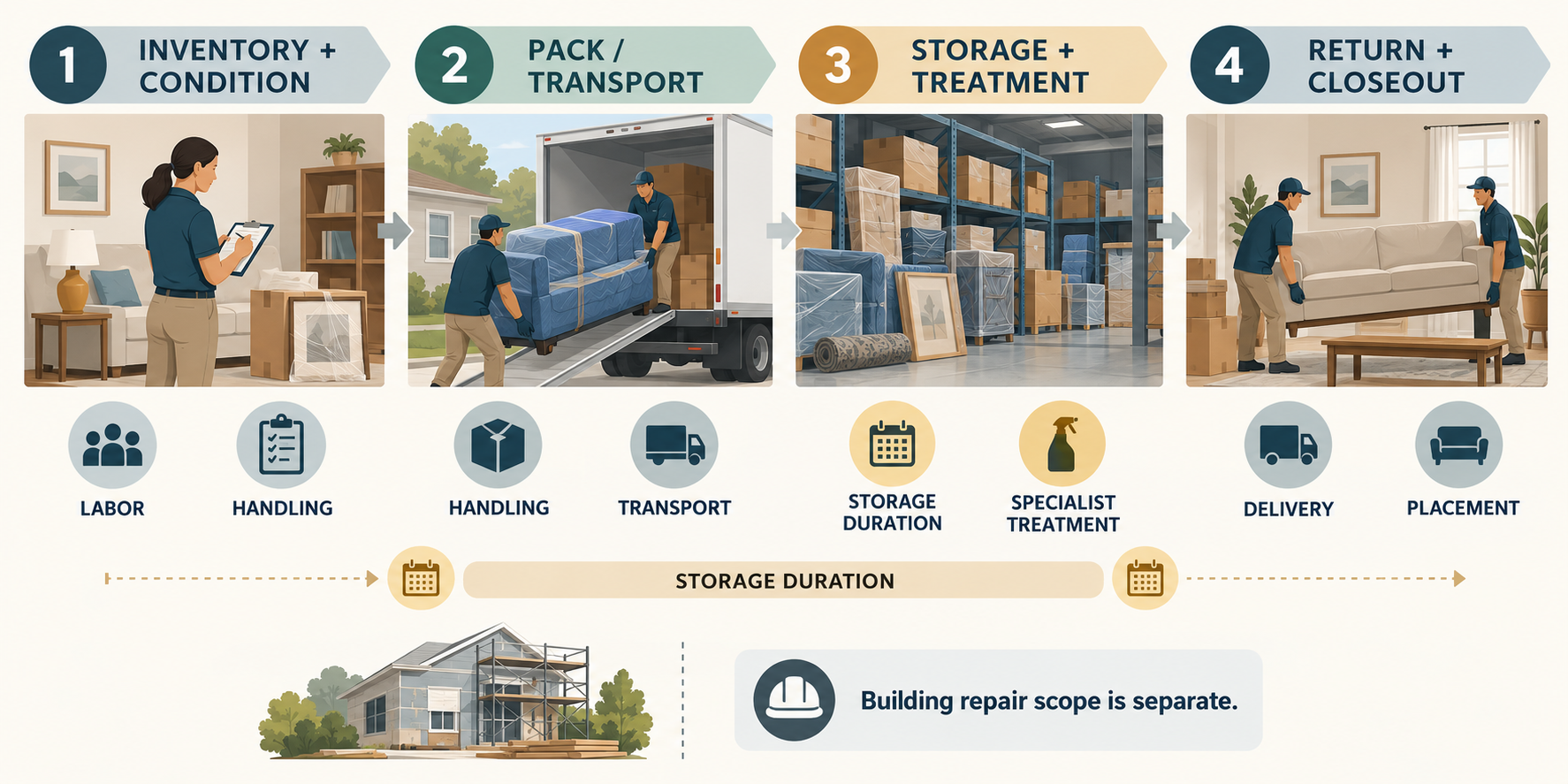
The first question is access
Pack-out can be needed because floors, walls, cabinets, or contents must be reached for drying, cleaning, demolition, or reconstruction. It can also be unnecessary if unaffected belongings can remain protected in place. Ask what work requires the room to be cleared and whether a partial move is sufficient.
Before authorizing the service, identify essentials that must stay accessible and items that need specialist handling. The logistics scope should support the building scope, not create a full-house move by default.
A pack-out is an information handoff
The inventory, photographs, labels, custody record, treatment notes, and return list can be as important as the truck and warehouse. Ask who updates the record when an item is discarded, treated, missing, or damaged. Confirm how the homeowner receives the record and how discrepancies are resolved.
Before authorizing removal, ask for the rooms and items included, inventory method, photographs, packing materials, labor, transport route, storage facility, storage rate, minimum period, access charges, treatment charges, disposal process, and pack-back conditions.
A 2026 U.S. consumer-market observation places pack-out examples around $800–$10,000 or more. The figure is a community market signal and may not include treatment, storage duration, or return. It is not a national rate, Canadian price, or insurance promise.
Why duration matters
Storage cost is often driven by time as much as volume. Delayed permits, hidden damage, drying, reconstruction scheduling, change orders, or a decision about salvage can extend the stay. Ask how a partial return is handled and whether the homeowner can retrieve essential items.
The reconstruction schedule is therefore a storage-cost assumption. A quote that looks reasonable for one month may be materially different if demolition, permitting, contents treatment, or rebuild work keeps the property unavailable for several additional months. Ask what event ends storage, whether storage renews monthly, and what happens if the building schedule changes.
Protect the inventory
When safe, photograph conditions before packing. Keep a copy of the inventory and record items that are discarded, treated, stored, returned, or missing. Clarify who is responsible for custody and how a discrepancy is reported. A tracking system may be useful, but no particular technology is universally required.
Insurance and restoration boundaries
An insurer may ask for documentation and may have policy-specific rules about contents, storage, and additional living expenses. Those rules are not established by a pack-out estimate. Coverage, limits, deductible, valuation, and claim handling control.
Pack-out is also distinct from cleaning or rebuilding. Ask whether the estimate includes only logistics or also restoration treatment, disposal, and pack-back. Keeping each phase visible makes the bill easier to compare and reduces surprises when the house is ready to receive the contents again.
Compare quotes by handling stage
Put competing quotes into the same sequence:
- inventory and condition documentation;
- packing, labeling, loading, and transport;
- warehouse intake and storage duration;
- treatment, specialist handling, disposal, or replacement coordination; and
- delivery, unpacking, placement, assembly, and closeout.
A single total can hide a low initial price that excludes storage, treatment, fragile-item handling, access, or return labor. Compare rooms and item groups, the volume or charging basis, minimums, travel, stairs or elevators, climate control, high-value or fragile-item procedures, access fees, and every included or excluded stage.
What a pack-out estimate should contain
Pack-out is a chain of custody and logistics service, not simply a moving day. The scope may include inventory, photographs, labeling, packing materials, labor, loading, transport, warehouse handling, storage, treatment, disposal, access, and return. A “pack-back” may include delivery and placement, but it may exclude unpacking, assembly, cleaning, or replacement of damaged items.
Ask whether charges are based on the number of items, boxes, rooms, truck loads, labor hours, storage volume, or a fixed project price. Confirm minimum charges, travel, stairs, elevators, special handling, climate-controlled storage, monthly storage renewal, and the cost of retrieving an item during the restoration. The 2026 U.S. community observation of about $800–$10,000 or more is broad and may exclude treatment, storage duration, and return; it is not a universal rate or Canadian estimate.
Before pack-back, ask what “return” means and what return condition is expected. Does it include delivery only, or unpacking, placement, reassembly, cleaning, and reporting of damage? Confirm how the returned condition will be recorded, how missing or damaged items are handled, and whether an item that cannot fit because the reconstruction changed the room will be held, delivered elsewhere, or charged again. Those questions separate a logistics closeout from a replacement or building-scope decision.
When a partial pack-out makes more sense
Not every loss requires the entire home to be emptied. A partial move may be enough when only one room, floor, or wall system needs access. A full pack-out may be reasonable when contents are widely affected, contamination has spread, drying equipment needs clear paths, or reconstruction will continue for a long period.
Ask what physical work requires removal and whether unaffected items can remain protected in place. A smaller move can reduce labor, transport, storage volume, and return work, but it can also make access or protection harder. The right comparison is the building scope, not a default preference for the smallest or largest move.
Storage duration is a schedule assumption
Storage can continue because demolition reveals new damage, drying takes longer, permits are delayed, materials are unavailable, a reconstruction contractor is waiting, or a contents treatment decision remains open. Ask what event ends storage and whether the rate renews monthly, by billing period, by volume, or under a fixed project price.
Compare a best-case return date with a risk-based date. If the home cannot be occupied until reconstruction and inspection are complete, temporary housing and storage may interact with additional living expenses. Track those budgets separately from pack-out so a claim or household decision is not based on one blended total.
Protect the chain of custody
Before removal, request the inventory method, room labels, photographs, item condition, handling categories, and process for changes. Ask who can authorize disposal, treatment, or replacement and how that authorization is recorded. A barcode, photo system, or other tracking method can be useful, but no particular technology is universally required.
When items return, compare the inventory with the delivery. Record missing, damaged, untreated, or changed items before signing a final closeout if possible. Ask whether the service includes unpacking, placement, assembly, cleaning, and disposal of packing materials. “Pack-back” can mean delivery only or a fuller return service.
A quote comparison example
One provider may offer a low packing price but charge storage, warehouse handling, treatment, retrieval, and pack-back separately. Another may provide a larger project total that includes those stages for a stated period. Neither can be compared without putting both into the same sequence and checking the duration, volume, rooms, fragile items, travel, access, and return condition.
The broad 2026 U.S. community observation of about $800–$10,000 or more is useful only as orientation. It may not include treatment, storage duration, or pack-back and is not a Canadian price or insurance promise. Ask for the charging basis and the phase end point instead of relying on the headline range.
The most useful pack-out decision protects both the building project and the contents record. It makes removal necessary for access, preserves evidence when safe, and keeps handling, treatment, storage, replacement, and return as visible choices.
Storage decisions can change the claim
An item may be packed because it blocks demolition, needs off-site treatment, is at risk of secondary damage, or is simply easier to protect elsewhere. Those reasons should be recorded separately. A contents item that is removed for access is not automatically a contents loss, and an item that is discarded because it is inconvenient to store is not automatically unsalvageable.
Ask whether the inventory distinguishes building fixtures, personal property, landlord-owned items, and items belonging to another person. Ask how pre-existing damage, smoke, water, mould, contamination, or ordinary wear will be recorded. Photographs and condition notes taken before handling can be important when a later treatment or replacement decision is disputed.
For a flooded rental property, record owner-supplied items and renter-owned belongings separately before a combined pack-out. The rental-home recovery guide covers the related approval, invoice, and temporary-housing handoffs.
If a storage period may extend, ask how the provider will notify the homeowner before a new charge starts and whether the stored volume can be reduced. A staged return may lower cost once safe access is available, but it should not return items into a room that is still wet, contaminated, unsecured, or under active reconstruction.