
Wildfire smoke and ash can affect a home without a major direct burn. The right question is not whether every smoke-impacted home must be gutted. It is which surfaces, cavities, systems, and contents were affected; what can be cleaned; what must be removed; and what evaluation supports reoccupation.
Separate observation from interpretation
Document where ash or residue is visible, which rooms were exposed, whether doors and windows were open, how HVAC operated, and which contents were affected. Then ask the professional to explain what those observations mean for cleaning, filtration, selective removal, or replacement. A photograph of ash does not establish a required demolition scope, while the absence of visible ash does not prove that concealed surfaces or air systems are unaffected.
The assessment should also identify conditions that cannot be evaluated safely or without opening an assembly. Keep those unknowns visible in the estimate and schedule.
A staged decision can preserve options
Where appropriate, the work may proceed as assessment, protection, cleaning of a defined area, evaluation of results, and selective removal or rebuilding. Staging can create extra mobilization and does not guarantee a satisfactory outcome, but it can avoid treating every wildfire exposure as either harmless or a full gut-rebuild without an intermediate decision.
The current wildfire restoration guide treats the problem as site-specific and does not support an automatic clean-or-rebuild rule. Assessment may consider residue, material type, concealed spaces, HVAC and filtration, contents, odor, cleaning feasibility, and the condition of the structure.
Removal can be appropriate when a material cannot be cleaned or when its condition is otherwise compromised. Cleaning can be appropriate when the material and contamination can be addressed responsibly. Neither decision should be based only on the presence of an odor or the fact that ash is visible.
Ash and indoor-air precautions
EPA guidance for wildfire smoke and ash recommends exposure-reduction measures such as closing openings during smoke conditions, using recirculation where applicable, and choosing a compatible high-efficiency filter. It advises lightly wetting ash rather than dry sweeping and using a HEPA-type vacuum where vacuuming is appropriate. Filter capacity, cleanup conditions, and occupant vulnerability matter.
EPA does not say that every home needs duct cleaning, a particular filter replacement, reconstruction, or a universal clearance test. People with greater health vulnerability should not be assigned ash cleanup without appropriate advice.
Cost questions
Costs can include assessment, cleaning, filtration, HVAC work, contents handling, odor treatment, selective removal, disposal, reconstruction, and temporary housing. A quote should identify which of those are included and whether the proposed work addresses building surfaces, contents, air systems, or only visible ash.
Reoccupation and insurance
Cleaning completion is not automatically proof of safe occupancy. Ask the relevant health, building, HVAC, and local authorities or qualified professionals what further evaluation applies to the property. Insurance scope and valuation are separate decisions; document conditions, keep estimates, and do not assume that a cleaning recommendation determines coverage.
Wildfire restoration guidance is evolving. Confirm that the technical guidance and local requirements used for a current project still apply rather than treating a past guide as a permanent rule.
Why wildfire smoke is not the same as a room fire
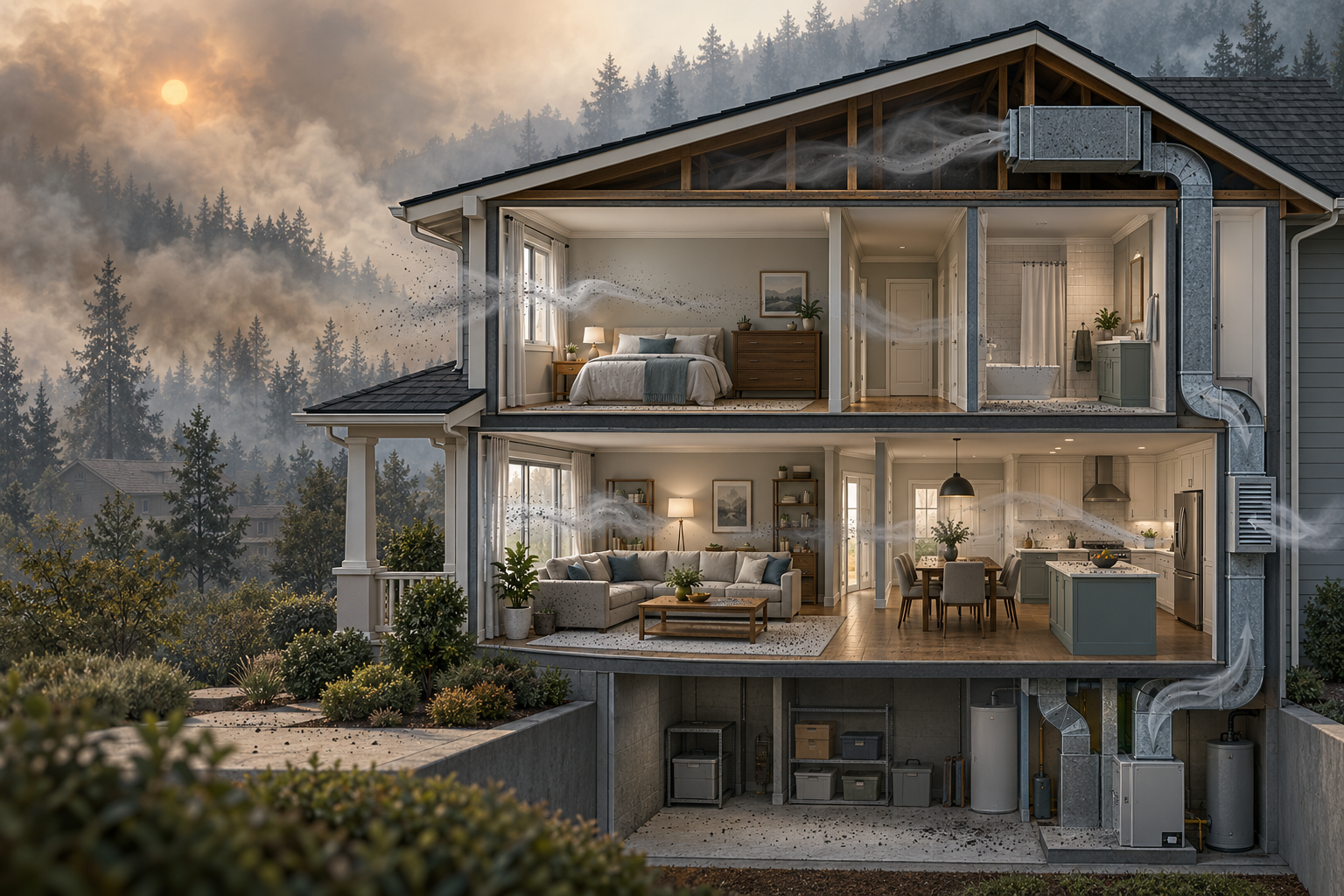
Wildfire smoke can affect a home that was never directly burned. It may enter through gaps, doors, windows, ventilation equipment, and outdoor-air intakes, while ash can settle on exterior and interior surfaces. The pattern, residue, odor, building materials, HVAC system, contents, and duration of exposure differ from a contained interior fire. That is why a wildfire loss should be assessed on its own facts rather than assigned the same clean-up or demolition plan as a structure fire.
The first decision is the affected boundary. Ask what was inspected, whether the inspection covered HVAC and concealed spaces, which surfaces show residue, and what evidence supports cleaning, selective removal, or replacement. A decision to remove materials should identify the condition that makes removal necessary; smoke exposure alone does not establish that every assembly must be stripped.
A California wildfire-claim example
California chaptered AB 1795 and AB 1642 in 2026. The statutes address certain insured residential smoke-damage claims within a legally defined wildfire impact zone, but their provisions include a conditional operative date and several required agency standards remain future work. If the home and claim may qualify, check the current statutory text for AB 1795 and AB 1642, and ask the insurer or relevant California agency how current rules apply. These laws do not establish a universal cleanup method or clearance test, and they do not apply to every California smoke loss.
HVAC and indoor-air boundaries
Smoke can enter through openings, mechanical ventilation, and outdoor-air intakes. The 2026 interagency wildfire-smoke health guide discusses indoor filtration and HVAC operation as exposure-reduction measures. A MERV 13 or higher filter is appropriate only if the system can handle it; the guide does not make a filter change proof of restoration or clearance. After the event, ash should be cleaned in a way that limits re-aerosolization; EPA does not say every home needs duct cleaning or reconstruction.
An HVAC system that may be contaminated or affected by fire should be assessed before normal use. Ask whether the proposal covers only filtration and surface cleaning or includes a professional assessment of internal surfaces, odor retention, restorable components, and a written work plan. Do not treat a filter change as proof that the house is ready to occupy.
Contents and selective removal
Contents may include textiles, furniture, electronics, documents, photographs, appliances, and items with sentimental value. Record the room, exposure, residue, odor, material, condition, and proposed treatment. Pack-out and storage can be useful for access or off-site treatment, but their cost should be separated from a decision to clean or replace an item.
Selective removal is more defensible when a material cannot be cleaned, retains residue or odor, is damaged by heat or water, or cannot be safely evaluated in place. A large demolition proposal should explain the affected boundary and the reason the material cannot responsibly remain. A small cleaning proposal should also state its limitations and the follow-up condition it can document.
Cost and insurance questions
Wildfire restoration costs depend on exposure, residue, building materials, HVAC, contents, access, cleaning method, selective demolition, disposal, specialist assessment, reconstruction, and temporary housing. There is no responsible single wildfire-smoke price. Compare the estimate by affected area, phase, method, contents, equipment, exclusions, and end condition.
Notify the insurer according to the policy and keep photographs, inventories, estimates, and receipts when safe. Coverage, valuation, deductible, limits, exclusions, and claim scope remain policy-specific. A contractor cannot determine whether the policy pays for a cleaning method, contents item, upgrade, or reconstruction decision.
Reoccupation is not inferred from cleanliness
Ask which authority or professional addresses structural safety, environmental conditions, HVAC, health concerns, and local requirements. The absence of visible ash or odor may be useful information, but it is not by itself a universal clearance test. The final decision should identify what was inspected, what remains unknown, and what judgment supports occupancy.
The useful goal is a defensible sequence: assess, protect, clean or remove the materials that the evidence supports, evaluate the result, and rebuild only where the condition and economics justify it.
Separate ash cleanup from rebuilding
Ash and smoke work can make a property look cleaner before the permanent building scope is known. Keep the steps separate in the estimate: protection and controlled removal, surface and contents cleaning, HVAC assessment, demolition or disposal, reconstruction, and any final verification or reoccupation decision. This prevents a cleaning allowance from being mistaken for a completed restoration budget.
Ask which areas were inspected, which were inaccessible, and which findings would cause the scope to change. A roof cavity, crawl space, attic, return-air path, exterior wall, or stored contents may need a separate assessment. If selective removal is proposed, the estimate should identify the boundary and the condition that will be checked after removal.
The same structure helps with insurance and household decisions. A policy discussion may address building damage, contents, debris, code, and living expenses through different provisions. A household may also choose to replace an item for appearance or convenience after the covered cleaning decision is complete. Keeping those reasons visible reduces disputes about whether a cost is for exposure damage, required reconstruction, or an elective improvement. It also keeps the final inventory and handoff understandable.
Treat post-cleanup sampling as site-specific evidence
EPA reported testing 100 randomly selected Eaton Fire properties after federal debris removal and removal of the top six inches of soil at destroyed-home sites. In that sample, 95 properties were below EPA’s 200 mg/kg residential lead screening level in 0–1 inch samples and 98 were below it in 6–7 inch samples. The tested properties, depths, cleanup, and follow-up belong to that specific operation. These aggregate results do not establish the condition of an intact smoke-impacted home, an unsampled parcel, or a universal post-wildfire clearance threshold. For an individual property, ask the appropriate environmental or public-health professional what sampling or evaluation is warranted.