
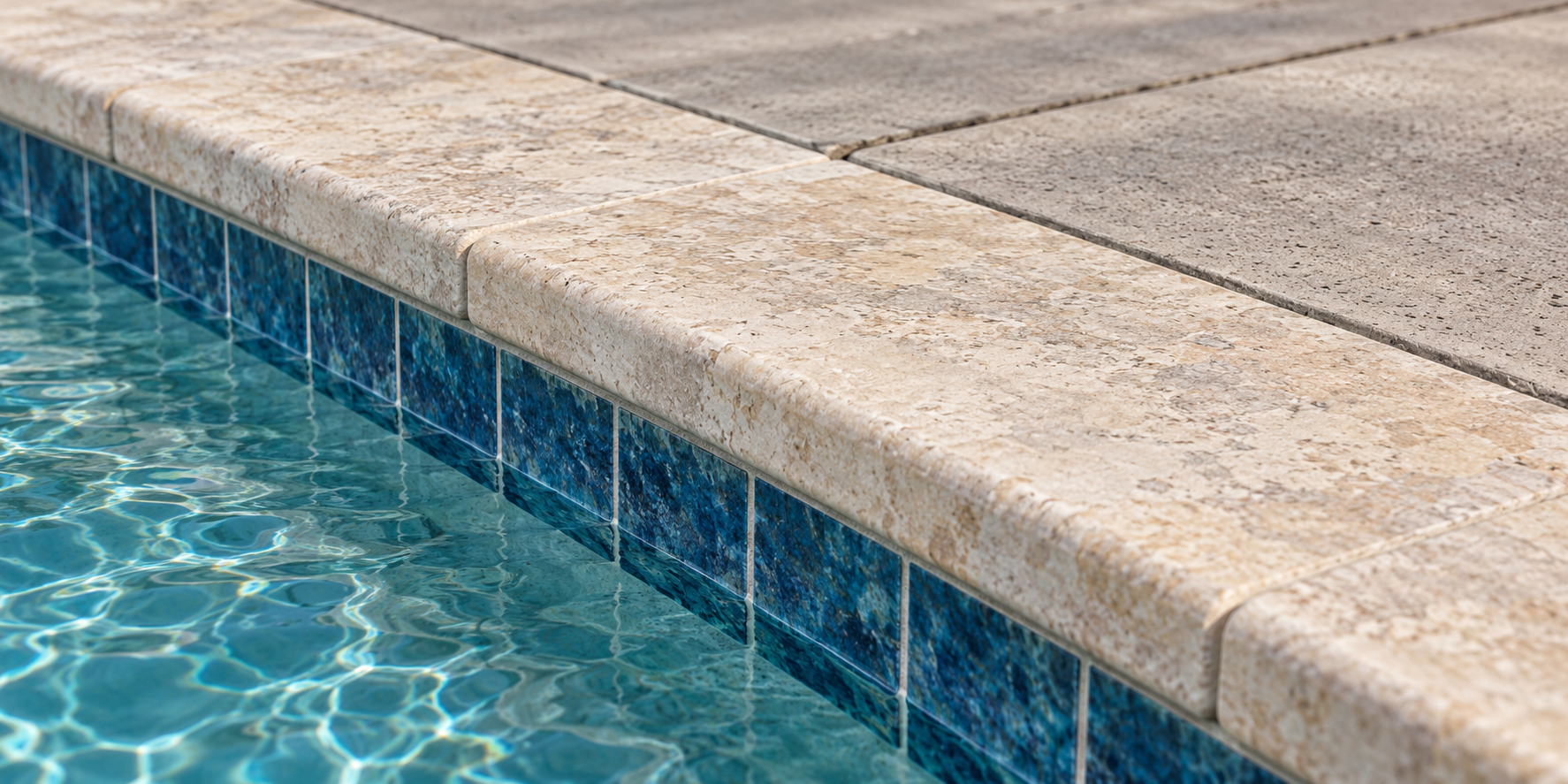
Pool tile and coping sit at the waterline and perimeter, so a small visible failure can be either isolated finish damage or evidence of movement, moisture, freeze exposure, or an underlying beam or shell condition.
Cost orientation
Tile and coping should not inherit the full resurfacing band automatically. A U.S. observation of roughly $6,000–$15,000 for resurfacing can serve as a broader-finish comparison point, while a tile or coping quote should identify area, material, substrate preparation, access, movement repair, grout or setting work, and restoration. Ask whether the work is spot repair, a waterline replacement, or part of a larger renovation; Canadian pricing remains local.
Decide whether the work is tile, coping, or both
Waterline tile and coping sit at the pool perimeter, but they are not the same scope. Tile work may involve loose, cracked, stained, or missing pieces, grout, substrate, and a waterline pattern. Coping work may involve the edge material, joints, beam or shell interface, deck transition, and drainage. A bid that says “replace the border” may conceal several different assumptions.
Start by documenting whether the failure is localized or continuous, whether materials are displaced, whether the deck has moved, whether freeze exposure is present, and whether water loss or shell movement is also reported. Surface appearance can guide the inspection but cannot prove that the underlying beam, shell, or soil is stable.
Spot repair versus full perimeter work
A spot repair may be suitable when the defect is limited and matching material is available. Ask how the contractor will match color, size, edge, grout, and adjacent finish, and whether the repair could expose a broader substrate problem. A full waterline or coping replacement may be more coherent when the material is discontinued, widespread failure has occurred, or a resurfacing project is already planned.
Full perimeter work can include removal, disposal, substrate or beam preparation, new tile or coping, setting and grout, movement joints, deck protection, access, water handling, cleanup, and restoration. Features, steps, attached spas, irregular shapes, and transitions to a deck or retaining condition can add labor. Request a measured scope rather than comparing a per-unit material allowance with an installed project.
Movement and freeze questions
Repeatedly loose tile, open joints, displaced coping, changing gaps, or cracks that coincide with water loss deserve more than cosmetic replacement. The professional should explain whether the issue is likely localized finish deterioration or whether shell, beam, deck, drainage, soil, or freeze-related conditions need evaluation. A new tile or coping installation cannot be used to certify the structure beneath it.
If the pool is being drained for resurfacing or another repair, coordinate perimeter work before refill when that reduces repeated access. If the cause is unresolved, keep the tile or coping allowance provisional. Ask who evaluates the substrate and who is responsible if additional movement is found.
Material and ownership tradeoffs
Tile choices can change material, layout, edge, matching, cleaning, and repair economics. Coping choices affect the edge detail, deck transition, drainage, appearance, and future replacement. The lowest material price may not be the lowest installed or lifecycle cost if the substrate needs preparation or the material is difficult to match later.
Consider the owner’s intended service horizon, climate, access, maintenance tolerance, and whether the pool finish, lights, cover, barrier, or equipment will also change. Keep ordinary surrounding deck or hardscape replacement in its own scope when it becomes the dominant project, while retaining the pool-specific interface details needed for coordination.
Quote scenarios and questions
The simplest scenario is a small, accessible spot repair with stable surrounding material. A typical project may include a full waterline, several coping sections, removal and substrate preparation, or coordination with resurfacing. A complex project includes movement, freeze or drainage concerns, damaged beam or shell conditions, extensive deck access, attached features, or a complete perimeter rebuild.
Ask for the affected length and areas, material specification, removal and disposal, substrate preparation, grout and joints, deck protection, water-level assumptions, access, restoration, warranty, and the condition that triggers extra work. The U.S. tile and resurfacing market signals show scope variation but do not establish a universal tile or coping price. Use local quotes in the actual currency; do not convert U.S. observations into Canadian pricing.
Close out the perimeter work
The owner should receive the material specification, affected measurements, substrate or joint preparation, grout or mortar information, photographs, warranty, and any limitation related to movement, freeze, drainage, or the deck interface. Record which sections were replaced and which existing sections remain. This helps a future contractor match the material and identify whether a later failure is new or part of a continuing condition.
After completion, inspect transitions, edges, joints, drainage, steps, attached spa areas, and the interface with the finish or deck. A visual closeout does not certify the underlying shell or beam. If the contractor identified an unresolved condition, retain it as an open item rather than treating the new tile or coping as proof that the cause was corrected.
Key points
- Tile and coping costs depend on area, material, access, and substrate condition.
- Repeated or displaced failures warrant movement or underlying-condition assessment.
- Spot repair and full waterline replacement are different homeowner decisions.
- Separate pool finish, shell, deck, and restoration work in the quote.