
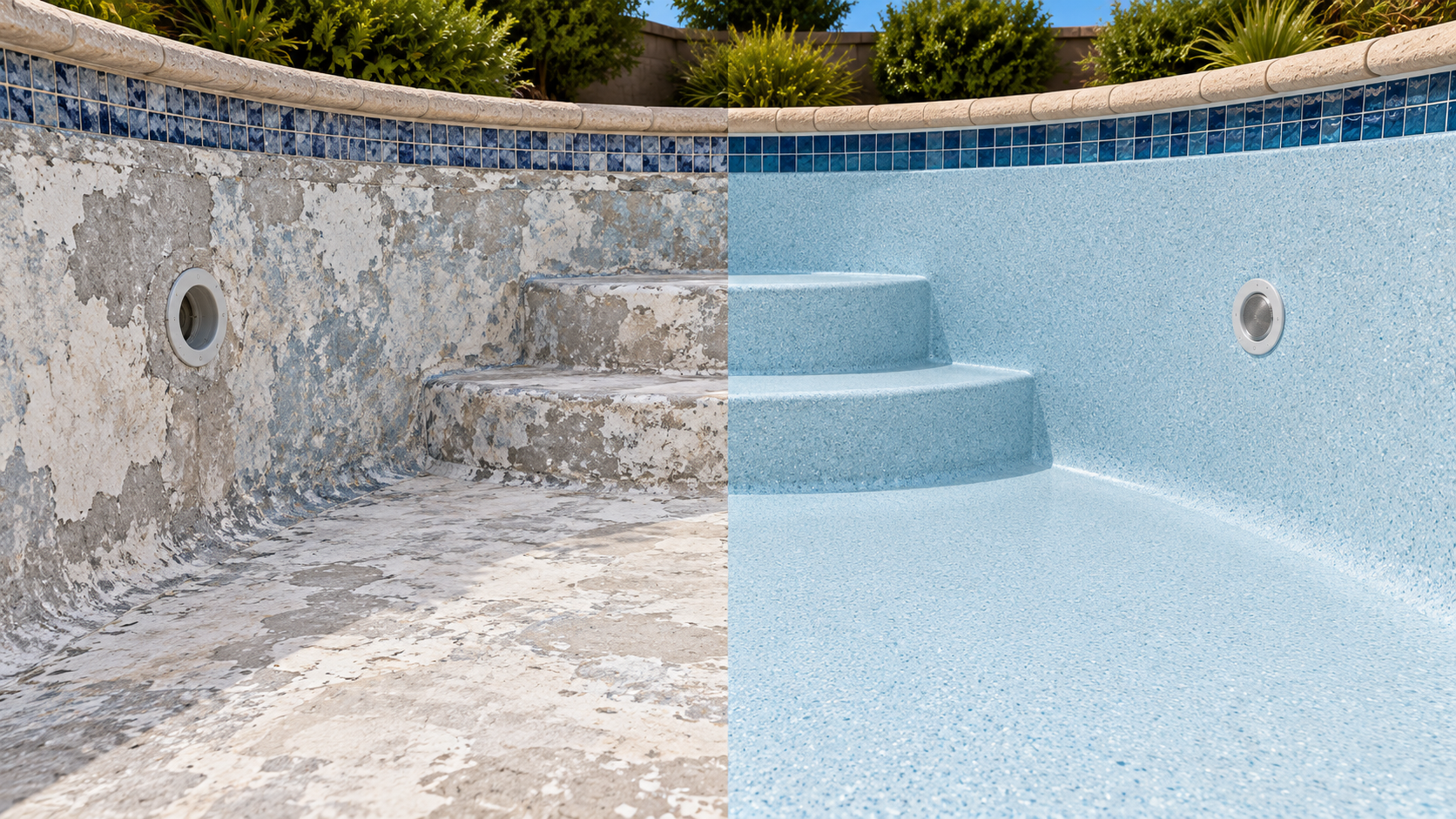
Pool resurfacing is finish work on the interior of a pool. It may involve draining, preparation, removal or treatment of the old finish, new plaster or aggregate, waterline details, refill, and startup. It is not automatically a shell repair or a whole-pool renovation.
Cost orientation
A current U.S. specialist market observation places pool resurfacing at approximately $6,000–$15,000. The band is source-specific and may vary with surface area, finish, preparation, access, draining, tile, coping, repairs, refill, and startup. Treat it as a finish-project scale marker, not a guaranteed installed total or a Canadian estimate. Ask the contractor to identify what the band includes and which hidden conditions are excluded.
The preparation is part of the resurfacing price
Homeowners often compare finish names while overlooking the work needed to expose and prepare the surface. A complete scope should state how the pool is drained, how existing material is removed or prepared, how cracks and hollow areas are treated, how fittings and lights are protected, and how the new finish is applied and commissioned. A finish allowance that omits preparation is not comparable with an installed resurfacing proposal.
Shape and features also matter. Steps, benches, shelves, unusual depths, attached spas, waterline details, drains, lights, and difficult access can increase labor or create coordination points. Ask the contractor to identify the measured surface area and the features included rather than relying on a pool-size label alone.
Resurfacing versus shell repair
Resurfacing renews an interior finish. It does not automatically correct shell movement, unstable soil, a buried leak, damaged plumbing, drainage problems, or a structural crack. Before approving work, ask whether recurring water loss, displaced tile or coping, changing gaps, or movement has been evaluated. If a visible problem may extend below the finish, hold a related repair allowance until the cause is understood.
This distinction protects both cost and warranty. A new surface can make an old problem harder to see, and a finish warranty may not cover movement or substrate conditions. Require the quote to describe the condition of the existing surface and the boundary between finish preparation and shell repair.
Finish choices and future work
Basic plaster or another cementitious finish, aggregate or pebble, extensive tile, and specialty systems have different labor, texture, appearance, matching, and maintenance implications. The appropriate technical standard and the contractor’s installation method matter more than a marketing label. No finish category guarantees a particular service life; water chemistry, workmanship, climate, use, and hidden conditions affect observed performance.
Ask how spot repairs will be matched, whether waterline tile and coping are included, how fittings and lights will be reset, what startup and testing require, and which future maintenance is expected. If the owner is already considering a pump, heater, automation, cover, barrier, or lighting upgrade, decide whether that work should precede the finish so finished surfaces are not disturbed later.
Scenario-based budgeting
A simple resurfacing scenario has a suitable shell, accessible site, one finish system, limited perimeter work, and a clear refill and startup plan. A typical scenario adds preparation of cracks or hollow areas, steps or shelves, waterline tile, coping, equipment coordination, or difficult access. A complex scenario includes shell investigation, buried leaks, extensive tile, deck restoration, draining constraints, or multiple equipment and safety changes.
The U.S. specialist observation of approximately $6,000–$15,000 is a dated market signal for resurfacing scope, not a guaranteed installed total. Ask whether the quoted amount includes draining, disposal, preparation, finish, features, tile, coping, refill, startup, access, and warranty. Canadian costs require current local CAD pricing rather than conversion of the U.S. signal.
Coordinate future work with the empty pool
If the owner is considering a pump, heater, automation, light, drain, liner, tile, coping, cover, barrier, or deck project, decide whether it should occur before the new finish. Shared draining and access may reduce disruption, but later work can damage or require cutting into the completed surface. The proposal should identify sequencing, protection, testing, startup, warranty responsibility, and closeout.
Finish selection also affects future maintenance. Ask how the proposed system handles spot repair and matching, what water-care assumptions support the manufacturer’s directions, and which products or service providers are available locally. Do not promise a universal interval or infer performance from a material label alone; workmanship, chemistry, climate, use, and concealed conditions matter.
Keep the startup and care handoff visible
The owner should receive the selected finish system, preparation record, water and refill responsibility, startup and testing steps, care directions, warranty limitations, and any open condition. Ask who monitors the first period after startup and how a question about discoloration, texture, water balance, or local damage is handled. A finish is not complete merely because the surface looks uniform on the day of application.
Retain photographs of fittings, drains, lights, steps, and perimeter work before and after the project. If a later issue involves movement, water loss, or the supporting shell, these records help distinguish finish performance from an underlying condition. Canadian owners should retain local CAD invoices and not rely on a converted U.S. market signal.
Check the estimate at the feature level
Pool area is not the only quantity that affects a finish quote. Steps, benches, shelves, ledges, attached spas, unusual depths, drains, returns, lights, waterline tile, and transitions to coping create additional preparation or application points. Ask the contractor to show which features were measured and whether each is included in the fixed scope or treated as an allowance. This makes two bids comparable even when the pool has a standard name or volume.
The preparation description should distinguish sound surface that remains from material removed or treated, cracks or hollow areas that receive separate attention, and fittings protected or reset. If the contractor cannot confirm the substrate before draining or removal, require a pause and approval point before extra work proceeds. A price for new finish should not silently absorb a structural diagnosis or buried leak repair.
Where a feature or edge is being changed, identify who restores it and how it interfaces with the new surface. Tile, coping, light, or fitting work may be a separate trade with its own warranty. The owner should know which work must finish before the resurfacing crew starts and which must wait until the new finish has completed its product-specific startup period.
Key points
- Resurfacing is an interior-finish project with its own preparation and startup scope.
- Surface area, finish, access, draining, and related repairs drive cost.
- A finish quote should not be used to diagnose a shell, soil, or movement problem.
- Avoid universal lifespan claims; compare installation quality and maintenance requirements.