
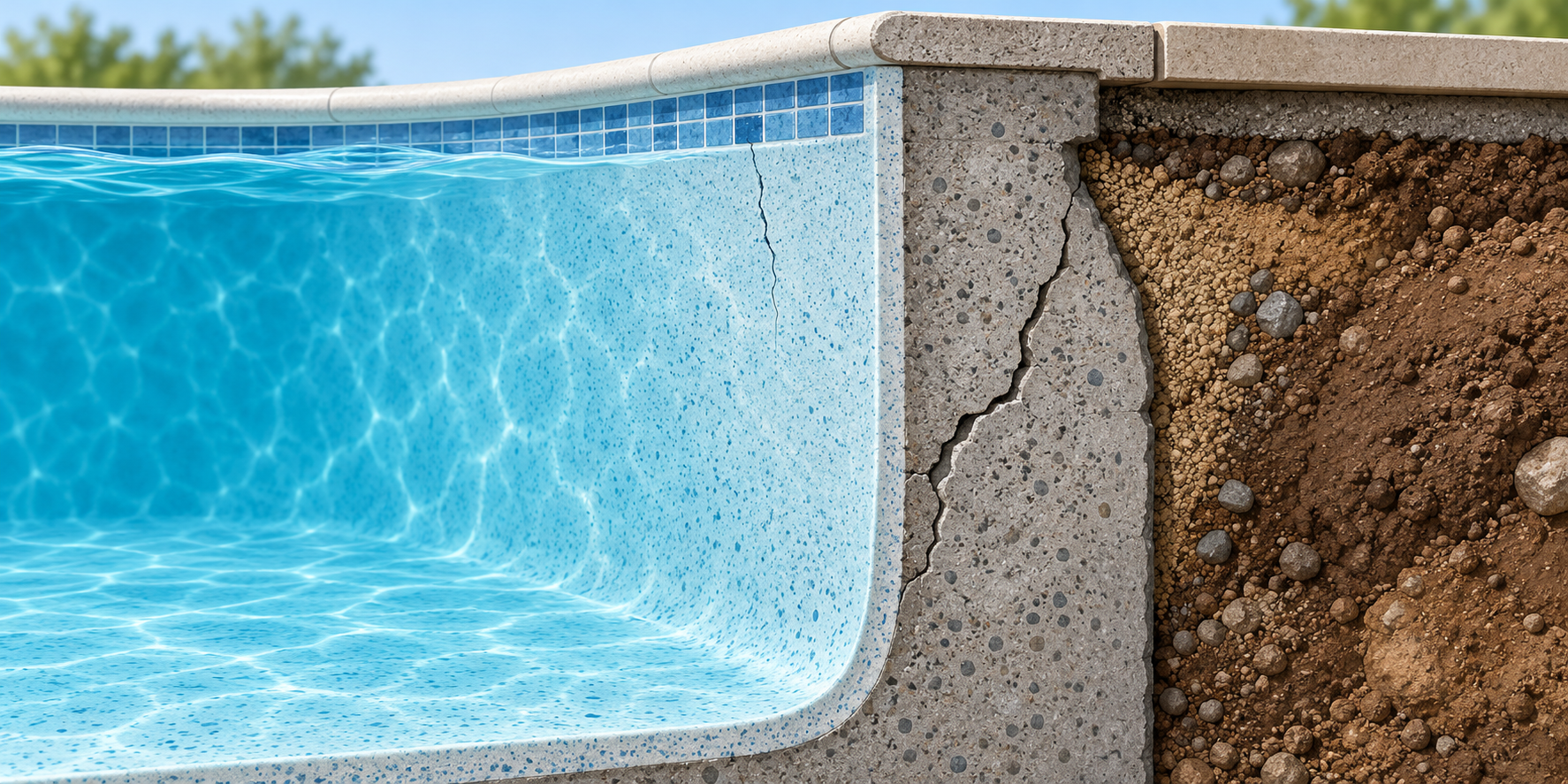
A crack in a concrete pool may be a finish defect, a shell concern, or a symptom of movement or water-related conditions. Appearance alone cannot establish which one it is, so the first cost is often diagnosis rather than patching.
Cost orientation
A resurfacing observation of roughly $6,000–$15,000 in the U.S. can help distinguish a finish-scale project from a shell investigation, but it is not a crack-repair or structural-repair price. A shell quote may add draining, testing, access, engineering or soil assessment, localized repair, resurfacing, and restoration. Do not approve work from a per-foot allowance until the cause and scope have been assessed; Canadian costs require local evaluation.
Classify the crack before choosing a repair
The first useful distinction is not the crack’s apparent length. It is whether the defect is in the interior finish, at a fitting or perimeter interface, or in the concrete shell or surrounding structure. A finish can crack or delaminate while the shell remains stable. A shell concern may be associated with movement, water loss, settlement, drainage, or other conditions that a surface patch cannot resolve.
Document when the crack appeared, whether it is changing, whether water loss changes with the pump on or off, and whether tile, coping, deck joints, doors, or nearby ground show related movement. These observations help a qualified professional plan the evaluation, but they do not establish a structural diagnosis from a photograph.
What a responsible evaluation may include
The scope may include a visual review of the finish and shell, water-level or leak observations, documentation of displaced tile or coping, examination of nearby drainage and soil conditions, and a recommendation for structural or engineering assessment. Draining the pool may make some areas accessible but also introduces water-handling, refill, and surface risks. Ask the professional to explain which observations require the pool to be empty.
If the concern involves movement or settlement, the relevant question is how the pool and surrounding ground are performing over time. A crack repair that looks acceptable on one day may not address an active cause. Keep the proposal provisional until the condition that drives the repair is understood.
Separate repair paths
For an isolated finish defect, the scope may be localized preparation, compatible material, color or texture matching, and related refill or startup. Matching can affect the visible result even when the underlying shell is sound.
For a shell-related repair, the quote may include qualified assessment, access, draining, crack treatment, structural work, testing for water loss, resurfacing, refill, and surrounding restoration. The proper method depends on the actual vessel and conditions; this article does not prescribe a structural repair technique.
When shell concerns occur with coping, tile, plumbing, drainage, or soil movement, the project may become a coordinated renovation or structural investigation. A finish contractor, pool specialist, geotechnical professional, or engineer may each have a different role. Ask who is responsible for the diagnosis and how the work will be verified before the pool is returned to service.
Cost scenarios without false precision
A finish-scale scenario may involve a visible area that can be reached and repaired during a planned surface project. A more involved scenario may require draining, preparation, water-loss testing, and resurfacing around the repaired area. The highest-uncertainty scenario includes active movement, settlement, recurring leaks, displaced perimeter materials, or difficult access; engineering, soil, excavation, and restoration may outweigh the repair material itself.
The U.S. resurfacing observation of roughly $6,000–$15,000 is a finish-project scale marker, not a shell-repair range. It should not be used to create a per-foot allowance for a structural problem. Canadian owners should obtain local quotes in CAD, and all owners should ask what is included in the number.
Questions that protect the decision
Before authorizing the repair, ask the professional to state which layer is affected, what observation or test supports that conclusion, and whether movement, water loss, soil, or drainage remains unassessed. Confirm who is responsible for structural or engineering advice and whether the pool needs to remain drained, restricted, or otherwise out of service while the next step is arranged.
The written scope should have one approval point before hidden or additional work. Identify the condition that would pause the repair, the price basis for extra access or restoration, and how the contractor will verify the agreed repair. Do not use a per-foot allowance or a surface finish estimate to price an unresolved shell question.
Record what the repair did and did not establish
The closeout should state the affected layer, evidence used, repair material or system, draining and refill assumptions, testing, resurfacing, warranty, and any unresolved movement, water-loss, drainage, soil, or shell concern. A finish repair should not be described as a structural certification. A shell or engineering assessment should identify its own limitations and follow-up conditions.
After return to service, retain photographs and note whether water level, coping, tile, deck joints, or the crack change. If a new symptom appears, provide the original report rather than authorizing a second cosmetic patch without review. The useful record preserves the difference between a completed localized repair and an open underlying condition.
Decide when the estimate can become fixed
A visible crack is not enough information to set a reliable repair total. The provider should state which portion of the estimate is fixed for an identified finish repair and which part depends on draining, testing, access, or a shell assessment. If the pool cannot be examined under the conditions needed to distinguish finish from shell, the proposal should say so rather than price a structural repair as though the cause were confirmed.
An owner can reduce avoidable uncertainty by giving the professional a dated history: when the crack was first noticed, any repair already made, whether water loss changed, nearby coping or deck movement, and any drainage or landscape change. The timeline helps direct the visit but does not establish the diagnosis. Do not cover the crack, inject a product, or drain the pool based on a generic cost article.
The quote should explain the test or professional opinion that permits the next stage. For example, an isolated finish scope can be authorized separately from a shell, soil, or engineering investigation. If the work is staged, record the stop point and who decides whether the pool may return to service. A lower first-stage cost is meaningful only if the owner understands the additional decision that may follow.
Key points
- A visible crack is not automatically a structural failure.
- Diagnosis, draining, access, shell or finish work, and resurfacing may be separate scopes.
- Water loss, movement, displaced perimeter finishes, and soil concerns warrant qualified assessment.
- Do not use a generic per-foot repair price as a substitute for diagnosis.