
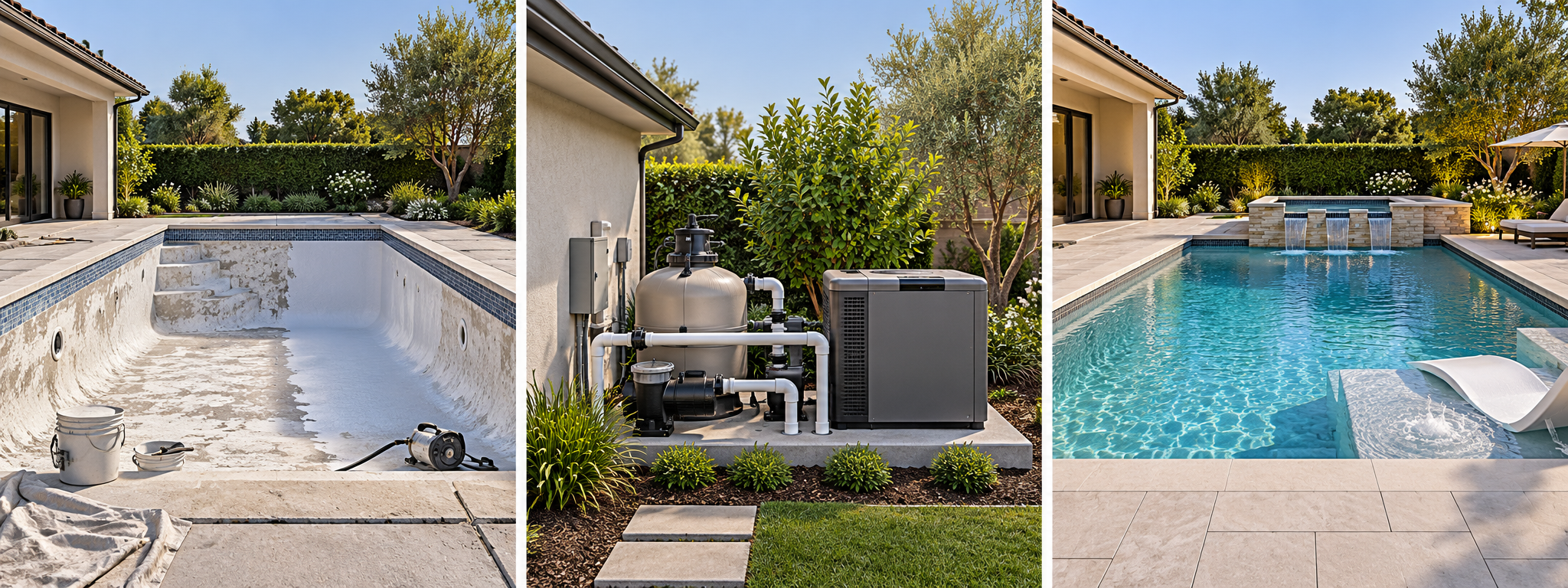
“Pool renovation” can mean a finish replacement, a coordinated equipment update, or a near-reconstruction. The first step is to define the scope instead of comparing a single renovation number.
Safety and technical limits
Pool electrical, fuel, structural, suction, sanitation, and barrier work requires current local and product-specific verification. Do not accept an aesthetic renovation quote that leaves those interfaces undefined.
Cost orientation
For scale, a current U.S. specialist observation places pool resurfacing at roughly $6,000–$15,000. That band is a finish-work signal, not a complete renovation budget. A renovation that also changes pumps, filters, heating, plumbing, barriers, deck work, or drainage can extend well beyond it. Treat the finish band as one quote layer and request separate allowances for equipment, hidden conditions, restoration, and startup. Do not convert it into a Canadian estimate.
Three renovation scopes that should not be confused
Finish-focused renovation may include draining, surface preparation, plaster or aggregate, waterline tile, coping touch-ups, refill, and startup. It can be the right scope when the vessel and equipment are suitable and the owner mainly wants to renew a worn interior.
System renovation adds equipment or controls, such as a pump, filter, heater, salt generator, automation, lighting, valves, or equipment-pad changes. The owner should see whether the work is replacement of failed equipment, an efficiency upgrade, or a new feature. Each has a different reason and future maintenance consequence.
Major remodel or reconstruction may change the shape, depth, steps, spa, water features, shell, deck, drainage, or utility infrastructure. This is no longer a simple resurfacing quote. It may involve design, engineering, demolition, excavation, and extended access or restoration work.
Using these labels in the written proposal keeps a low-scope renovation from being compared with a near-rebuild as if they were competing versions of the same job.
Sequence the work around dependencies
Renovation order matters because a finished surface can be damaged by later access or equipment work. Confirm the design and condition assessment first. Resolve shell, soil, plumbing, and drainage questions before selecting a finish. Plan equipment-pad, utility, and automation changes before closing walls, decks, or finished surfaces. Coordinate lighting, drains, fittings, coping, and waterline details with the finish contractor. Leave refill, startup, testing, cleanup, and owner handoff visible at the end.
Some work can be combined to reduce repeat draining, access, or mobilization. Combining work is not automatically cheaper, though. It can enlarge the dependency chain and make it harder to compare responsibility when a later problem appears. Ask which work must occur together and which can be deferred without undoing completed work.
Compare renovation with the next complete alternative
Compare a confirmed renovation estimate with the complete alternative that would serve the same use. State the pool’s current function, intended season, safety arrangement, equipment, and surrounding deck or drainage requirements; then price what would be retained, changed, removed, and restored under each option. A finish-focused renewal should not be compared with a replacement that includes new equipment, barriers, or larger decking unless those differences are shown separately.
A stable shell with one worn finish may support a narrow renewal. Several known equipment projects may justify coordinating access while the pool is empty. Repeated water loss, movement, major layout changes, or unresolved soil and utility conditions can require a broader assessment before the owner compares reconstruction. Keep those unknowns conditional and use local written quotes; the U.S. resurfacing signal is not an estimate for a Canadian renovation.
Before approval, record the common scope used for comparison, allowance triggers, exclusions, sequence, inspection responsibility, warranty, and change-order authorization. This gives the owner a reasoned basis for selecting the project without treating a fixed percentage of replacement cost as a renovation rule.
Require a clear closeout boundary
The renovation record should list what was retained, repaired, replaced, deferred, and tested. Keep product models, finish or liner information, equipment settings, permits or inspections, startup results, warranty documents, photographs, and unresolved allowances together. This prevents a later service provider from assuming that a new surface or equipment item represents a complete system renewal.
Ask who owns future maintenance, opening and closing, water treatment, equipment service, and warranty claims when several trades contributed. A coordinated project can improve the system while still leaving distinct boundaries between pool work, electrical, gas, structural, landscape, and household scopes. Closeout should make those boundaries explicit.
Keep allowances tied to what is not yet known
Renovation estimates often mix selected work with conditional work. Separate four types of lines: measured and selected work, such as a specified finish or equipment model; work required to connect it, such as plumbing or controls; condition-dependent work, such as substrate or shell repair exposed after removal; and owner-selected additions, such as a feature or expanded deck. This classification makes a proposal easier to compare than a single contingency percentage.
For each allowance, identify the observation that would make it necessary. Examples include a surface that does not accept the selected finish, a fitting that cannot be reused, an electrical supply that does not support the specified equipment, or a concealed condition found after demolition. Ask who will document that observation, whether work pauses for approval, how the cost is calculated, and whether an unused allowance is credited. A contractor should not be asked to guarantee an unknown condition, but the owner should not authorize open-ended work without a decision point.
The owner can then compare bids in two passes. First compare the confirmed scope and the products, quantities, and restoration each includes. Then compare how each contractor handles the same unknowns: testing, unit rates, notice, change orders, schedule effects, and warranty. If one estimate has a low base and large undefined exclusions while another prices known related work, the totals do not describe the same renovation.
Retain the before-condition photographs and change authorizations with the final handoff. If a later issue appears, the record should show whether the affected shell, plumbing, finish, utility, or barrier was part of the renovation, was deferred, or was never assessed.
Key points
- Define whether the project is finish work, system renovation, or reconstruction.
- Separate known work from allowances for hidden conditions.
- Coordinate shared draining and mobilization, but do not hide specialist scopes in a lump sum.
- Compare the renovated system with the owner’s future use and maintenance horizon.