
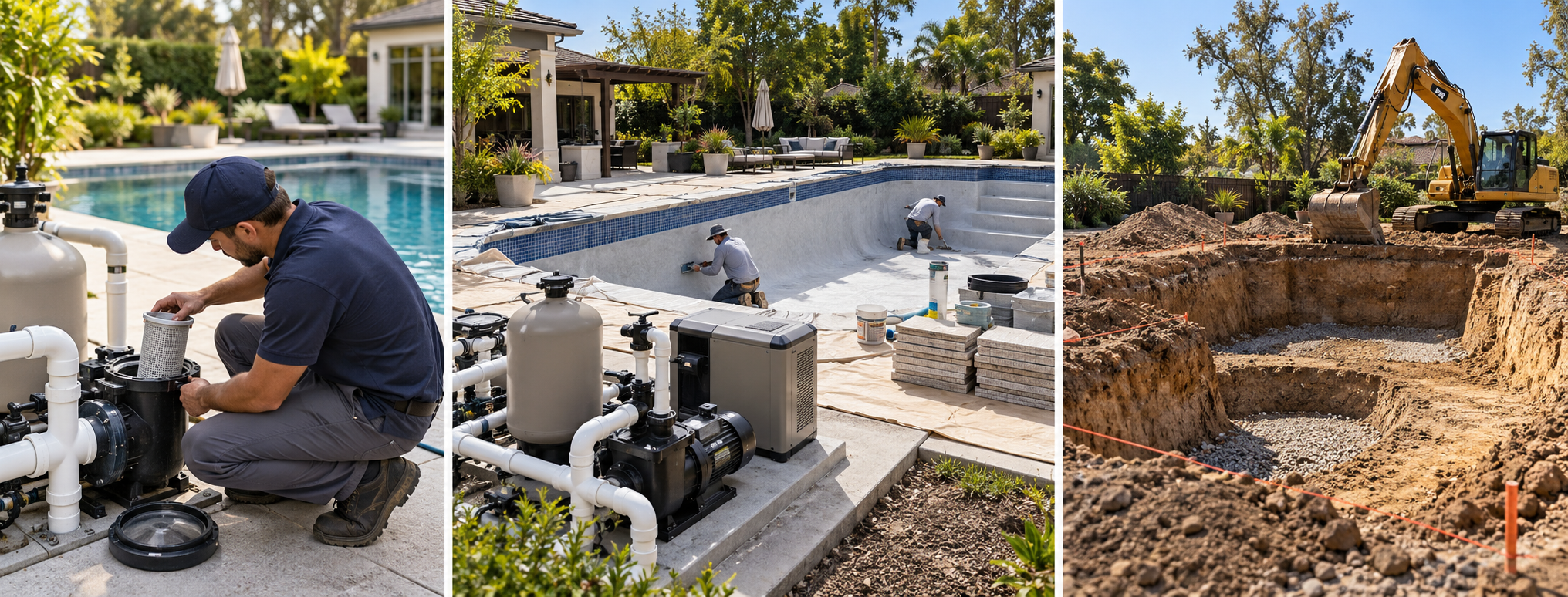
The useful question is not “How old is the pool?” It is whether the current shell, water-retaining system, equipment, safety arrangement, layout, and future ownership costs still support the way the pool will be used.
When inspection is worth paying for
An inspection or specialized diagnostic is especially useful before buying a property, before opening a large renovation, or when several symptoms overlap. A normal inspection does not automatically prove hidden plumbing integrity or structural soundness; additional testing or engineering may be needed.
Cost orientation
A transparent comparison can use known component signals without pretending they are a rebuild price: U.S. specialist observations in this category place resurfacing around $6,000–$15,000 and pump replacement around $700–$4,000. Those figures are separate scope markers, not an additive estimate. Ask for a current-repair quote, a condition-based renovation option, and a rebuild or replacement option with shared site and equipment assumptions. Canadian owners need local quotes rather than converted U.S. figures.
Conditions that change the recommendation
Repair is more attractive when the issue is documented, the shell and buried lines are not implicated, compatible parts are available, the equipment is serviceable, and the owner expects a reasonable period of use. It is less attractive when the same failure has returned repeatedly, the repair requires disruptive access, or the part is being installed into a system with several other near-term failures.
Renovation may fit when the pool location and basic structure still work for the household but several planned improvements can be coordinated. It can also make sense when a current pool has a better layout or site position than a replacement project could achieve. The owner still needs a condition assessment and a written scope for concealed work.
Reconstruction deserves consideration when movement, unstable soil, severe shell or plumbing concerns, repeated water loss, major functional changes, or extensive system incompatibility makes incremental work unreliable. Age alone is not a threshold. A qualified pool, structural, or engineering assessment is more useful than a rule based on years or a fixed percentage of replacement cost.
Ask for comparable proposals
Request a condition report, photographs or drawings, a line-item scope, allowances for concealed conditions, testing included, change-order rules, schedule, warranty boundaries, and closeout documents. Have each bidder state what is excluded. If one proposal is for a repair and another is for a renovation, ask the contractors to price a common minimum scope before comparing optional improvements.
Do not approve shell, suction, electrical, gas, or soil-related work from a surface symptom alone. Keep safety and technical decisions with the qualified professional responsible for the actual system and jurisdiction.
Use a decision record, not just a final number
After choosing repair, renovation, or rebuild, retain the condition evidence, scope alternatives, assumptions, allowances, and reason the selected path fits the owner. Record which shell, plumbing, equipment, safety, deck, drainage, and utility components were retained or replaced. If an option was deferred, state what future symptom or condition would reopen that decision.
The closeout should include drawings or photographs, product models, permits or inspections, testing, startup, warranties, change orders, and unresolved conditions. A repair or renovation can be complete while still leaving an older component in service; the documentation should make that boundary clear. A rebuild should document the site and system just as carefully because future service will depend on the new configuration.
Separate condition confidence from repair economics
A decision can be expensive for two different reasons: the known repair may require substantial work, or the cause and extent may still be uncertain. Keep those questions separate. A documented isolated component failure has a narrower comparison than a water-loss problem with untested buried plumbing, a changing crack, or several systems near replacement. Do not let a low initial repair estimate stand in for a complete project when diagnosis is unfinished.
A useful decision record can show each major system in three states: observed and serviceable, confirmed work needed, or not evaluated. Apply it to the shell and finish, liner or vessel, plumbing, circulation equipment, heating, sanitation, controls, safety arrangement, deck, and drainage. Then attach the evidence for each status: inspection observation, test result, service history, product record, or open question. An inspector’s limitation should stay visible rather than being translated into a favorable or unfavorable assumption.
This matrix makes the repair/renovation boundary more concrete. If one confirmed failure sits in an otherwise serviceable system, price the repair and state what remains untested. If several known near-term projects share draining, access, or equipment work, compare a coordinated renovation with separate visits. If the uncertain items include shell movement, repeated leaks, or site conditions, obtain the assessment needed before treating a rebuild estimate as a comparable option.
Finally, include how the owner will use the pool and for how long. A household planning a short stay may value a defined repair and transparent open item; a long-term owner may give greater weight to serviceability and the cost of repeated disruption. Neither horizon changes the physical condition, and neither justifies withholding a material unresolved issue from a buyer.
Key points
- Pool age is a clue, not a repair-versus-rebuild decision rule.
- Separate isolated failures from systemic condition.
- Price the current repair and the likely next project, not just today’s invoice.
- Use qualified inspection or engineering when shell, soil, buried plumbing, or safety condition is uncertain.