
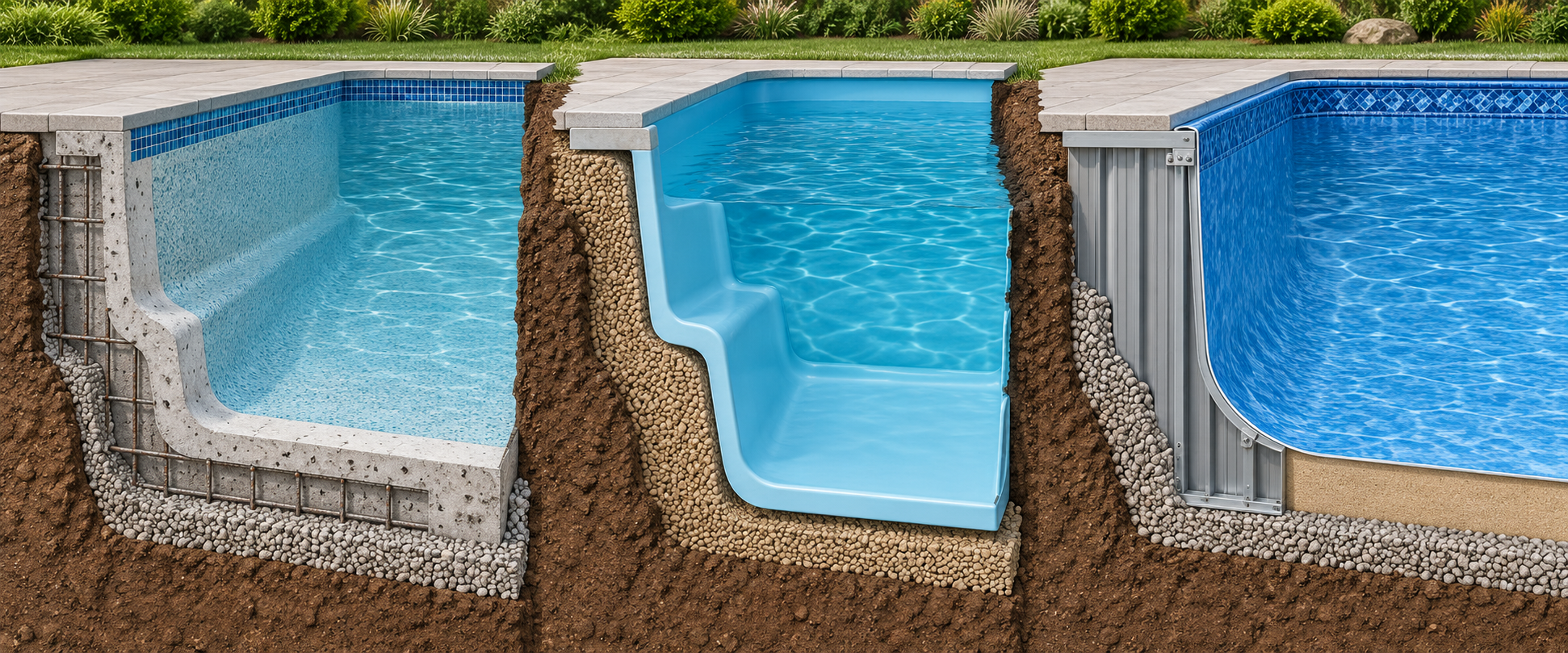
Pool construction type affects the initial build, site constraints, and the future surface or repair work. Compare the same size, site, equipment, safety arrangement, and surrounding work before treating material as the only price difference.
What the systems ask of the project
Concrete pools are built on site and allow substantial shape and feature flexibility. Fiberglass uses a manufactured vessel, so shell size, delivery route, crane access, setting, and backfill matter. Vinyl-liner pools use a supporting structure and a replaceable interior liner; future liner work depends on fit, floor and wall condition, steps, and fittings. These are broad system descriptions, not a promise about the quality or service life of a particular installation.
| Comparison | Concrete | Fiberglass | Vinyl liner |
|---|---|---|---|
| Initial scope | Site-built shell, reinforcement, finish, and several trades | Vessel delivery, excavation, setting, backfill, equipment and finish interfaces | Structure, liner, floor or wall preparation, fittings, equipment and installation |
| Site constraint | Excavation, access, soil and drainage | Vessel dimensions, turning radius, overhead route or crane | Excavation, access to structure and liner handling |
| Future surface decision | Finish repair or renewal; distinguish surface wear from shell movement | Product-specific repair or refinishing | Liner repair or replacement; inspect substrate and fittings |
| Quote comparison | Separate shell, finish, equipment and surrounding work | Separate vessel, delivery, access and backfill | Separate structure, liner and preparation |
Local price observations are not interchangeable
Two Toronto/GTA providers publish 2026 installed estimates by material. Easy Pools lists CAD $50,000–$90,000 for vinyl, $65,000–$120,000 for fiberglass, and $100,000–$220,000+ for concrete. Reliable Hardscapes lists CAD $55,000–$80,000 for vinyl, $55,000–$160,000+ for fiberglass, and $120,000–$250,000+ for concrete. The providers describe different size, feature, and included-scope assumptions; their figures are not normalized and should not be averaged into one range. These are local provider estimates, not representative Canadian market data. Easy Pools · Reliable Hardscapes
The category also contains dated U.S. specialist signals for inground construction, resurfacing, and liner work. Keep those separate from Ontario estimates and request current local proposals. A market range does not tell you whether a specific site needs rock removal, retaining, drainage, a crane, additional deck, a barrier, or restoration.
Compare the whole ownership path
Ask what future project is most likely to be separate from ordinary service. A concrete pool may need finish work; a vinyl pool may need liner work and sometimes substrate or fitting repairs; a fiberglass pool may need repair or refinishing matched to the vessel. No system has a guaranteed lifespan. Installation, water management, climate, use, product, and later access all matter. Ask local providers which repairs they actually support and what product or installation records they need before quoting.
Climate and access belong in the comparison. Freeze exposure, groundwater, soil movement, delivery width, equipment access, and deck restoration can change both installation and later repair. A system that fits the design but cannot be delivered or serviced economically may be a poor project choice.
Construction and renewal create different timelines
The construction sequence influences when project money is spent. Concrete work is built on site and involves multiple stages and finish choices; ask the builder to identify each included trade and what the contract assumes about the substrate and finish. Fiberglass needs a route and staging plan for a manufactured vessel, excavation and setting, and backfill matched to the product. Vinyl requires a supporting structure and a carefully fitted liner, with surface preparation and fittings affecting a future replacement. These differences can influence schedule and access as well as the bid.
Future renewal is not a single identical event for each material. A concrete interior finish may need localized repair or broader renewal; a vinyl liner may need patching or replacement and can expose floor, wall, or fitting work; a fiberglass surface issue needs evaluation against that vessel and approved repair materials. The owner should ask which conditions are covered by the builder’s warranty and which future work is considered maintenance, product defect, settlement, or water-related damage.
Understand what the available estimates cannot tell you
The Ontario figures provide examples of local installed ranges but do not establish whether one material is cheaper over the whole ownership period. Easy Pools’ published categories do not give a normalized cost of equipment, heating, cover, service, or later finish renewal for matched pools. Reliable Hardscapes also uses ranges that vary by shell size and project scope. The broad overlap is a reminder to compare detailed proposals, not evidence that all three systems cost the same.
The U.S. specialist construction range in this category has the same limitation: it is not material-specific, and its inclusions should not be assumed to match an Ontario quote. Do not use a provider’s statement about relative maintenance as a substitute for a property-specific budget. Ask local providers about water-care demands, equipment, finish or liner service, parts, and repair skills for the exact product.
Compare construction schedule and later access separately
Construction time is a project-specific estimate, not a guaranteed ranking of materials. Ask each builder for a sequence that names design approvals, excavation, delivery or shell work, utilities, finish or liner, inspection, startup, and restoration. A manufactured vessel may create a delivery and lift dependency; site-built concrete work may involve several trades and finish stages; a vinyl structure has its own wall, floor, fitting, and liner sequence. Weather, access, crew scheduling, and local inspection can matter as much as the material label.
The owner’s yard changes after the initial build. Fences, mature landscaping, retaining work, deck structures, and equipment enclosures can make later access more difficult. Consider how a replacement liner, finish material, filter vessel, pump, or heater would reach the equipment or pool area. Ask the builder to preserve service clearance and record any delivery route that will later be blocked by permanent work.
A proposal comparison should therefore separate initial build period, expected shutdown for future maintenance, and access for material or equipment removal. No universal completion time or repair interval is supported by the material-price observations; use the schedule and service assumptions in the actual local bids.
Key points
- Compare equivalent installed scopes rather than shell prices.
- Delivery and site conditions can outweigh the material choice.
- Ontario figures here are separate provider estimates, not a combined market range.
- Future finish, liner, repair, and service costs remain product- and condition-specific.