
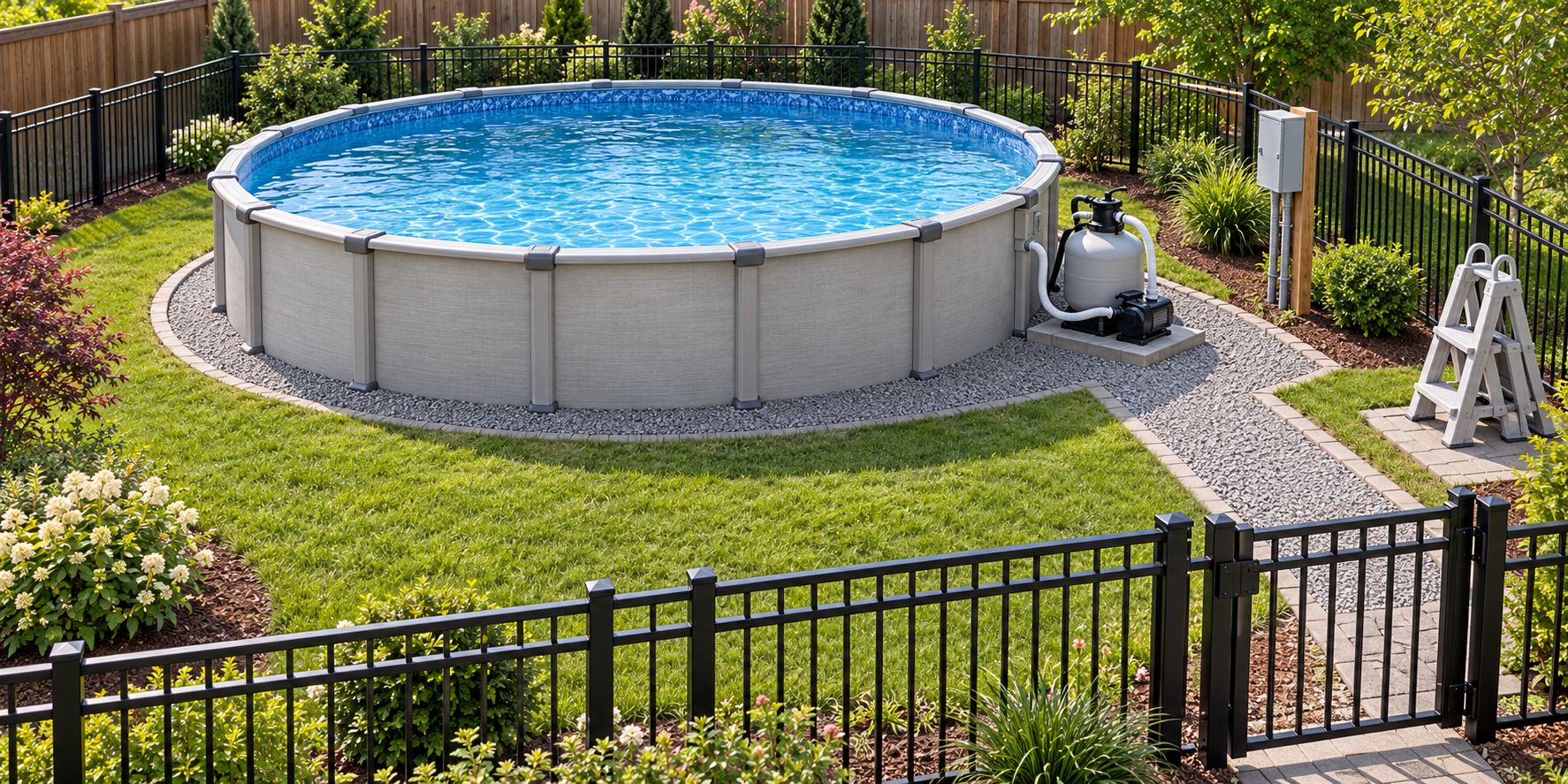
An above-ground pool may begin as a product purchase, but a usable installation can also require a stable base, assembly, equipment, electrical work, water, safe access, decking, seasonal handling, and removal or replacement planning.
Separate the package from the installed project
HomeAdvisor reports a U.S. above-ground pool product-market range of about $1,000–$6,000. It is a consumer-market observation, not a complete installed quote. Ask whether the price includes the pool, liner, pump and filter, fittings, ladder or steps, delivery, assembly, site preparation, electrical work, water, startup, barrier, decking, taxes, and cleanup.
For a separate Toronto example, Easy Pools lists CAD $3,000–$15,000 for an above-ground pool kit with professional installation. The page excludes electrical work, fencing, decking, and permits, so treat the figure as one provider’s local estimate rather than a complete installed budget or a Canadian market range. Compare the written inclusions with the actual site before using it to screen a quote.
A package that includes a pump does not prove that the equipment is installed for the selected pool or that a new electrical supply is included. If the yard needs grading, base construction, drainage, retaining work, soil removal, or restoration, get those items priced separately.
Include equipment, access, and barriers
The quote should identify the model, liner, pump, filter, fittings, cover, ladder or steps, water supply, startup, and the qualified professional responsible for electrical work. Record whether the price assumes an existing suitable outlet or new work. Local approvals and electrical requirements depend on the jurisdiction and the actual pool arrangement.
Review every route a child could use to reach the water: doors, gates, ladders, removable steps, deck access, and neighboring fences. CPSC barrier guidance is useful safety context but is not automatically local law. Confirm current requirements with the local authority before purchasing the access or barrier arrangement.
A product-specific recall is another reason to verify the exact model before installation. CPSC’s 2026 Sunneday and Blue Bay recall covers seven named above-ground pool models; the agency described an exterior support strap that can form a foothold, even with the ladder removed. The notice gives affected owners recall-specific directions and does not establish a rule for other pools. Match the exact model and UPC and follow the current CPSC recall notice.
CPSC separately recalled Evajoy models EJ-HF032, EJ-HF044, and EJ-HF045 in February 2026. On those named pools, an exterior compression strap can create a foothold even when the ladder is removed; the notice describes a free repair kit. Check the model and follow the Evajoy recall instructions. This is another model-specific notice, not evidence of a defect in other pools; the recalled-product sale prices are historical product prices, not installation costs.
Base, water, and electrical work deserve separate review
The base is a structural support for the selected pool, not merely a place to level the lawn. Ask how the installer will establish the footprint and level, which existing surface is acceptable, how removed soil will be handled, and how runoff will be directed. If the yard has a slope, soft area, retaining wall, roots, or drainage problem, ask for an assessment before ordering a pool whose warranty depends on a specified base. Do not assume sand, a patio, or a residential deck is suitable without the manufacturer and installer confirming the actual product requirements.
Plan the water source and first fill. The quote should state whether a water delivery or hose connection is assumed, who checks the initial fill, and which startup tasks are included. Water weight and full-depth use also affect how the surrounding area is managed; the selected location should be reviewed for drainage and local setbacks.
Electrical work should be identified independently from the package. Confirm what power the exact pump and controls require, who determines whether the existing supply is suitable, whether a new circuit or outdoor equipment is needed, and who handles inspection. Use a qualified professional and current local requirements. Do not substitute an extension cord or a general installation note for the required electrical assessment.
Decks and access can change both the first cost and future cost
A simple step or removable ladder and a large deck are different projects. A deck can improve access but adds construction, maintenance, and potentially structural and barrier questions. Ask whether it will be attached to the pool, independently supported, or connected to a house or existing platform, and assign the work to the appropriate qualified professional. CPSC barrier guidance describes some above-ground walls as part of a barrier only in certain arrangements; ladders and steps can still create access routes. Confirm the local rule and the chosen pool configuration before building the deck.
Also price the route for assembly and eventual removal. A narrow gate, retaining wall, overhead obstruction, landscaping, or hard surface may add labor or restoration. For a seasonal pool, estimate repeated handling and storage. For a permanent model, consider whether equipment and liner can be serviced without removing the deck.
Choose a product with the ownership pattern in mind
A low-cost seasonal pool may fit a short or uncertain ownership horizon if the owner accepts setup, storage, water care, and earlier replacement exposure. A permanent above-ground pool may be a better match for regular use when the site and budget can support a durable base, barrier, deck, and winter plan. Neither is automatically cheaper. Compare the same expected seasons of use: purchase and base, setup, opening and closing, water, service, storage, replacement or removal, and owner time. Keep any support, barrier, and electrical assumptions tied to the exact model and property.
Decide what the seller and installer each guarantee
A kit invoice and an installation contract can divide responsibility at the point where the pool leaves the package. Before paying a deposit, identify who verifies the selected model against the site, who supplies any missing fittings or compatible equipment, and who is responsible for the base and final level. Ask whether the installer follows the specific manufacturer instructions and which site conditions would void product support. This is especially important when the owner buys the pool from one seller and hires a different crew to prepare the yard.
The project should record the pool model and UPC, liner and equipment included, base materials or existing surface accepted, assembly scope, first fill, electrical work, barrier arrangement, and excluded deck or landscaping. If a condition changes the install, such as an uneven base or a route that does not accommodate the package, the contract should state how the work is priced and who authorizes it. Keep product warranty and installation workmanship terms separate; they answer different questions.
Plan eventual removal with the same care as setup. If the owner expects to remove a seasonal model, confirm how the water is handled, what parts are reusable, and whether ground cover, base material, or landscaping must be restored. If a permanent pool will stay with the property, keep an access route for equipment service and record the barrier and deck arrangement. Those end-of-use choices can alter the real ownership cost even if they are not part of the retail price.
Key points
- A pool package is not necessarily an installed project.
- Base preparation, drainage, access, electrical work, and barriers can change the scope.
- Seasonal and permanent installations have different recurring and removal costs.
- Verify any product-specific recall against the exact model and UPC.