
Manufactured-home roofs may be low-slope or pitched, single-section or multi-section, original or covered by one or more overlays. A quote for a coating, roof-over, or full replacement should account for the existing assembly, wet decking, penetrations, ventilation, section joint, drainage, and any added weight. The roof surface is not the entire roof decision.
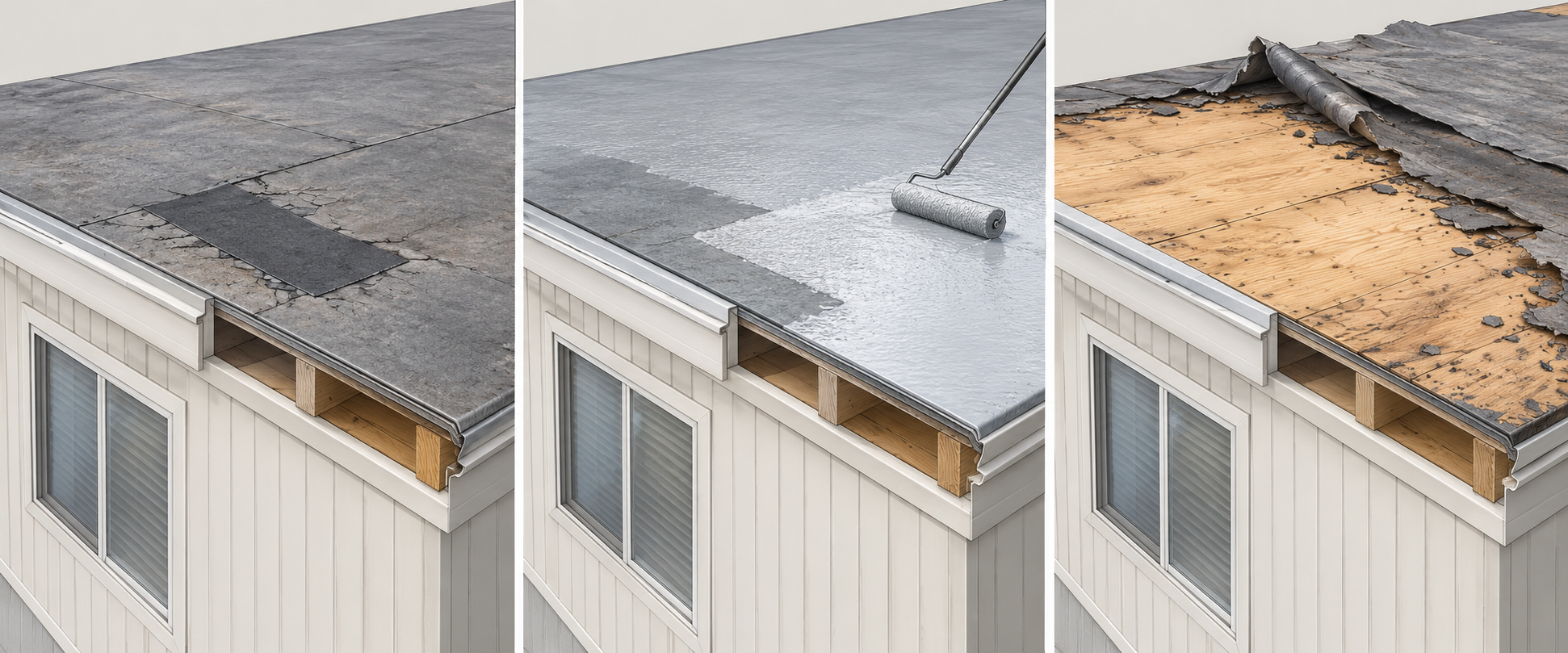
Identify the existing roof system
Record the roof shape, covering, age if known, overlays, ponding, leaks, penetrations, vents, skylights, section joint, and interior signs of water entry. Look for the home’s data plate and manuals before discussing added layers. Roof-load information and manufacturer instructions may matter, especially when a new assembly adds weight or changes drainage.
Compare the four common scopes
A repair may address a localized penetration, flashing, seal, or damaged area when the assembly remains sound. A coating may extend service life only when the substrate, drainage, preparation, and product suitability support it. A roof-over can reduce tear-off but may hide damage, change height and edge details, add weight, or create compatibility and warranty issues. Full replacement may include removal, decking or structural repairs, new underlayment or membrane, flashing, ventilation, and section-joint close-up.
No option is automatically better. A low-slope roof, prior overlay, wet decking, inadequate drainage, movement, or unknown design information can change the recommendation. Do not treat a generic roof-over method as proof that the home can carry another layer.
Price the conditions that change the scope
Ask the roofer to separate inspection, access, tear-off, disposal, decking, structural or engineering review, covering, flashing, penetrations, ventilation, gutters or drainage, section close-up, permits, and interior restoration. Clarify whether the quote includes removal of existing layers and what happens when concealed damage is found. Keep roof work separate from broader structural or storm-restoration projects where appropriate.
U.S. and Canadian prices should be researched and quoted independently. The available evidence does not establish a universal manufactured-home roof price, and an exchange-rate conversion is not a local estimate. Compare roof area, assembly, access, labor, disposal, and exclusions—not only a per-square-foot number.
Compare roof scopes with an allowance
For a U.S. planning example, a coating or minor restoration might be modeled at $6,000, a roof-over at $14,000, and a tear-off or replacement at $24,000, with $6,000 reserved for decking, flashing, access, or structural correction: up to $30,000 for the complex case. A separate Canadian model might use CAD 8,000, CAD 18,000, and CAD 31,000 plus CAD 8,000 for correction. These are illustrative scenarios, not market averages; roof area, slope, material, access, and load conditions control the quote.
Ask whether the bid includes removal, substrate inspection, ventilation, penetrations, edge metal, disposal, engineering, and permits. A coating price is not an alternative to replacement when the roof structure or wet assembly is failing.
Use home-specific verification
Roof loads, structural capacity, wind or snow exposure, materials, and permit treatment vary. Have a qualified roofing professional and, where needed, an engineer or local authority verify the proposed assembly. If there is active leakage, sagging, movement, or water near electrical equipment, prioritize safe temporary protection and assessment before selecting a cosmetic coating.
Diagnose the roof assembly before choosing a surface
Ask the roofer to identify the existing system, number of overlays, substrate condition, leak locations, drainage, penetrations, ventilation, section joint, and any interior signs of water. A coating, overlay, roof-over, and tear-off each assume a different starting condition. If the decking is wet, the roof is sagging, the joint moves, or the design information is unavailable, price an inspection or opening before selecting the finish. A surface product cannot correct a failing structure or recurring water entry.
For a multi-section home, ask whether the proposal addresses the center joint and how work will protect the interior during opening. For a low-slope roof, ask how drainage and ponding affect the proposed assembly. For a pitched roof or added overlay, have the professional verify added weight, edge details, and compatibility with the home’s documented design. A data plate can offer a starting clue but does not replace structural review where capacity is uncertain.
Compare repair, coating, roof-over, and replacement
A localized repair may address flashing, a penetration, or a bounded damaged area if surrounding material is sound. A coating depends on the substrate, preparation, adhesion, drainage, and product limits. A roof-over may reduce tear-off and disruption but can conceal damage, add weight and height, and complicate edges or future repairs. Full replacement may include tear-off, decking repairs, underlayment, new roofing, ventilation, flashing, disposal, and section close-up. Get a professional’s explanation of why each option is or is not suitable for this roof.
Ask for a side-by-side proposal with expected service life only where supportable, maintenance, warranty coverage, exclusions, and what condition voids the warranty. Compare installed total, not material alone. Ask whether the warranty covers labor, leaks, ponding, movement, and existing substrate limitations. If a less expensive coating requires repeated maintenance or excludes the known roof issue, compare that total with replacement rather than treating its first invoice as the entire cost.
Make hidden conditions visible in the bid
Separate inspection, temporary leak protection, tear-off, disposal, decking, structural assessment, underlayment, surface material, flashing, penetrations, ventilation, gutters, section-joint work, permits, and interior restoration. State roof dimensions and assumptions for pitch, access, number of layers, and condition. Ask how concealed rot is measured and priced, and require approval before expanding the work. A quote with a fixed price for a roof whose substrate has never been inspected should explain who carries that uncertainty.
The cost may also include moving satellite equipment, solar or HVAC units, protecting landscaping, providing temporary coverage, and restoring vents or trim. If the roof is part of a storm claim, document the condition and follow insurer requirements before removing evidence. Coverage decisions are separate from a roofer’s repair recommendation.
Use scenarios as scope comparisons
A limited repair case assumes a dry, stable assembly and one accessible failure. A coating case assumes a suitable, prepared substrate and no structural or drainage defect. A roof-over case assumes capacity and edge details are acceptable. A replacement case can include tear-off, decking, flashing, and joint correction. A complex case adds structural review, access equipment, widespread rot, or temporary weather protection. These are distinct scopes, not market price tiers; use local bids for dollars.
The planning allowances in this guide show how the components can be assembled, but they are not a current survey. Ask two roofers to inspect the same conditions and price the same alternatives. If one recommends a roof-over and another recommends tear-off, compare the substrate evidence, weight assumption, and warranty rather than averaging their totals.
Close out the work for future service
Before concealment, photograph decking, flashing, and joint repairs. Retain product data, warranty, permit, inspection, disposal, and contractor information. Ask for a final walkthrough that checks drains, edges, vents, penetrations, and interior signs of leakage. Record any excluded or deferred repair so the next roofer does not assume the roof was fully replaced.
The completed scope should leave the home weather-tight under its approved design. If water returns, use the original inspection and warranty details to locate whether the failure involves a seam, penetration, substrate, movement, or a new event. This documentation turns the roof budget into a decision history rather than a single invoice.
Include weather protection and seasonal timing
Roof replacement can expose the interior if tear-off and covering are interrupted. Ask how the crew protects an open roof, whether emergency tarping is included, and who pays for water damage if weather changes. Access, temperature, rain, snow, and material delivery can affect safe work windows. If the roof is actively leaking, price temporary stabilization as a separate immediate scope while a permanent option is evaluated.
A project that overlaps a home sale, insurance deadline, or planned move may need different scheduling. Confirm lead time for product, permit, engineering review, and inspection before selecting the contractor. Time pressure can change price and quality options; include it in the decision rather than assuming a standard schedule.
Verify the insurance and warranty path
Before tear-off after storm damage, ask the insurer what photographs, inspection, or estimate it needs and whether temporary repairs should be authorized first. Coverage varies by policy and cause; a roofer’s view of damage is not a coverage decision. For a roof under warranty, check whether a coating, overlay, or new penetration affects existing coverage and get the answer in writing.
Keep the insurer’s scope separate from the contractor’s full replacement estimate. The homeowner may need to compare covered work, deductible, upgrades, code-required changes, and excluded decking or interior repair as distinct amounts.
Decide what documentation the next owner needs
After replacement, keep the product and color, installation date, roof area, tear-off details, deck repairs, permits, inspection records, and warranty. Note whether an overlay remains beneath the new surface and whether structural work was performed. If the home is sold, this record helps a buyer compare roof age and scope without assuming that “new roof” means full tear-off or replacement of every concealed layer.