
Identification is part of the project scope for a factory-built home. Labels and data plates can help a contractor, inspector, lender, or engineer understand the home’s construction context, design information, equipment assumptions, or section identity. They do not by themselves approve a repair or prove that a current alteration complies with local requirements. A 2026 federal law also directs HUD to distinguish certain manufactured homes built without a permanent chassis through future revised standards and identifiers; current implementation and records for an individual home must be checked.
What to look for in a U.S. manufactured home
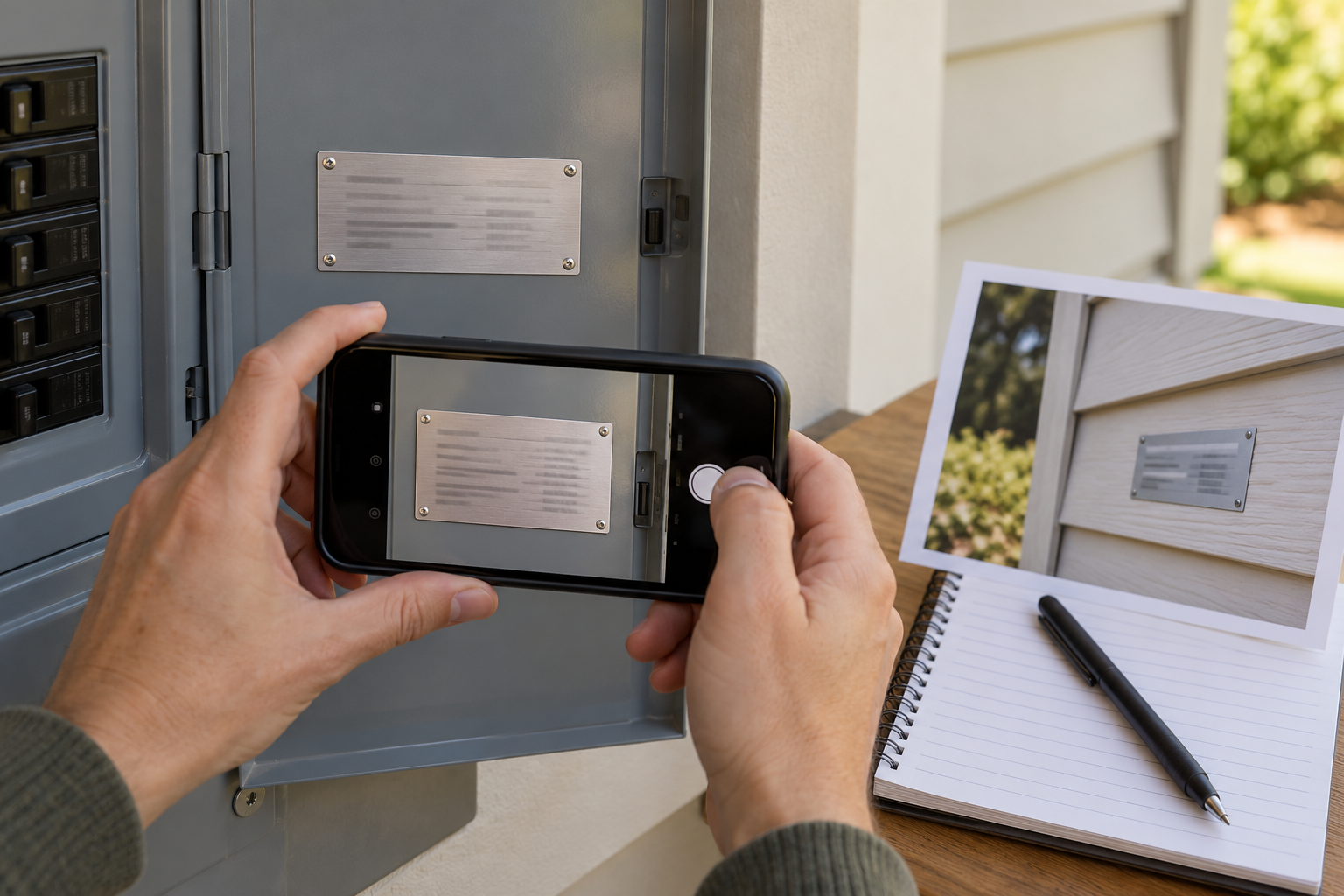
HUD says a certification label is attached to the exterior of each transportable section. An interior data plate may contain serial, model, date, factory, wind and snow information, roof-load information, and label numbers. HUD identifies possible data-plate locations such as on or near the main electrical panel, in a kitchen cabinet, or in a bedroom closet. Homes and records vary, so treat these as places to inspect rather than a guarantee.
Photograph the label and plate without damaging them. Record the serial or VIN, section letters or numbers, manufacturer, model, and any design-zone information. Keep copies with closing documents and the project file. A contractor may need the information for equipment selection, roof work, openings, additions, relocation, or a foundation question.
If no permanent chassis is visible, do not use chassis presence as a stand-alone test of whether the home falls within the amended federal definition. Public Law 119-101, enacted July 11, 2026, changed that definition to include qualifying homes built with or without a permanent chassis. It directs HUD to issue revised standards that distinguish no-chassis homes through a certification label, data plate, and manufacturer invoice notation. The law sets the identification goal; it does not tell an owner whether a particular older or newly built home already has a new label, where it will appear, or how a missing record is verified. Confirm current implementation with HUD, the manufacturer, and the authority or lender requesting documentation.
This transition matters when two information sources seem inconsistent. HUD’s existing public label page describes the familiar labels and data plates and may continue to use earlier chassis wording. Public Law 119-101 is the controlling source for the amended definition, while separate program rules determine whether a lender or transaction has adopted a distinguishing standard. Keep copies of both the home-specific evidence you found and the date and office that accepted it. Do not alter a plate, add a label, or infer the home’s engineering characteristics from a new legal category.
If a label or plate is missing
Do not assume a physical HUD certification label can simply be replaced. HUD states that labels are not reissued, but a Letter of Label Verification may be available through historical records. Manufacturer or inspection-agency records may help with a missing data plate or VIN. The availability of records depends on the home and its history.
Ask the lender, title professional, local authority, manufacturer, or qualified inspector what documentation they will accept before paying for a repair or foundation project. A record that satisfies one transaction or jurisdiction may not answer a structural or equipment-compatibility question.
Build a usable project record
A useful file has more than one photograph. Keep a dated image of every exterior certification mark, the full data plate, the serial or VIN on the frame where safely visible, purchase and installation records, manufacturer manuals, prior inspection reports, and permits for additions or moves. Write down where each item was found and any discrepancy between the serial, section labels, and title. Store copies with the property records and share them only with the contractor, lender, insurer, or authority that needs them.
When requesting a bid, send the record and ask which item the contractor relied on. If a roofer uses a design-zone value, an HVAC installer needs an equipment model, or a mover asks for section dimensions, make sure the value is read from a relevant source rather than copied from another unit. Ask for missing-document research as a separate scope with its own cost and expected outcome. A search may locate a verification letter or manufacturer record, but it cannot reconstruct unknown structural or equipment details by itself.
Before a sale or refinance, get the recipient’s documentation checklist in writing. Ask whether it needs a physical label, a data plate, a verification letter, a title record, a certification for the home type, or a current inspection. Then send the same question to the agency or institution that can confirm the answer. This avoids paying for a general records search that produces a document the transaction will not accept.
For Canadian homes, keep product certification, factory quality-control evidence, site installation approval, and municipal inspection records distinct. A provincial example may show where a label is placed, but it does not establish how another province treats that home. For either country, an identification record narrows the unknowns; it is not an engineering report, insurance binder, title opinion, or permit approval.
Canadian certification labels
Canadian factory-built housing uses jurisdiction-specific certification and installation frameworks. Ontario guidance for factory-built tiny homes gives a provincial example in which a certification label is placed inside the electrical-panel door and checked by a municipal building inspector. A historical CMHC source describes distinctions involving CSA Z240 and CSA A277, while current provincial treatment must be verified. Do not use an Ontario label location or standard as a Canada-wide rule.
Alberta’s published variance provides another bounded example: a CSA A277 label can serve as evidence for a fully factory-completed home in the stated context, while an unfinished unit still needs permits for the remaining completion work. The province-specific label described there is for completed factory homes. A label therefore identifies a certification path; it does not show that every later site task is complete or approved.
When the information matters most
Identification is especially useful before:
- changing a roof, foundation, anchorage, or structural wall;
- replacing HVAC, a water heater, or other equipment in a constrained closet;
- resizing windows or doors;
- adding a porch, deck, carport, or room;
- moving the home or setting it on a different site;
- buying, selling, refinancing, or requesting a foundation certification.
Give the professional the full record and ask what remains unknown. If the quote assumes a particular wind zone, roof load, fuel, section arrangement, or certification pathway, make that assumption visible. Missing documentation is a reason to verify scope; it is not permission to fill in the blank with a generic manufactured-home rule.
Turn the records into a repair scope
Before asking for a price, tell the contractor what decision the information must support. A roof contractor may need roof-load and model details; an HVAC professional may need equipment and data-plate information; an engineer may need plans and prior foundation records; a buyer or lender may need a specific certification or title document. The same plate is not a universal answer to all four questions. Ask the recipient which document matters and what they will do with it.
Make a simple record inventory with three columns: item requested, item found, and next verification step. For example, note that an exterior certification mark is visible on section one, the plate is missing from the expected interior location, and a manufacturer or agency lookup is still needed. Photograph the full context and the text clearly, but do not remove the plate, scrape a label, or invent a serial number when information is worn. Keep the original images and a separate readable transcription so a second person can check it.
If the home has more than one section, record every section mark and compare the identifiers. A missing or inconsistent mark can affect installation records, transaction review, or whether a professional can connect a document to the correct unit. Ask the manufacturer, label administrator, inspection agency, or authority which search uses the information you have. Get the expected fee, turnaround, and document type before ordering a search; an archive search is not a structural inspection and may return no record.
Estimate the documentation work separately
Documentation can have real project cost even when it does not involve construction. The work may include a records search, manufacturer visit, engineer review, title correction, certification check, lender review, or reinspection after a repair. Put each item in the budget with the party responsible, the document or decision expected, and the condition that would trigger additional work. Keep professional fees, agency fees, contractor labor, and physical repair separate so the owner can stop when the actual question is answered.
A useful low-complexity case is one in which all sections have readable labels, the plate matches the title and purchase file, and the recipient accepts the existing documentation. A more involved case may involve a missing plate but an available manufacturer record. A difficult case may include conflicting identifiers, an older home with incomplete records, or a home whose title and physical configuration differ. These are planning categories, not predictions about how often each occurs. Ask the professional to quote the next verification step rather than price an open-ended records project.
Do not treat a title, tax record, insurance policy, or lender approval as proof that every label or design detail is correct. Likewise, an identification document does not settle whether an alteration was permitted or whether a particular appliance is compatible. Match each record to the question it can answer and ask for another kind of evidence when the decision requires it.
Handle missing or changing standards carefully
The federal definition changed in July 2026 to include qualifying manufactured homes built with or without a permanent chassis. Public Law 119-101 also directs HUD to issue revised standards with a distinct label, distinguishing data plate, and invoice notation for homes built without a chassis. Those provisions establish the statutory direction; they do not identify a new label location, a replacement procedure, or what a specific lender will accept. Check the current HUD process before commissioning a new label or records search, and retain the date and name of the office that confirmed the procedure.
For current homes, continue to document the identifiers that exist and clearly separate them from any new standard or application that is not confirmed for that unit. If a seller or contractor says a record is “not needed anymore” because the definition changed, ask the requesting lender, authority, or insurer directly. If someone says every no-chassis home already has a new label, ask for the rule and effective date. The decision should rest on a current written requirement, not a general reading of the amendment.