
Many manufactured-home finishes can be remodeled with ordinary trades, but the budget changes when work affects a marriage wall, floor or roof assembly, openings, underfloor utilities, equipment, chassis-supported structure, or a prior alteration. The key question is not whether the home can be improved. It is which parts of the proposed work need factory-built-specific review before finishes are priced.
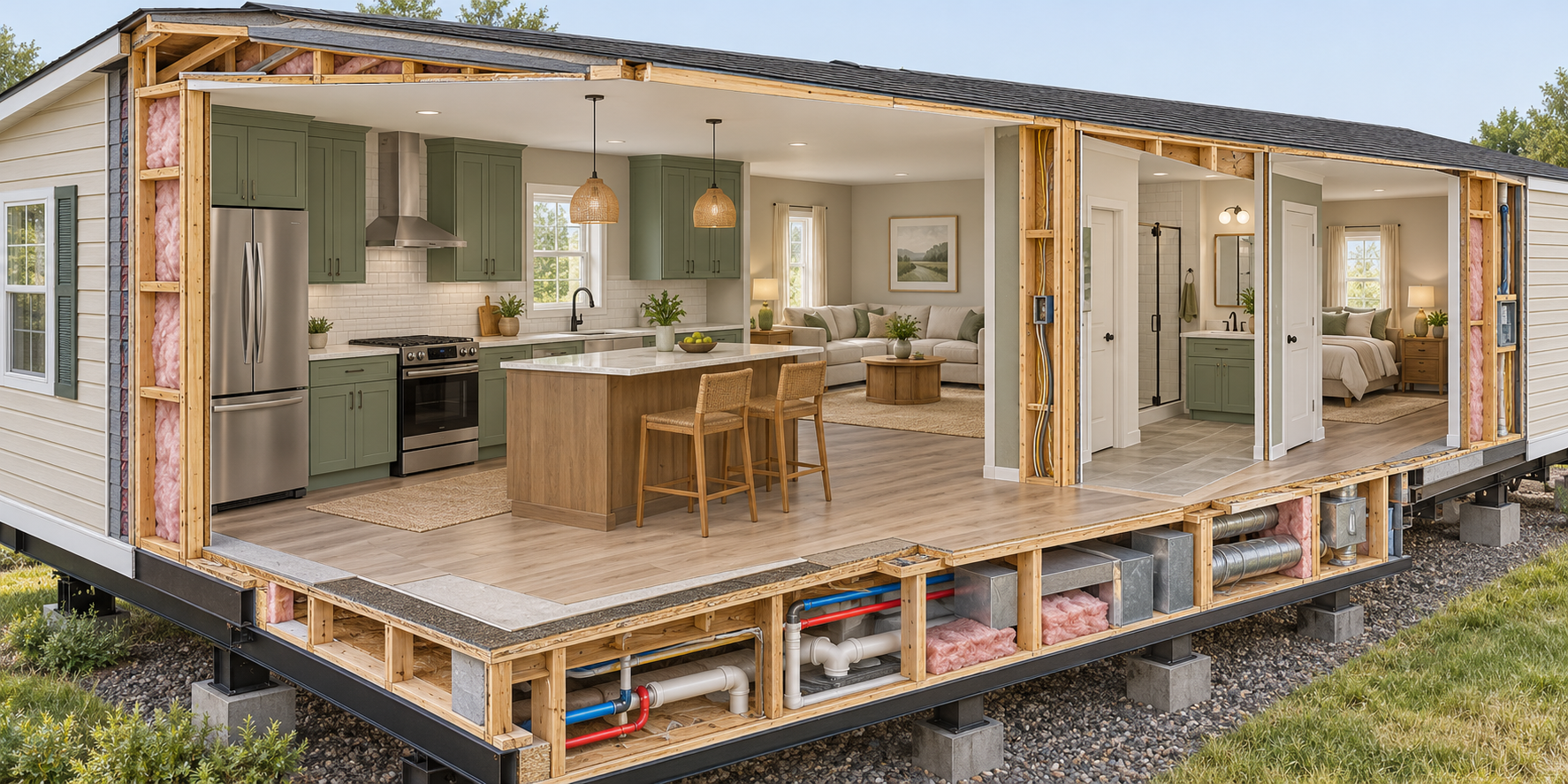
Separate ordinary work from interfaces
Cabinet replacement, painting, flooring, and fixture updates may be relatively conventional when the surrounding assemblies are sound. Scope becomes more specialized when the project moves a load-bearing or structural wall, changes an opening, relocates plumbing or HVAC beneath the floor, changes a roof, adds a room, modifies a section joint, or increases electrical or fuel demand.
Gather the home type, age, labels and data plate, section count, manuals, foundation and support information, prior permits, and evidence of water or movement. Confirm whether the proposed work affects a factory-certified assembly or a site-built addition. Do not assume that a modular home, manufactured home, and seasonal unit share the same alteration path.
Price the enabling work
Request separate lines for design or engineering, permits, protection and demolition, structural review, support or leveling, plumbing, electrical, HVAC, openings, moisture repair, underbelly access, finish work, disposal, inspection, and restoration. A wet floor, damaged belly, inaccessible utility, or section-joint problem can change a finish allowance into a repair project.
If the work is driven by a kitchen or bathroom renovation, coordinate the room finish with the system work. A new cabinet or floor should not hide an active leak or make future underfloor access impossible. If a wall is opened, ask what is being checked before it is closed.
Compare remodel, reconfiguration, and replacement
A major remodel can make sense when the home’s support, envelope, systems, and documentation are sound and the requested changes remain within a feasible approval path. A room addition, separate structure, or limited reconfiguration may solve the same problem with less disruption. A low purchase price does not make a structurally complex alteration economical.
HUD guidance warns that significant additions or structural changes may require local permits and can affect compliance or warranty. Federal construction and installation standards do not replace the authority for post-installation work. Verify the actual requirement before relying on a remodel percentage or universal repair-versus-replace rule.
Build a scope-based remodel scenario
For a U.S. planning example, a limited interior remodel might include $12,000 for design and approvals, $35,000 for finishes, $15,000 for utility or equipment interfaces, and $8,000 for access and restoration: $70,000. A separate Canadian model might use CAD 15,000 + CAD 45,000 + CAD 20,000 + CAD 10,000 = CAD 90,000. These are illustrative assumptions, not a national major-remodel price. Structural, moisture, electrical, or support findings can make the budget larger.
Request an existing-condition investigation before fixing the finish budget. The quote should separate design, permits, demolition, structural work, utilities, specialized manufactured-home interfaces, finishes, temporary protection, and contingency. Compare the full approved remodel with replacement or a smaller phased project rather than comparing only visible materials.
Make uncertainty visible
Keep U.S. and Canadian quotes separate and state all assumptions about the home, location, access, structure, utilities, and permits. There is no universal manufactured-home major-remodel cost. The decision-ready budget includes the work needed to make the finished change safe, approved, serviced, and restorable—not only the visible finishes.
Create a scope before asking for a remodel price
Write a project brief with the rooms affected, desired changes, known symptoms, equipment, utilities, and constraints. Separate finish work that leaves existing systems in place from changes to a wall, opening, roof, section joint, foundation, utility route, or equipment. Ask whether the remodel affects the home’s factory-built structure or only finishes and site-built additions. The answer changes which drawings, trades, permits, and inspections may be needed.
Gather manuals, labels and data plates, plans, permits, foundation information, prior repairs, and photographs. An architect, engineer, or qualified contractor can use these to identify interfaces that a finish-only estimate may miss. If no documentation exists, price an investigation phase first. Do not let a contractor assume a wall is nonstructural, a floor is dry, or an underfloor pipe can be moved without inspection.
Compare full remodel, phased work, and alternatives
A complete remodel may solve several needs at once but require temporary housing, broad demolition, utility relocation, and coordination across trades. Phasing can spread expense and reduce disruption but may require repeated protection, mobilization, and finish repair. A smaller reconfiguration, addition, separate structure, or replacement home could meet the same goal with a different total cost. Compare alternatives using usable result, permits, structural work, total disruption, warranties, and future maintenance.
Ask the remodeler for separate lines for design, permits, protection, demolition, structural or support work, plumbing, electrical, HVAC, openings, moisture correction, finishes, disposal, inspection, and restoration. Identify assumptions about dry and level surfaces, existing wiring and plumbing, and accessible underfloor work. Include an allowance only for a named unknown and define how it will be spent. An undefined contingency is not a substitute for investigation.
A low finish bid may omit costly enabling work. For example, moving a kitchen may require a new drain route, electrical capacity, ventilation, floor repair, or access closure. Replacing flooring over a soft area may leave a leak or support problem. A new room or roof may affect load paths and foundation. Ask which trade verifies each interface and who coordinates it before work begins.
Track changes without losing the budget
Set a baseline budget with owner-selected finishes, required repairs, approval fees, temporary housing, and a separately stated reserve. For each change order, write the finding, scope, price, schedule effect, and decision deadline. Update the remaining budget rather than treating each extra as independent. If a hidden condition consumes the reserve, decide whether to defer a discretionary upgrade, phase the work, or stop for redesign.
Ask the contractor to provide progress documentation before concealed work is closed. Photos, inspection reports, equipment submittals, and test results help verify that plumbing, electrical, insulation, framing, and section interfaces match the plan. Keep payment milestones linked to completed work and required inspections. The schedule may affect storage, rent, financing, utility service, and the household’s ability to occupy the home; include those effects in the comparison.
Know when the remodel is no longer the original project
If opening a wall reveals widespread moisture, movement, electrical damage, or structural change, pause and price a revised scope. Ask the professional what is necessary for safety and approval, what can wait, and what work is optional. Repeatedly adding repairs to the original estimate can make a project unaffordable without ever comparing it with replacement or a smaller plan. A clear stop point protects the owner from authorizing an open-ended remodel.
There is no universal rule that a remodel above a given share of a home’s value is uneconomic. The home condition, land, financing, location, owner’s needs, repair alternatives, and likely future use all matter. If resale value drives the decision, consult an appropriate valuation professional; construction cost is not proof of increased value. Keep that question separate from the project’s structural and permit feasibility.
Close out for service and future transactions
Collect approved plans, permits, inspection records, lien releases where relevant, invoices, material and equipment manuals, warranties, test results, and photos of concealed connections. Update the home record with changes to floor plan, electrical loads, plumbing routes, and additions. Ask which warranties depend on maintenance or inspection. If the work altered a factory-built component or section joint, keep the designer’s explanation and authority acceptance with the records.
A successful remodel is a usable, safe, approved result within a controlled total budget. The proposal should state the existing assumptions, related work, exclusions, and procedure for newly discovered conditions. This lets the owner compare a phased or smaller project with the full plan without confusing finish choices with necessary correction work.
Compare contractor bids without averaging incompatible scopes
Send all remodelers the same drawings, home information, finish schedule, and known-condition report. Ask them to separate allowances, exclusions, owner-supplied products, permits, and work performed by subcontractors. If one price is much lower, identify whether it omits engineering, access, testing, restoration, or temporary housing rather than assuming its labor rate explains the difference.
For large uncertainty, consider a paid preconstruction or investigation phase before committing to the full project. The result should be defined: measured conditions, permit feedback, a coordinated scope, and a revised budget. This can reduce the chance that a fixed construction price is based on assumptions that no contractor has verified.
Protect the occupied home during work
Ask how dust, weather, security, heat, water, and access will be managed while the home is open. A remodel may require temporary relocation if utilities are disconnected or hazardous work is underway. Identify which rooms remain usable and who secures tools and materials. Include the cost of storage or alternate accommodation in the total project comparison when necessary.
The disruption can favor a phased repair even when its direct labor cost is higher. Ask the contractor to price phases with mobilization and protection included so the owner can compare the real cost of staging against one continuous project.