
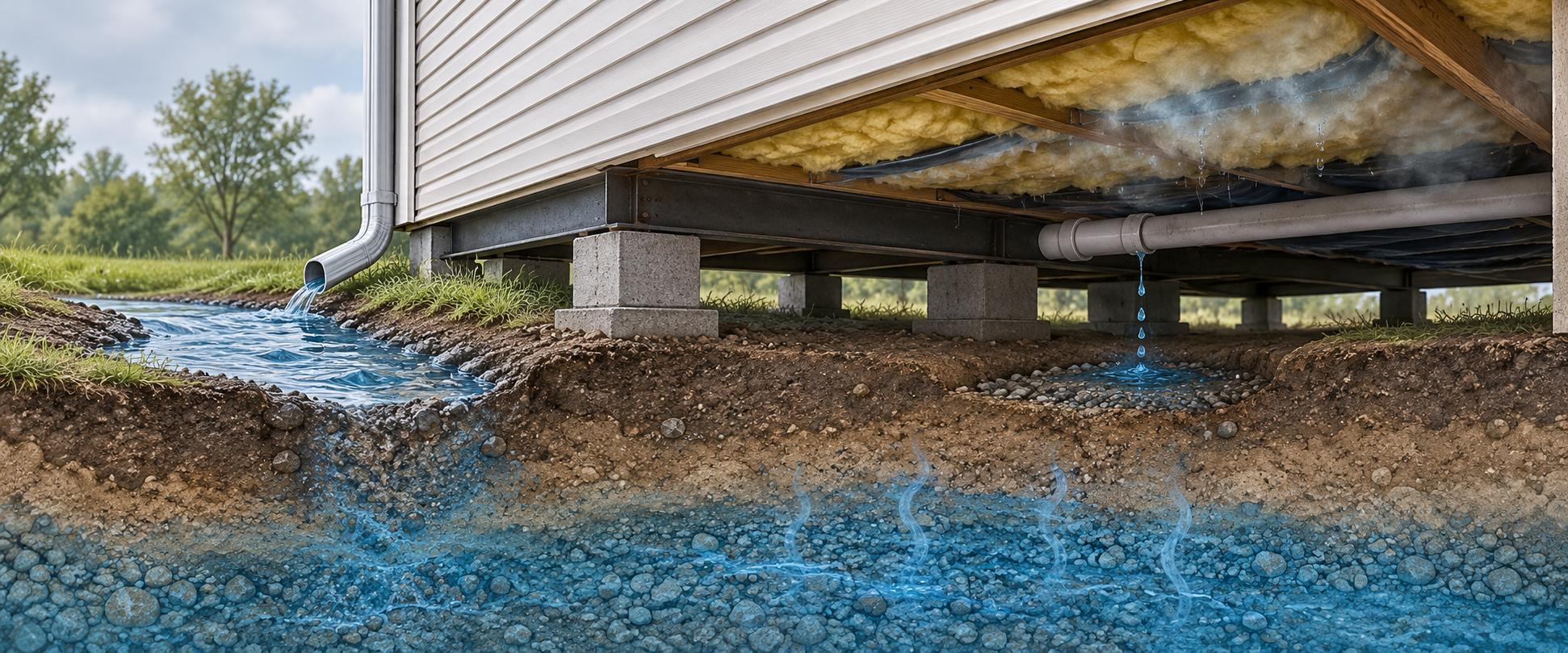
Water below a manufactured home may come from roof runoff, poor grading, a depression, high groundwater, a plumbing leak, condensation, or a damaged site connection. Treating the visible puddle, wet insulation, or musty smell without finding the source can leave the supports, belly, ducts, plumbing, and floor exposed to repeat damage.
Trace the water before choosing a fix
Record when it appears, whether it follows rain or snowmelt, where it is deepest, and whether nearby downspouts, slopes, plumbing, or utility trenches point toward the home. Check whether the ground drains away, whether the perimeter enclosure changes surface-water movement, and whether water is entering through a damaged belly or opening.
U.S. installation standards identify site drainage and ground-moisture control as distinct installation subjects. They do not prescribe one drainage design for every property. A solution may involve surface grading, downspout discharge, a swale, a drain system, groundwater management, plumbing repair, or a combination. Keep larger excavation or site-drainage work separate from a small under-home correction.
What may be damaged
Persistent moisture can affect insulation, belly material, duct supports, plumbing, floor assemblies, piers, anchors, skirting, and stored materials. A wet floor or soft spot inside may need a separate source and structural assessment. Mold or sewage contamination requires the appropriate remediation scope; ordinary drainage work is not a substitute for hazardous-material or restoration work.
DOE weatherization guidance treats the manufactured-home belly and insulation as specialized assemblies. Do not close the problem with new insulation or a patch before moisture and safety conditions are understood.
Build the cost in layers
Ask for separate lines for investigation, temporary water control, grading or drainage, plumbing repair, excavation, pump or discharge work, belly and insulation restoration, support repair, cleanup, and finish restoration. Access through skirting, wet or confined conditions, utility conflicts, soil, distance, and restoration can dominate the labor.
There is no reliable national price for “water under a manufactured home.” Obtain a local scope in the United States or Canada and keep currencies, standards, and site rules separate. If the quote addresses only cleanup or skirting, ask who is correcting the source and how the result will be checked after the next wet event.
Model the source and the consequence separately
For a U.S. planning example, a simple case might include $1,000 for investigation, $3,500 for grading or discharge work, $2,500 for access and cleanup, and $2,000 for underbelly or insulation restoration: $9,000 before support or plumbing repairs. A separate Canadian example could use CAD 1,300 + CAD 4,500 + CAD 3,000 + CAD 2,500 = CAD 11,300. These are scenario assumptions, not a standard water-under-home price.
The allowance should change when the source is groundwater, roof or surface runoff, a plumbing leak, or a failed discharge path. Ask for a plan to verify the correction after wet weather and for separate alternates for support, floor, belly, duct, or electrical damage. Cleaning visible water without correcting the source can make a low first quote the most expensive path.
Sort the possible water sources
A useful assessment separates water arriving from above ground, below ground, the home’s plumbing, and indoor air. Surface runoff may follow roof drainage, slope, a driveway, or a neighboring lot. Groundwater may rise seasonally or collect in a low area. A supply or drain leak can wet the same soil but requires plumbing repair. Condensation and humid air can affect insulation and the belly without a visible surface-water path. More than one source can be present, so ask the professional what evidence supports each conclusion.
Record when water appears, rainfall or snowmelt, plumbing use, occupancy, and the location of wet soil or damaged materials. Photograph the conditions before pumping or cleanup if safe. Note whether the water is clear, sewage-contaminated, or near electrical equipment and let the appropriate professional determine safe access. This record helps avoid paying a drainage contractor to correct a plumbing leak or asking a plumber to solve groundwater.
The first visit may only identify the source category. A larger scope may require test pits, a licensed plumber, soil or grading assessment, a foundation professional, or remediation. Ask what the diagnostic fee includes and whether it is credited toward repair. A good proposal says what would confirm the diagnosis and what different finding would change the work.
Choose the correction that controls the source
Roof runoff may need a discharge route away from the home. Surface flow could require grading, a swale, or an approved drain outlet. Persistent groundwater may call for a system designed for the property rather than a shallow surface correction. A plumbing leak needs repair and post-work testing. Moisture trapped by an enclosure or damaged belly may need access, drying, and restoration after the source is controlled. These are options to evaluate, not universal details; local slope, soil, neighbor drainage, and code affect feasibility.
Compare a temporary measure with the durable correction. A pump may protect the immediate area but add power, discharge, maintenance, and failure considerations. A drain may need excavation, cleanouts, outlet rights, and access for maintenance. Grading can be less disruptive but may not address high groundwater. Ask who owns the discharge destination and whether water will be redirected toward another structure or property. Keep any emergency pumping or cleanup line separate from permanent work.
Price damage and prevention as separate scopes
List investigation, source correction, drainage or plumbing, access and excavation, pump or discharge equipment, electrical work, foundation or support correction, drying, insulation, belly material, duct or pipe repair, disposal, remediation, skirting, and finish restoration. Ask which line is provisional until the cavity is opened. Confirm how wet insulation is assessed, what material will be removed, and what test or observation shows the area is ready to close.
A limited case might be a small area of surface runoff corrected with a clear discharge path. A larger case could involve grading, buried drainage, restoration, and repair to belly insulation. A difficult case may involve groundwater, structural support damage, a sewage or contamination issue, or a plumbing leak in a concealed location. These are scope scenarios, not price averages. Obtain separate local estimates after diagnosis and compare the source correction, access, and restoration included.
Check the repair after conditions change
A completed job should state how the owner can tell it is working. That might mean observing the area after the next rain, a plumber documenting pressure or drainage tests, or a professional verifying repaired materials before the belly is closed. Do not expect one dry day to prove a groundwater problem is solved. Keep the drain, pump, discharge, cleanout, and access details with the home records.
If water returns, compare its location and timing with the baseline. Call the contractor and ask whether the return is within the warranty or indicates a different source. Avoid adding a second system before the first diagnosis is revisited; overlapping drains or outlets can make later maintenance more confusing. Persistent water near supports, electrical equipment, sewage, or a soft floor deserves prompt qualified attention.
Keep the under-home assembly inspectable
When restoring skirting, belly material, or insulation, preserve any access needed for service and follow applicable product and professional instructions. Do not trap active moisture behind a new enclosure or assume that a vapor barrier alone fixes groundwater. The finished quote should say how source correction, drying, and enclosure restoration fit together and who signs off before closure. This reduces the chance that the next leak requires removing newly installed work.
Include maintenance after installation
A drain, sump, swale, or pump can solve one exposure while creating future maintenance. Ask how often the system needs inspection, how debris is removed, where the discharge goes, what happens during a power outage, and how a buried line can be located. Make sure the owner can reach cleanouts or service points without removing permanent finishes. Price periodic service and electricity separately from installation when they are material to the option.
If the system depends on a discharge easement, shared ditch, or neighboring property, obtain written permission before construction. A physically effective route may not be legally available to the owner. Record the approved route and responsible party with the home documents.
Coordinate drainage with the rest of the property
A correction below the home can affect foundation walls, septic fields, wells, retaining features, neighboring lots, and municipal stormwater systems. Before directing water to a ditch or boundary, confirm property rights and local drainage rules. Ask whether an outlet remains accessible for maintenance and whether discharge could undermine a support or walkway. Include survey, easement, and restoration work if the route crosses another owner’s land.
These constraints can eliminate an otherwise inexpensive fix. Resolve them before excavation and get permission in writing so the completed system does not create a later dispute or require relocation.
Avoid treating a pump as a permanent answer
If a pump is proposed, ask where it discharges, how it is powered, what alarms or backup exist, and who checks it during vacancy. Confirm that discharge is allowed and does not return toward the home. Include periodic maintenance and failure response in the household plan. A pump may be a valid engineered part of a solution, but buying equipment without a source and discharge plan does not resolve the moisture decision.